 BuildWell
Construction glossary
87 terms contractors meet on estimates, contracts, invoices and job sites, each in plain words with what it means for your business.
A
- Accounts receivableAccounts receivable is the total amount clients owe a business for work it has invoiced but not yet been paid for.
- ACHACH (Automated Clearing House) is the US electronic network banks use to move money between accounts, for things like direct deposit and bank transfer payments.
- Aging reportAn aging report is a list of unpaid invoices grouped by how long each has been outstanding, usually in 30-day buckets.
- AllowanceAn allowance is a set amount included in a contract price for an item not yet selected, such as fixtures or flooring, adjusted later to the actual cost.
- As-built drawingsAs-built drawings are drawings, marked up during construction, that show how the work was actually built, including any changes from the original plans.
B
- BidA bid is a contractor’s offer to perform a defined scope of work for a stated price, usually submitted in competition with other contractors.
- Bid bondA bid bond is a surety bond guaranteeing that a bidder will sign the contract and provide the required performance and payment bonds if awarded the job.
- Board footA board foot is a unit of lumber volume equal to a board 1 inch thick, 12 inches wide and 12 inches long, or 144 cubic inches.
- Break-even pointThe break-even point is the amount of revenue at which a business covers all its costs and makes neither a profit nor a loss.
- Builder’s risk insuranceBuilder’s risk insurance is property coverage for a building under construction or renovation, including materials on site, against losses such as fire, wind and theft.
- Building permitA building permit is official permission from a city or county to perform construction work, usually issued after the plans are reviewed for code compliance.
C
- CallbackA callback is a return visit to a completed job to fix a problem, finish something missed or handle a warranty claim, usually without additional pay.
- Certificate of insuranceA certificate of insurance (COI) is a document from an insurance agent or company that summarizes a business’s policies, limits and policy dates.
- Certificate of occupancyA certificate of occupancy (CO) is a document from the local building department stating that a building meets code and may be occupied.
- Change orderA change order is a written agreement, signed by the contractor and client, that changes the scope, price or schedule of a contract after it’s signed.
- Conditional lien waiverA conditional lien waiver gives up lien rights for a specific payment only once that payment is actually received and clears.
- ContingencyA contingency is an amount set aside in a project budget or contract to cover costs that can’t be predicted when the price is set.
- Cost-plus contractA cost-plus contract pays the contractor the actual cost of the work plus an agreed fee, either a percentage of cost or a fixed amount, for overhead and profit.
- Cubic yardA cubic yard is a unit of volume equal to a cube 3 feet on each side, or 27 cubic feet, used for concrete, soil, gravel and mulch.
D
- DepositA deposit is an upfront payment the client makes before work begins, usually to hold a spot on the schedule and cover early material costs.
- Design-buildDesign-build is a project delivery method in which one company holds a single contract for both the design and the construction of a project.
- Direct costsDirect costs are the costs that can be traced to a single job, such as the labor, materials, subcontractors, equipment rental and permits for that job.
- Draw requestA draw request is a request to release a set portion of a construction loan or contract, based on the work completed so far.
- Due on receiptDue on receipt is a payment term that asks the client to pay an invoice as soon as they receive it, with no grace period.
E
- E-signatureAn e-signature is an electronic sign of a person’s agreement to a document, such as a typed name, drawn signature or click, recognized by law for most contracts.
- EPA RRP ruleThe EPA Renovation, Repair and Painting (RRP) rule requires certified firms and lead-safe work practices for paid work that disturbs paint in pre-1978 housing and child-occupied facilities.
- EstimateAn estimate is a contractor’s written calculation of what a job will cost, based on the scope, quantities and prices known before work starts.
F
- Form 1099-NECForm 1099-NEC is the IRS form a business uses to report payments for services to non-employees, such as subcontractors, once they reach the yearly threshold.
- Form W-9Form W-9 is the IRS form a business uses to collect a payee’s legal name, address, tax classification and taxpayer identification number.
G
- General contractorA general contractor (GC) holds the main contract with the owner and is responsible for completing the project, including hiring and managing subcontractors.
- General liability insuranceGeneral liability insurance covers a business’s legal liability for bodily injury and property damage it causes to other people, such as clients and the public.
- Guaranteed maximum priceA guaranteed maximum price (GMP) contract pays the contractor’s costs plus a fee, up to a ceiling; costs above the cap are the contractor’s responsibility.
H
I
- Indirect costsIndirect costs are costs that support the work but aren’t tied to a specific task, such as supervision, temporary facilities, project insurance and site cleanup.
- InspectionAn inspection is a visit by a building official to check that permitted work meets code at a specific stage, before it’s covered up or occupied.
- InvoiceAn invoice is a document a contractor sends to request payment for work done or materials supplied, listing the charges, total due and payment terms.
- Invoice factoringInvoice factoring is selling your unpaid invoices to a factoring company, which pays you most of their value now and collects from your client.
J
L
- Labor burdenLabor burden is the cost of an employee beyond their hourly wage, including employer payroll taxes, workers’ compensation, insurance and benefits.
- Late feeA late fee is a charge added to an invoice when the client pays after the agreed due date, either as a flat amount or as interest on the balance.
- Lien waiverA lien waiver is a signed document in which a contractor, sub or supplier gives up the right to file a mechanic’s lien for a stated payment.
- Linear footA linear foot is a measurement of length in feet along a line, regardless of the material’s width or thickness.
- Lump-sum contractA lump-sum contract, also called a fixed-price contract, sets a single total price for a defined scope of work, regardless of what the work actually costs.
M
- MarkupMarkup is the amount added to a job’s costs to reach the selling price, usually expressed as a percentage of those costs.
- Markup vs marginMarkup measures profit as a percentage of cost, while margin measures the same profit as a percentage of the selling price, so a job’s markup is always higher than its margin.
- Mechanic’s lienA mechanic’s lien is a legal claim against a property, filed by a contractor, sub or supplier who improved it and wasn’t paid.
- MobilizationMobilization is moving people, equipment and materials to a job site and setting up to start work, and the cost of doing so.
N
- Net 15Net 15 is a payment term that makes the full invoice amount due 15 days after the invoice date.
- Net 30Net 30 is a payment term that makes the full invoice amount due 30 days after the invoice date.
- Net 60Net 60 is a payment term that makes the full invoice amount due 60 days after the invoice date.
O
P
- Pay applicationA pay application is a formal request for a progress payment showing the value of work completed against the schedule of values, less retainage and earlier payments.
- Pay-when-paid clauseA pay-when-paid clause lets a general contractor wait to pay a subcontractor until the owner pays the general contractor, within a reasonable time.
- Payment bondA payment bond is a surety bond guaranteeing that the contractor will pay its subcontractors, laborers and suppliers on a project.
- Payment termsPayment terms are the parts of a contract or invoice that say how much the client pays, when each payment is due and how it can be made.
- Performance bondA performance bond is a surety bond guaranteeing that the contractor will complete the work according to the contract, protecting the owner if the contractor defaults.
- Preliminary noticeA preliminary notice is a document sent early in a job telling the owner and others that you are supplying labor or materials, often required to keep lien rights.
- Prevailing wagePrevailing wage is the minimum hourly wage and fringe benefits that must be paid to workers on certain public construction projects, set by job classification and area.
- Pro forma invoiceA pro forma invoice is a preliminary bill that shows what a client will be charged before the work is done or the goods are delivered.
- Profit marginProfit margin is profit expressed as a percentage of the selling price, showing how much of each dollar of revenue the business keeps.
- Progress billingProgress billing is invoicing a project in stages, as work is completed, instead of billing the full amount at the end.
- ProposalA proposal is a document in which a contractor offers to perform a project, describing the scope, price, schedule and terms, often with reasons to choose them.
- Punch listA punch list is a list of remaining work and corrections, such as touch-ups, adjustments and missing hardware, that must be done before a job is considered complete.
- Purchase orderA purchase order (PO) is a document a buyer issues to a supplier or subcontractor authorizing a purchase at stated quantities, prices and terms.
Q
R
- RetainageRetainage is a portion of each progress payment that the client holds back until the work is complete, as security that the job gets finished.
- RFI (request for information)An RFI, or request for information, is a formal written question from a contractor to the designer or owner to clarify plans, specifications or contract terms.
- Roofing squareA roofing square is a unit equal to 100 square feet of roof surface, used to measure roofs and order roofing materials.
S
- Sales tax on materialsSales tax on materials is the state and local tax on building materials, which depending on the state is paid by the contractor at purchase or charged to the client.
- Schedule of valuesA schedule of values is a list that splits the contract price into parts of the work, each with a dollar value, used to track progress and bill for it.
- Scope of workA scope of work is the written description of the work a contractor will perform on a job, including what’s included, what’s excluded and the standards it must meet.
- Self-employment taxSelf-employment tax is the Social Security and Medicare tax self-employed people pay on their net earnings, covering both the employee and employer shares.
- Square footA square foot is a unit of area equal to a square one foot on each side, found by multiplying length by width.
- SubcontractorA subcontractor is a contractor hired by the general contractor, not the owner, to perform a specific part of a project, such as electrical, plumbing or drywall.
- SubmittalA submittal is information a contractor sends to the designer or owner for approval before installing something, such as product data, shop drawings or samples.
- Substantial completionSubstantial completion is the point when work is complete enough that the owner can occupy or use the project for its intended purpose, even if minor items remain.
- Surety bondA surety bond is a three-party agreement in which a surety company guarantees to an owner or agency that a contractor will meet an obligation.
T
- TakeoffA takeoff is the process of measuring a project from plans or on site and listing every material and quantity needed to build it.
- Time and materialsA time and materials (T&M) contract bills the client for labor hours at agreed rates plus the cost of materials, often with a markup on the materials.
U
- Unconditional lien waiverAn unconditional lien waiver gives up lien rights for a stated payment the moment it’s signed, whether or not the money has actually been received.
- Unit price contractA unit price contract pays the contractor a set price for each unit of work, such as a linear foot, square foot or cubic yard, with the total based on actual quantities.
- Use taxUse tax is a state tax on taxable goods used in the state when sales tax wasn’t collected at purchase, generally at the same rate as the sales tax.
V
W
- WarrantyA warranty is a contractor’s promise to repair defects in workmanship or materials that appear within a stated period after the work is completed.
- Waste factorA waste factor is a percentage added to measured material quantities to cover offcuts, breakage, pattern matching and installation mistakes.
- Work orderA work order is a document that authorizes a specific job or task and describes the work, location, schedule and who will do it.
- Workers’ compensationWorkers’ compensation is insurance that pays medical costs and part of lost wages for employees hurt on the job, generally in exchange for limits on suing the employer.
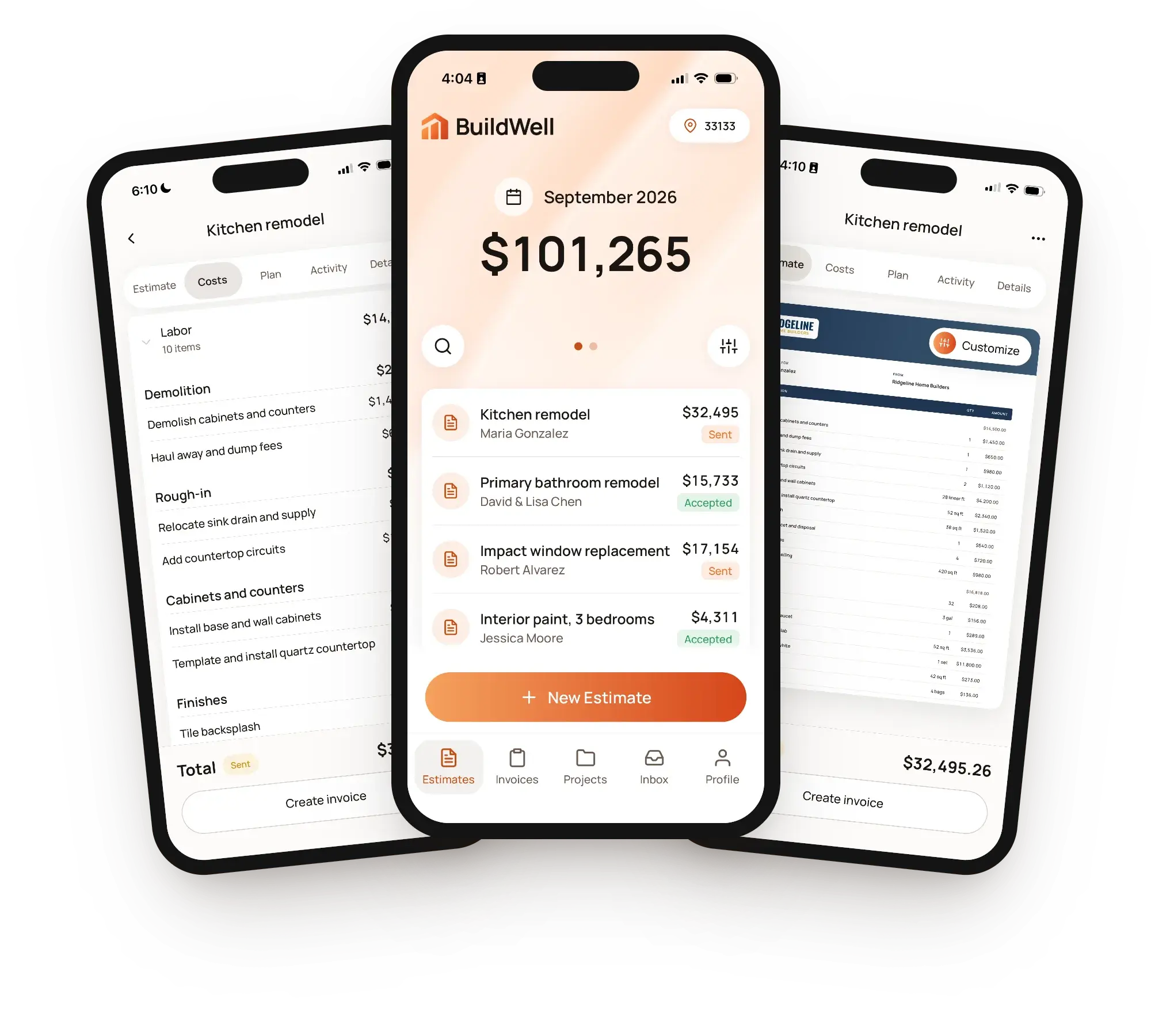
Try BuildWell today
Estimates, invoices, e-signatures and payments in one place, on your phone and on the web.
Start for free →3-day free trial. Cancel anytime.