 BuildWell
Allowance
An allowance is a set amount included in a contract price for an item not yet selected, such as fixtures or flooring, adjusted later to the actual cost.
Allowances let you sign a contract before the client has picked every finish. The estimate might include a fixed amount for light fixtures or a price per square foot for tile. When the client chooses, the contract price moves up or down to match the actual cost.
Spell out what each allowance covers: material only, or material and installation; whether it includes tax and delivery; and whether your markup applies to overages. Clients often assume an allowance covers more than it does.
Set allowances realistically. A low allowance makes the bid look cheaper but sets up a dispute when the client’s choice costs twice as much. Base it on what clients like this one usually choose, and tell them what the amount buys.
Settle each allowance in writing as soon as the selection is made, with a change order that shows the allowance, the actual cost and the difference. Waiting until the final invoice to reconcile allowances creates surprises.
How an allowance works in a contract
An allowance holds a place in the contract price for something the client hasn’t chosen yet. Instead of waiting for every fixture and finish to be picked, you put a dollar amount in the estimate, sign the contract and start work. When the client makes the choice, the contract price adjusts to the real cost.
Each allowance needs three things in writing: the amount, what it covers, and how differences are settled. “Coverage” means whether the amount is for material only or material and installation, and whether it includes sales tax and delivery. “Settled” means how overages are charged, whether your markup applies to them, and how unused amounts are credited back.
The adjustment is made with a change order once the selection is made, not at the final invoice. The change order shows the allowance, the actual cost and the difference, and the client signs it before you order. That keeps the running contract price accurate and avoids a pile of surprises at the end.
Allowances are common for fixtures, lighting, tile, flooring, cabinet hardware and appliances: anything where taste drives the price and the client hasn’t shopped yet. They suit items that affect other work less well. If a range changes the cabinet layout, that choice should be made before the contract is signed.
Types of allowances
Allowances are written either as a lump sum or as a unit price, and either for material alone or for material and labor together.
| Type | Written as | Example | Watch for |
|---|---|---|---|
| Lump sum | A fixed dollar amount | $1,500 for light fixtures | Whether installation is included |
| Unit price | A price per unit | $6 per square foot of tile | The quantity and waste factor behind it |
| Material only | The cost of the item | $800 for a kitchen faucet | Tax, delivery and markup on overages |
| Material and labor | The item plus installation | $12 per square foot installed | Labor can change when the selection does |
Unit allowances suit finishes priced by area or length, where the quantity is known but the product isn’t. Lump sums suit items counted one by one, such as fixtures and appliances.
Write unit allowances with the quantity they assume. “$6 per square foot for 120 square feet of floor tile” makes the total clear, and shows the client that a pattern needing more waste can change the quantity as well as the price.
Why allowances matter to both sides
For contractors
Allowances let you sign and schedule a job before every decision is made. They also carry risk: an allowance set too low makes your bid look cheaper but sets up an argument when the client’s choice costs twice as much. Overages are extra revenue only if the contract says how they’re charged and you document each one.
For homeowners and clients
An allowance is a placeholder, not a promise of what the final price will be. Your selections decide it. When comparing bids, look at the allowances line by line; a contractor with lower allowances isn’t necessarily cheaper, just less realistic about what you’re likely to choose.
Ask what each allowance would buy, and whether it includes installation. If you already know you want a higher-end item, say so, so the allowance can be set closer to reality from the start.
How to set and settle allowances step by step
- List every item the client hasn’t chosen yet: fixtures, tile, flooring, hardware, appliances.
- Price each one from what similar clients have chosen, at current supplier prices.
- Write what each allowance covers: material or material and labor, tax, delivery, and how overages and credits are handled.
- Give the client a selection deadline for each item, tied to when it has to be ordered.
- When the client chooses, compare the actual cost with the allowance.
- Write a change order showing the allowance, the actual cost, the difference and any markup, and get it signed before you order.
- Keep a running allowance log and show the net adjustment on each progress invoice.
Tell the client what each allowance buys in practical terms: a mid-range faucet, a basic porcelain tile. That shared picture prevents most allowance disputes before they start.
It also helps to put each selection deadline on the job schedule, so a late choice shows up as a schedule risk before it becomes a delay.
Allowance example with numbers
Say a kitchen contract includes three material-only allowances, and says overages carry a 10% markup while credits are returned at cost.
| Item | Allowance | Actual cost | Difference |
|---|---|---|---|
| Light fixtures | $1,200 | $1,650 | +$450 |
| Faucet and sink | $900 | $780 | −$120 |
| Backsplash tile, 30 sq ft | $240 ($8/sq ft) | $420 ($14/sq ft) | +$180 |
| Total | $2,340 | $2,850 | +$510 |
The overages total $450 + $180 = $630. With the 10% markup, that’s $693. The faucet and sink credit of $120 comes off at cost, so the net change order is $693 − $120 = $573, added to the contract price.
If the client’s tile is a large-format product that takes longer to set, the extra labor is a separate line on the same change order, since these allowances covered material only.
On the final invoice, the contract price already includes the $573 change order, and the allowance log shows each item closed out, so there’s nothing left to settle at the end.
Common allowance mistakes
- Setting allowances low to make the bid look cheaper.
- Not saying whether an allowance includes labor, tax or delivery.
- Leaving out how overages are marked up and how credits are returned.
- Giving no selection deadline, so late choices hold up the schedule.
- Ordering the client’s selection before the change order is signed.
- Waiting until the final invoice to reconcile every allowance at once.
- Forgetting that an upgraded selection can change the labor as well as the material.
- Letting a selection change the layout or other work without pricing those changes too.
An allowance that’s realistic, clearly described and settled as soon as the choice is made rarely causes trouble.
Common questions
01What happens if a client goes over an allowance?
02What happens to an unused allowance?
03Can a contractor charge markup on allowance overages?
04Is an allowance the same as a contingency?
05How should allowances appear on an estimate?
06Who chooses the item covered by an allowance?
Estimates, signatures and invoices in one app
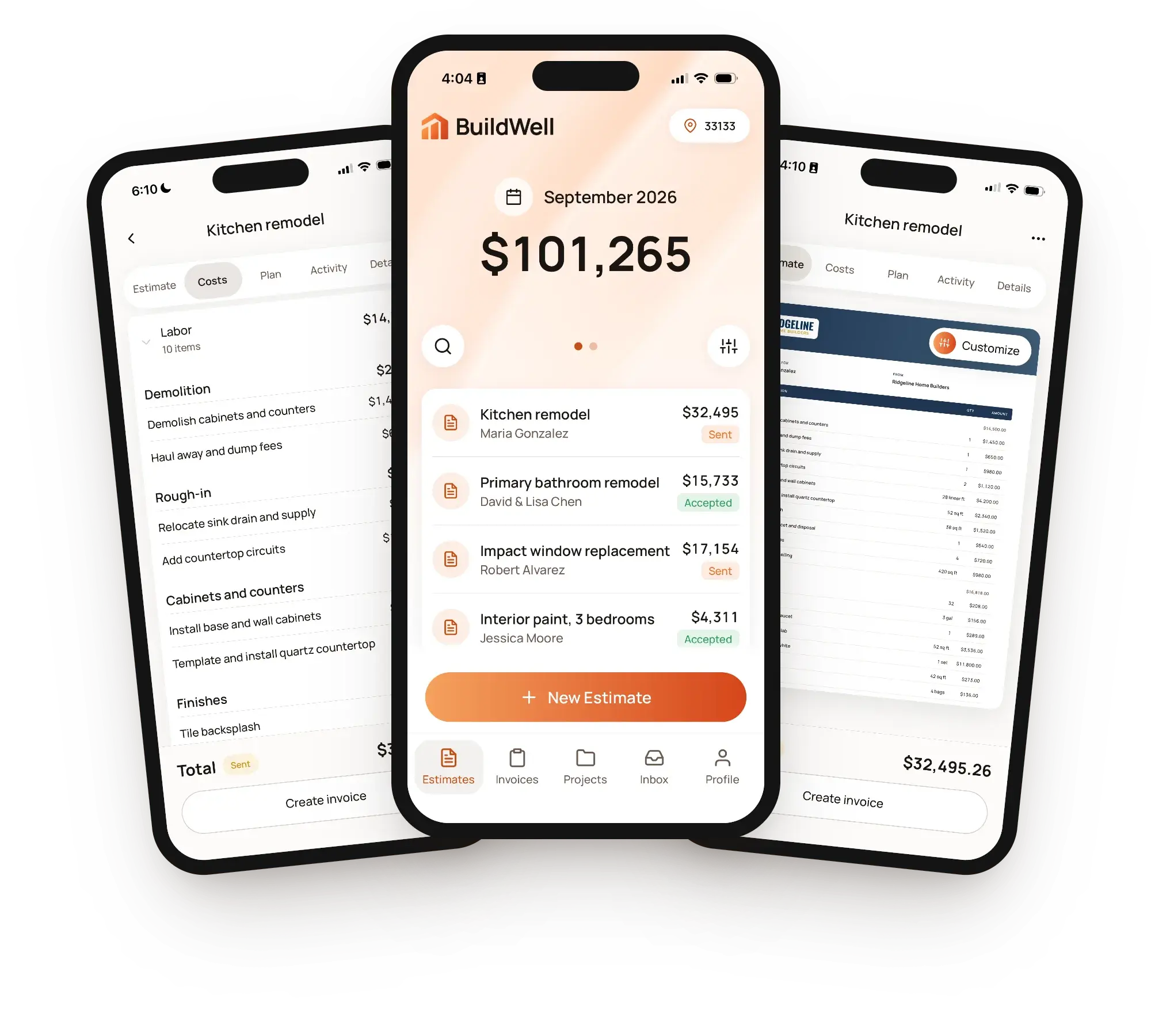
BuildWell writes itemized estimates priced for your area, gets them signed on the client’s phone, and turns them into invoices.
- AI estimates priced for your area
- Estimates, invoices, clients and projects
- Clients sign on any phone
- Card and bank payments, no extra BuildWell fee
- iPhone, Android and the web
- AI estimates priced for your area
- Estimates, invoices, clients and projects
- Clients sign on any phone
- Card and bank payments, no extra BuildWell fee
- iPhone, Android and the web
Both plans include every feature and start with a 3-day free trial. Add a card to start; you’re not charged until the trial ends. Cancel anytime.
Try BuildWell today
Estimates, invoices, e-signatures and payments in one place, on your phone and on the web.