

BuildWell

Siding estimating software that wins more jobs

Estimating and invoicing software for siding contractors. Describe the walls and trim, and get tear-off to soffit priced.

  • Store prices near the job
  • Wages for your metro
  • iPhone, Android and web
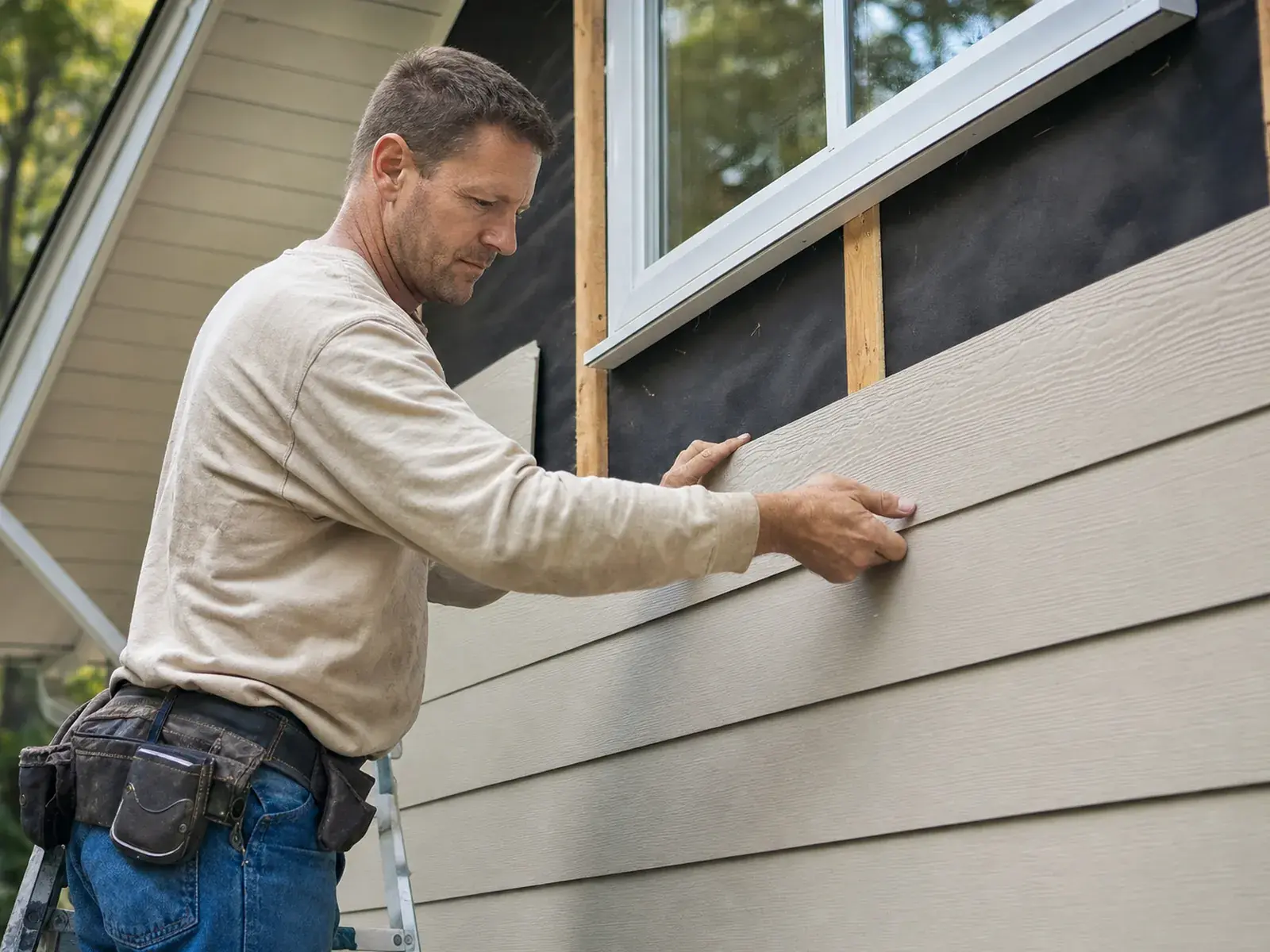
A siding contractor installing horizontal fiber cement siding from a ladder

Run every siding job start to finish

Estimate on site, get it signed before you leave, invoice when the work’s done and see the payment land.

BuildWell on a laptop showing a branded invoice and its payments, the estimates home screen on one phone and an invoice in a different style on another

What is siding estimating software?

Siding estimating software turns a house's measurements and a description of the job into an itemized price the homeowner can sign. That means the takeoff, the materials, the labor and a page that explains it.

One wall of siding is four kinds of work

A residing job looks like one product on one wall. On the estimate, it's four kinds of work:

  • Wall area, measured in squares or square feet: tear-off, sheathing repair, house wrap, foam board and the siding itself.
  • Trim runs, measured in linear feet: starter strip, outside corners, J-channel, drip cap, trim boards, fascia and caulked joints.
  • Openings and penetrations, counted one by one: windows and doors to flash, light fixtures, hose bibs and vents that need mounting blocks.
  • Overhead areas: soffit, priced by area, and fascia, priced by length.

Per-square quotes hide the trim

Most siding contractors either quote an all-in number per square or do a full takeoff from elevations.

The per-square number is quick, but a plain ranch and a two-story house with gables and 30 openings don't cost the same per square. The trim is where the difference hides.

The takeoff is accurate, but it eats an evening for a bid you might not win.

BuildWell builds the takeoff from your description

BuildWell builds the takeoff from what you describe:

  • It asks about the parts that change the price.
  • It lists each piece of work with the labor hours it typically takes.
  • It prices materials at stores near the job.
  • It prices labor at your metro's wage plus your overhead and markup.

You check the quantities and send it.

The signed estimate becomes the invoice

When the house is done, the signed estimate becomes the invoice. Same lines, same totals, and the deposit you took is already on the record.

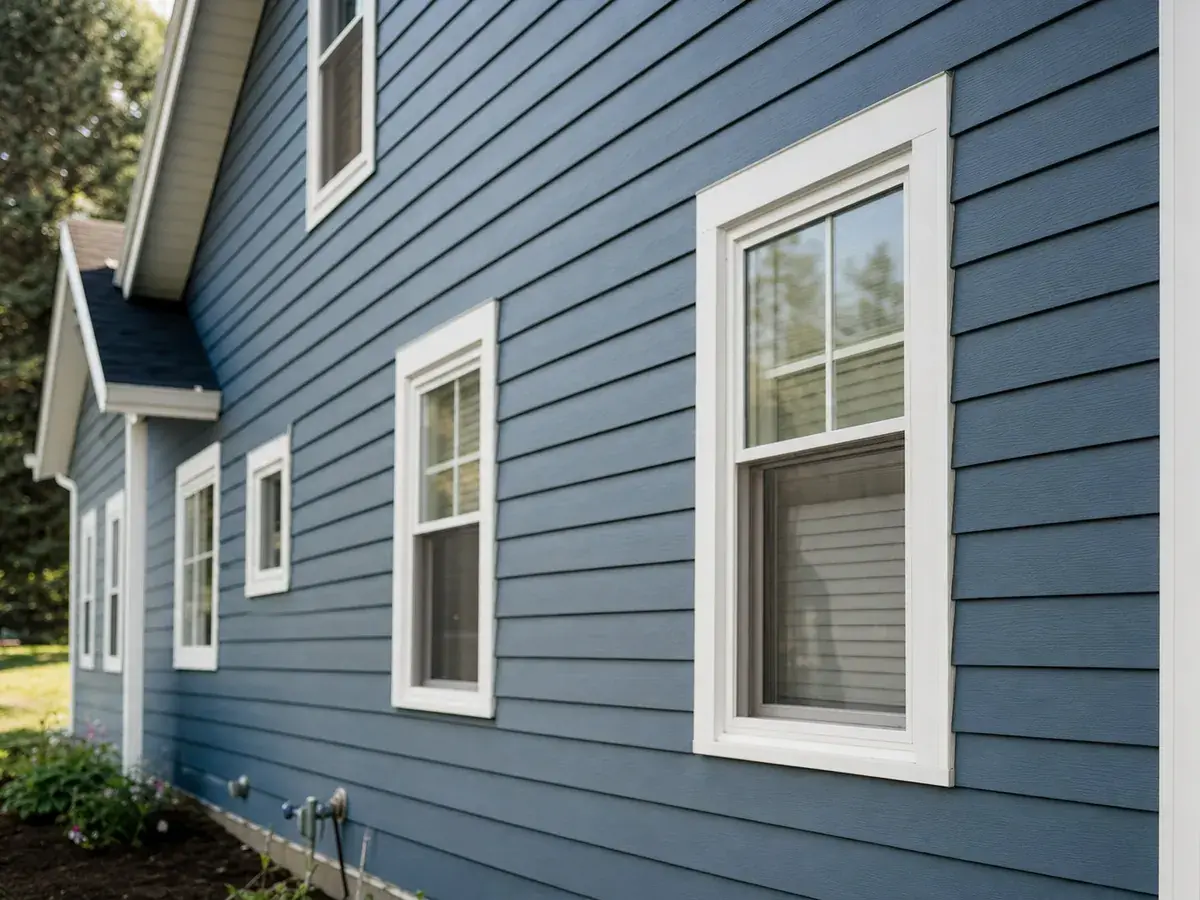
A house with new blue-gray lap siding and white trim

Why siding contractors choose BuildWell

The estimate is done before you leave

Describe the job after walking the elevations. It's ready while you're parked.

It asks what's under the old siding

Tear-off or go over? Sheathing or bare studs? Soffit and fascia too?

Trim gets its own lines

Corners, J-channel and starter are priced by the foot, so openings count.

Materials are priced at stores near the job

Missing prices are flagged, not guessed. You confirm before it goes out.

Labor is priced for your market

Local carpenter wage, helper wage for tear-off, plus your overhead and markup.

Send vinyl and fiber cement side by side

Duplicate the estimate, change the siding line, and they sign one.

Estimates in English or Spanish

Send each client their estimate and invoice in their language.

Same account on phone and computer

Start on site and finish at your desk. Nothing to sync.

Built for siding contractors

What changes when siding contractors price jobs from real data instead of memory.

  • A residing estimate from your walkaroundDescribe tear-off, wrap, siding and soffit. Get line items with a total.
  • Panels and trim at local pricesSiding, wrap, corners and J-channel priced at a store near the job.
  • Field and trim priced separatelyWalls by the square foot, trim by the foot, at local wages.
  • Material deposits and final paymentHomeowner signs from a link. Deposit before ordering, balance after the walkaround.
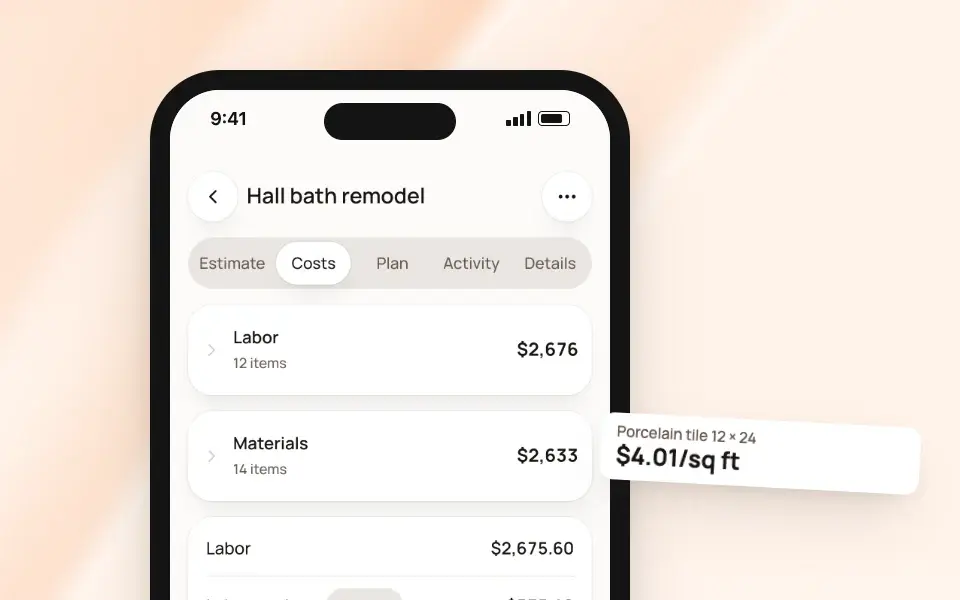
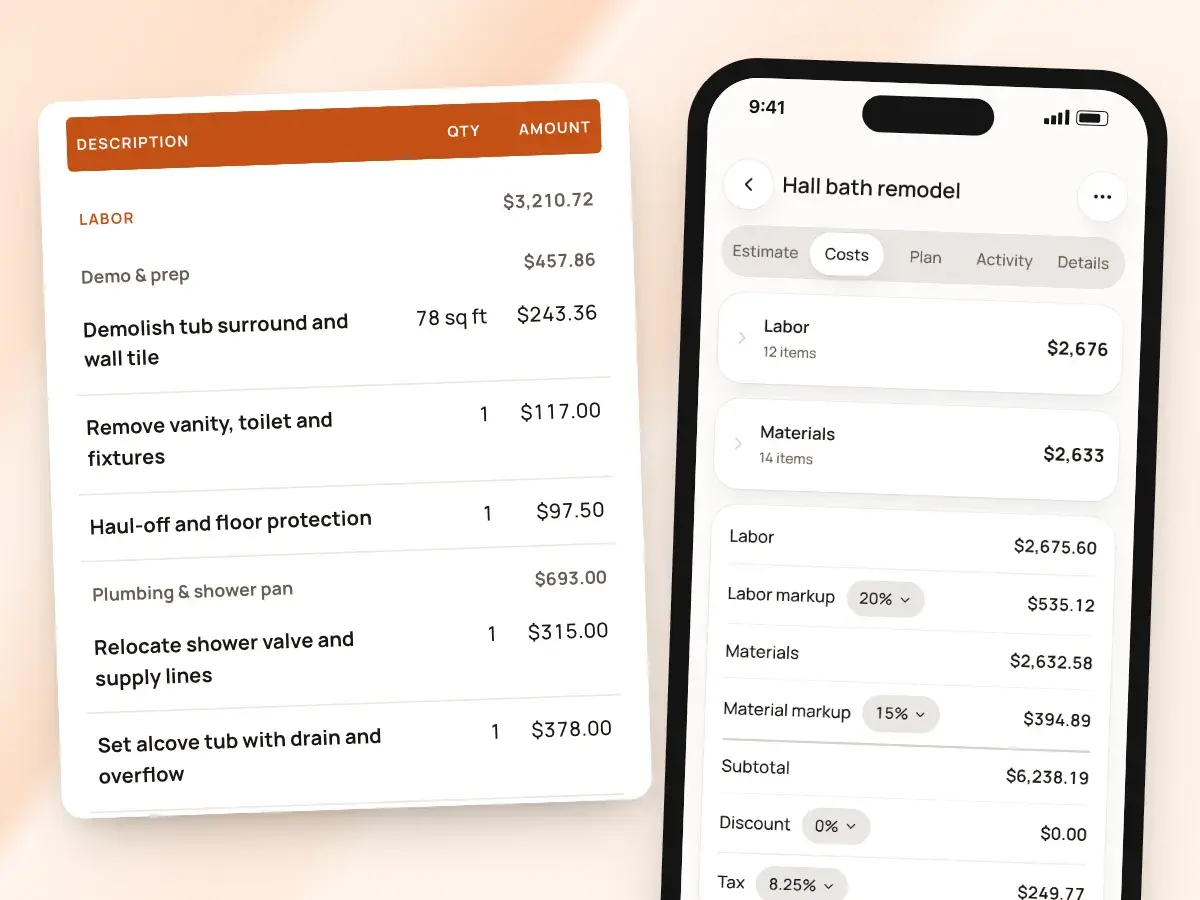
An estimate’s costs on a phone beside its priced lines, grouped by job step

How to price siding jobs

A siding price is built from five groups of work:

  1. Removal and repair: tearing off the old siding and trim, hauling it away, and replacing damaged sheathing.
  2. The weather barrier: house wrap or foam board, plus flashing tape and drip cap at every window and door.
  3. The field: the siding panels or boards on the wall area.
  4. Trim and accessories: starter strip, corner posts, J-channel, trim boards and caulking.
  5. Soffit, fascia and details: overhead areas, fixture mounting blocks, vents and cleanup.

Measure the walls, not the footprint

Measure each wall's length times its height. For a gable, the triangle is half the base times the height.

Many installers deduct garage and patio doors but not every window, since the cuts around a window waste material anyway.

Add waste before you enter quantities

A house with lots of corners and angles wastes more than a plain box. Enter the quantity after waste, so what you order matches what you priced.

Measure trim runs separately

  • Starter: the bottom edge of every wall.
  • Outside corners: the height of every corner.
  • J-channel or trim: the perimeter of every window and door.

Price each line from your own hours

These are the common lines on a siding estimate and what each is measured in:

  • Square foot: tear-off, sheathing, wrap, panels and soffit.
  • Linear foot: starter, corners, J-channel, trim, flashing and caulk.
  • Each: mounting blocks.

The hours and prices are yours to set, and every line's hours are editable to match your crew.

Line itemMeasured in
Existing siding tear-off and debris removalSquare feet
Osb wall sheathing repair and replacementSquare feet
House wrap weather barrier installationSquare feet
Rigid foam continuous insulation over sheathingSquare feet
Window and door opening flashing tapeLinear feet
Aluminum drip cap head flashingLinear feet
Vinyl siding starter strip installationLinear feet
Vinyl outside corner post installationLinear feet
Vinyl j-channel installation at openingsLinear feet
Vinyl siding panel installationSquare feet
Fiber cement lap siding installationSquare feet
Fiber cement trim board installationLinear feet
Vinyl soffit panel installationSquare feet
Aluminum fascia cover installationLinear feet
Exterior siding joint and penetration caulkingLinear feet
Siding mounting block installation for fixturesEach
Each one its own line on the estimate. The hours and prices are yours to set.

Field work adds up before any trim

Example: The field work on a 20-square house (2,000 square feet of wall) adds up like this when vinyl replaces old siding. The rates are example figures; say your own records show:

  • Tear-off: 1.5 hours per square, 30 hours
  • House wrap: 1 hour per square, 20 hours
  • Vinyl panels: 3 hours per square, 60 hours

That's 110 hours before a single corner post goes up.

Fiber cement and trim add their own hours

Example: Say fiber cement lap takes your crew 5 hours per square. Switch the panels to it and the panel line becomes 100 hours, so the field comes to 150.

Trim runs add their own time. On the same house, say 160 linear feet of outside corners takes your crew 10 hours, and 400 linear feet of J-channel around the windows and doors another 20.

Your labor rate covers more than the wage

An installer's wage is only part of what an hour costs you. Your rate also pays for:

  • workers' comp and general liability
  • staging, ladders, pump jacks or a lift
  • the truck, trailer and brake
  • the days lost to weather
  • the hours spent measuring houses that sign with someone else

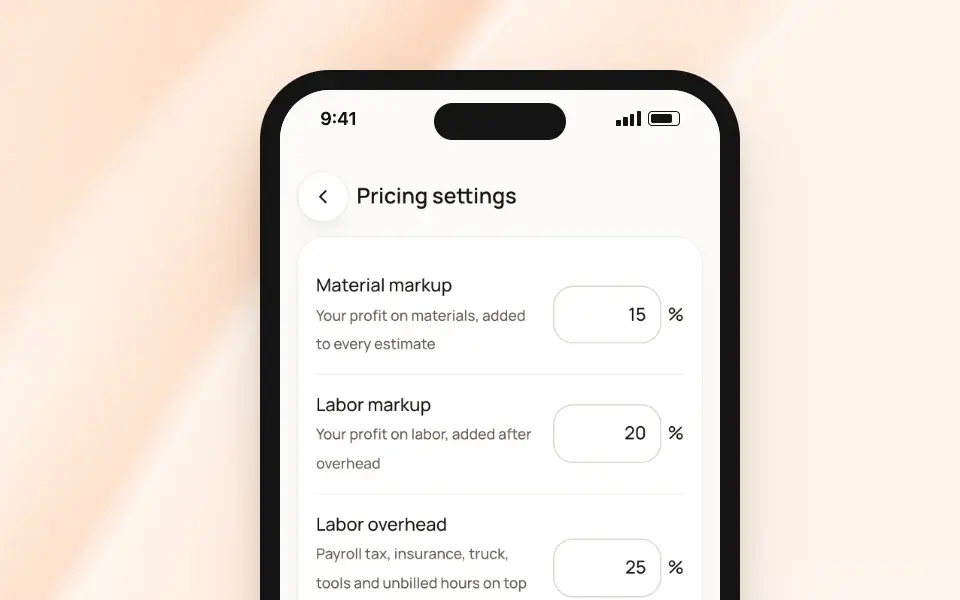
BuildWell builds the rate in three steps

  1. Wage: the median wage for the line's trade in your metro.
  2. Overhead: your labor overhead, which starts at 100% and so doubles the wage.
  3. Markup: your labor markup, 20% to start.

Example: Say your installers cost you $30 an hour. Use your real figure, and blend in your helpers' rate if they do the tear-off. The 110 hours of field work on that vinyl job come to:

  • Wages: 110 × $30 = $3,300
  • With 100% overhead: $6,600
  • With 20% markup: $7,920 for the field labor

Trim, soffit, fascia and details come on top.

Price sheathing, wall fixtures and disposal up front

  • Materials: price panels, wrap, accessories, fasteners and caulk at what they cost near this job this week, plus your markup. BuildWell's material markup starts at 20%, and you can change it per estimate.
  • Sheathing: you won't know its condition until the old siding is off. Price an allowance, a number of square feet of replacement, and state your price for anything beyond it.
  • Things on the wall: lights, outlets, hose bibs, dryer vents, shutters and gutters all have to come off, get a mounting block or get worked around. Count them on the walkaround.
  • Disposal and permits: price the dumpster as its own line. Many jurisdictions require a permit to reside, so add your permit fee; in BuildWell, a flat permit fee is added automatically when the estimate includes permits.

Check older houses for lead and asbestos

Paint on a house built before 1978 may contain lead. BuildWell adds a lead-safe setup and cleanup line when you say the house is that old.

Some older houses also have cement siding that may contain asbestos. Removing it is regulated, so have it tested and check your state's rules before you price the tear-off.

How to start a siding business

Find out what your state requires

Licensing for siding work varies a lot. In many places it falls under a home improvement contractor registration or a general contractor license, sometimes only above a dollar amount per job.

Some cities add their own registration. Check your state's licensing board and the local building department before you sign a contract.

Get lead-safe certified for older houses

If you'll disturb paint on homes built before 1978, the EPA requires your firm to be certified and the work done or directed by a certified renovator.

Set up the business properly

Many siding contractors begin as a sole proprietor or a single-member LLC. Then:

  • Get a free EIN from the IRS.
  • Open a business bank account that every deposit and supplier bill runs through.

Buy the insurance clients will ask about

  • General liability: the certificate homeowners and builders ask for before you start.
  • Workers' compensation: required in most states once you have employees. Work on ladders and staging makes the premium matter; build it into your rate.
  • Commercial auto: for the truck and trailer.

Plan for working at height

OSHA requires fall protection for construction work six feet or more above a lower level, which covers most of a two-story wall.

Budget for staging, harnesses and training, and price the setup time into every job over one story.

Learn the install rules for what you carry

Siding manufacturers publish rules for clearances, fastening, laps and joints. The product warranty may depend on following them.

Look established from the first bid

An itemized estimate with your logo, registration number and terms says more than a per-square number on a card. In BuildWell, add them once and every estimate and invoice carries them.

Win the first houses

Early siding jobs tend to come from:

  • Neighbors. A residing job is visible from the street, so put up a yard sign.
  • Roofers and general contractors who don't do siding.
  • Realtors and investors preparing houses for sale.
  • Local search. Set up a free profile on the map apps homeowners use, and ask every client for a review.

Follow the money as closely as the work

Know which bids are out, which are signed and which balances are open.

A siding business can stay busy all season and still run short of cash if final invoices wait a week after the dumpster leaves.

Siding contractor pay and taxes

Income depends on market, crew and margin

Installer wages vary between metro areas and with experience.

As an owner, you earn the difference between what you charge and what each house costs you. So your labor rate and material markup matter more than any wage table.

Self-employment tax is 15.3% of net earnings

As a sole proprietor or single-member LLC, you pay self-employment tax on your net earnings: 15.3% in total.

  • Social Security, 12.4%: applies to net earnings up to the Social Security wage base, which is $184,500 for 2026.
  • Medicare, 2.9%: applies to all of it.
  • Deduction: you can deduct half of the self-employment tax on your income tax return.

Federal and state income tax come on top. Set aside part of every deposit and final payment as it arrives.

Pay estimated taxes every quarter

Nobody withholds tax from your jobs, so the IRS expects payments through the year on Form 1040-ES. They're usually due in:

  • mid-April
  • mid-June
  • mid-September
  • mid-January

If your season is concentrated in summer and fall, your September and January payments may be the heavy ones.

Track your deductions as you go

Siding businesses commonly deduct:

  • tools, brakes, saws and staging
  • the business share of the truck and trailer
  • fuel
  • insurance, license and registration fees
  • lead-safe certification and training
  • dumpster and disposal costs
  • phone and software

Keep receipts and log mileage as you go rather than rebuilding the year at tax time.

Subs paid $2,000 or more get a 1099-NEC

If you pay an unincorporated subcontractor for services, you'll generally need to send them a Form 1099-NEC. For payments made in 2026 and later, that applies once you've paid them $2,000 or more in a year, up from $600 before 2026.

Get a Form W-9 from every sub before the first payment.

Pay method doesn't decide contractor or employee

Siding crews are often paid by the square. But how you direct the work, not how you pay it, decides whether someone is a contractor or an employee.

Check your state's sales tax on materials

States treat siding contractors differently:

  • Some have you pay sales tax when you buy materials.
  • Others have you charge it to the homeowner on materials, or on the whole job.

Check your state's revenue department. In BuildWell, sales tax applies to materials only, not labor, at the rate you set.

This is general information, not tax or legal advice. A tax professional who works with contractors can tell you what applies to your state and business.

Estimates in minutes
talk through the job, get every line priced
Real local prices
materials and labor priced for your ZIP code
Get paid faster
professional invoices clients pay by card or bank
English or Spanish
on your phone and your computer

Pricing for siding businesses

One plan with everything, billed weekly or yearly.

Weekly
$7.99 / week
Billed weekly. Cancel anytime.
  • AI estimates priced for your area
  • Estimates, invoices, clients and projects
  • Clients sign on any phone
  • Card and bank payments, no extra BuildWell fee
  • iPhone, Android and the web
Start free trial
Best value
Annual
$79.99 / year
About $6.67 a month, billed yearly
  • AI estimates priced for your area
  • Estimates, invoices, clients and projects
  • Clients sign on any phone
  • Card and bank payments, no extra BuildWell fee
  • iPhone, Android and the web
Start free trial

Both plans include every feature and start with a 3-day free trial. Add a card to start; you’re not charged until the trial ends. Cancel anytime.

Siding software FAQ

01Can BuildWell estimate a full residing job?
Yes. Describe the house (wall area, stories, what's coming off and what's going on) and BuildWell lists tear-off, sheathing, wrap, siding, corners, J-channel, soffit, fascia and caulking as separate lines with materials and labor. You can change any quantity before you send it.
02Does it work in squares?
Siding lines are measured in square feet, linear feet or each, so a 22-square house is 2,200 square feet of wall. Enter trim runs like corners and J-channel in linear feet.
03Can I show the homeowner vinyl and fiber cement side by side?
Duplicate the estimate and change the siding line in the copy. Fiber cement usually takes more labor per square foot than vinyl, so set your hours on each, and the two totals show where the difference comes from.
04How do I price sheathing I can't see until the old siding is off?
Add sheathing repair as its own line with an allowance, a stated number of square feet, and put your price for anything beyond it in your terms. If you find more, revise the estimate; the homeowner signs the revision before you do the extra work.
05What happens on a house built before 1978?
When you tell BuildWell the home was built before 1978, it adds a lead-safe work area setup and cleanup line. Disturbing paint on an older house generally falls under the EPA's lead renovation rule, so the containment and cleanup belong in the price.
06Can I add work that isn't in the catalog, like taking down and rehanging gutters?
Yes. Add a custom line item with your own description, hours and rate, or a material of your own at your own price. Prices you type in for a material are saved for the next estimate.
07Can I take a deposit before I order materials?
Yes. Invoice any percentage of the signed estimate as a deposit, then invoice the balance when the job's done. Every payment is recorded against its invoice.
08Can the homeowner sign on their phone?
Yes. They open your link, read every line with your logo and terms, and sign with their finger. You see when they've opened it and when they accept or decline.
09Does BuildWell work in Spanish?
Yes. The app runs in English or Spanish, and each estimate or invoice can be printed in either language, whichever your client reads.
10What does BuildWell cost?
$7.99 a week or $79.99 a year, and both plans start with a 3-day free trial. The same subscription covers the iPhone app, the Android app and the web.

Price your next siding job today

Estimates, invoices, e-signatures and payments in one place, on your phone and on the web.

Start for free →3-day free trial. Cancel anytime.