 BuildWell
Free Estimate Generator
Fill in the job, see the estimate as you type, and download a PDF to send. Free, no account.
Everything stays in this browser. Nothing you type is sent to BuildWell.
How to use the free estimate generator
The free estimate generator builds a clean, itemized estimate in your browser. Type your business details once, add the client and the job, list the work line by line, and the preview updates as you go. When it looks right, download the PDF and send it by email or text. Below the tool you’ll find a worked example, the parts every strong estimate has, the mistakes that cost contractors jobs, and how an estimate leads to the invoice.
- 1
Add your business
Enter your business name, contact details and license number, and upload your logo.
- 2
Add the client
Enter who the estimate is for and the job address, so the client recognizes it.
- 3
List the work
Add a line for each part of the job, with a quantity and a price. Break big tasks into parts: removal, materials, installation.
- 4
Add tax, discount and terms
Set your sales tax rate and any discount, then write how long the price is good for and what happens if the scope changes.
- 5
Download and send
Download the PDF and send it to the client by email or text.
Who uses an estimate
Anyone who prices work before doing it sends estimates. These trades send them most, and each needs something a little different on the page.
Remodelers
Remodels have many parts and many decisions. Break the job into demolition, rough-in, surfaces and fixtures, so the client sees where the money goes and can choose what to change.
Bathroom remodeling software →Plumbers
Separate each fixture from the labor to install it, and say what you can’t see until a wall is open. A written exclusion for hidden damage saves an argument later.
Plumbing software →Electricians
List devices, circuits and panel work as their own lines, and say whether permit and inspection fees are included. Clients compare electrical estimates line by line.
Electrical software →Roofers
Price by the square, show tear-off and disposal on their own lines, and give a price per sheet for decking you may need to replace once the old roof is off.
Roofing software →Painters
Name the rooms or elevations, the number of coats and who supplies the paint. Prep is where painting estimates differ most, so give it a line of its own.
Painting software →Handymen
Small jobs still need a written price. A short estimate with the tasks listed and your minimum charge turns a phone call into booked work.
Handyman software →How to make an estimate: an example
Here is a filled-in estimate for a hall bathroom, made with the generator above. The business, client and prices are invented for the example; your prices depend on your market and your costs.
- Lines in the order the work happensDemolition first, finishes last. The client can follow the job, and you can see at a glance if a step is missing.
- Units where the price scalesBacker board and tile are priced per square foot, so if the tiled area changes, the price changes with it and nobody has to argue about it.
- A client-supplied itemThe client bought the vanity. Only the labor to set it is charged, and the line says so.
- An allowance in the notesThe client hasn’t picked a tile yet, so the estimate says what’s allowed for it and how a pricier choice is billed.
- Exclusions and a payment scheduleHidden damage is the most common surprise in a bathroom. The terms say how it’s handled, and tie each payment to a stage of the work.
Before you send it, check it has
- Your business name, contact details and license number
- The client’s name and the job address
- An estimate number and date
- Each part of the work as its own line, with quantity and price
- Subtotal, discount, tax and total
- How long the estimate is valid
- What’s excluded, and how changes are priced
- Payment terms, such as the deposit and when the balance is due
What goes into a strong estimate
The parts every estimate needs, and why each one matters to the client reading it.
A header that’s clearly yours
Your business name, logo, phone, email and license number. Clients look up licenses, and a recognizable header makes the estimate easy to find in their inbox weeks later.
The client and the job address
The person who will approve the work, and where it is if that’s not their mailing address. It’s the first thing they check to know the estimate is theirs.
A number and a date
The number lets you both refer to the estimate in calls and on the invoice. The date starts the clock on how long your price is good for.
A scope in plain words
Each line says what you’ll do, not just what you’ll buy: “Install 40 ft of 5-inch gutter with 3 downspouts” rather than “Gutters.” Plain words leave less room for a different idea of the job.
Quantities and unit prices
When a line has a measurable quantity, show it. Square feet, linear feet, fixtures and hours explain the total, and they make a change easy to price.
Totals the client can check
Subtotal, any discount, tax and the total, adding up to the cent. A total that doesn’t match the lines makes the whole estimate look careless.
Exclusions and assumptions
What’s not included, and what you assumed when you priced it, such as sound framing behind the tile. If it isn’t written down, a client will assume it’s included.
Validity, payment terms and acceptance
How long the price holds, the deposit and when the rest is due, and a clear way for the client to say yes, by signing or replying in writing.
Common estimate mistakes
And how to avoid them, so the document does its job the first time.
One lump sum
A single number gives the client nothing to compare and nothing to agree with but the total. An itemized estimate shows what they’re paying for.
No expiry date
Without one, a client can accept an old price months later, after your material costs have gone up.
Leaving out exclusions
Whatever isn’t excluded in writing tends to be treated as included. List what you won’t do, and how surprises are priced.
Vague lines
“Labor” and “Materials” invite questions. Name the work on each line, so the client reads a plan instead of a bill.
Arithmetic by hand
A total that’s off by a few dollars costs more trust than it’s worth. Let the generator add the lines, the discount and the tax.
Sending it days later
The longer a client waits for a price, the more time they have to call someone else. Write it the same day you see the job if you can.
Estimate templates you can create
The generator has 6 layouts and 12 colors. Here is the example above in three of them; pick yours in “Look” at the bottom of the form.
Features of the free estimate generator
Live preview
The document redraws as you type, in the same layout BuildWell itself sends.
Your logo and colors
Upload a PNG, JPG, SVG or WebP up to 2 MB, and pick from 12 colors.
6 templates
Classic, Headline, Banner, Statement, Minimal and Letterhead.
Tax and discounts
Set a discount and a tax rate. The discount comes off before tax, and the totals are exact to the cent.
Private by default
What you type stays in this browser and is remembered on this device. Nothing is sent to BuildWell.
A PDF with no account
Download the PDF from your browser’s print dialog and send it however you like. No sign-up.
Tracking and follow-up in BuildWell
A PDF can’t tell you whether it was read. When you send an estimate from BuildWell, you see when the client opens it and how many times, and you’re notified when they accept and sign or decline. You know when to call, and you don’t have to guess whether the price landed. How the client portal works.
- Opened, and how oftenSee when the client opens your estimate and how many times.
- Accepted or declinedGet notified when the client accepts and signs on their phone, or declines.
- PaidGet notified when the client pays an invoice, and see what’s still owed.
- Sent from your phoneText or email the link in your own words. Clients need no app or account.
- Estimate E-1042 sent by textMon 9:14 AM
- Opened by the client · viewed 3 timesMon 7:52 PM
- Accepted and signedTue 8:03 AM
- Deposit invoice sentTue 8:10 AM
- Deposit paid by bank transferWed 11:26 AM
Skip the typing. Let it price the job.
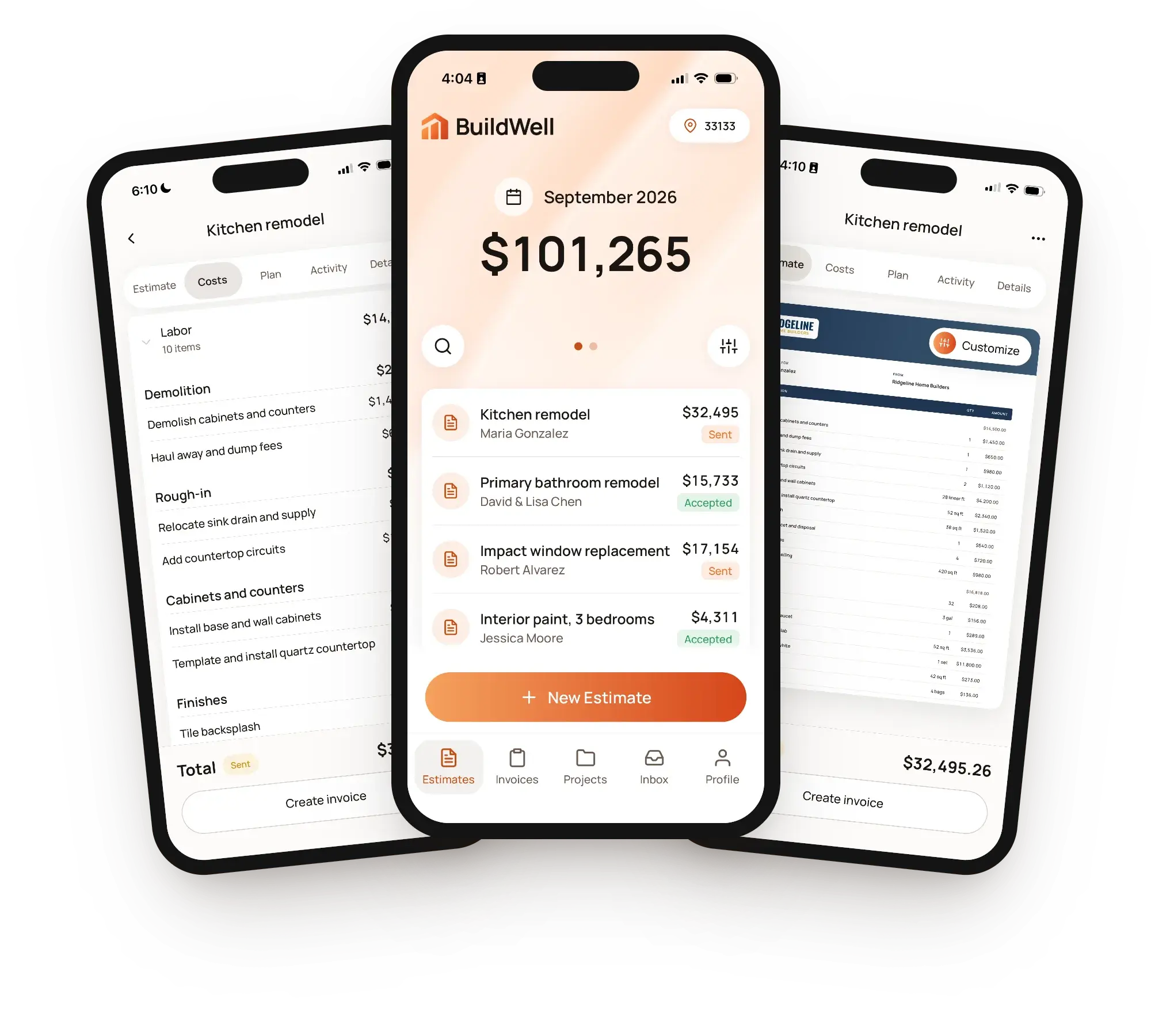
Describe the job by voice or photos. BuildWell lists the work, prices it for your area, gets it signed on the client’s phone, and turns it into the invoice.
- AI estimates priced for your area
- Estimates, invoices, clients and projects
- Clients sign on any phone
- Card and bank payments, no extra BuildWell fee
- iPhone, Android and the web
- AI estimates priced for your area
- Estimates, invoices, clients and projects
- Clients sign on any phone
- Card and bank payments, no extra BuildWell fee
- iPhone, Android and the web
Both plans include every feature and start with a 3-day free trial. Add a card to start; you’re not charged until the trial ends. Cancel anytime.
Estimate FAQ
01Is it really free, with no sign-up?
02What’s the difference between an estimate and a quote?
03How long should an estimate be valid?
04Should I list labor and materials separately?
05Do I charge sales tax on an estimate?
06Can I add my logo?
07How do I save it as a PDF?
08Will my details be here next time?
09Can BuildWell price the estimate for me?
10Can the client sign this estimate?
Free resources
Templates, calculators and definitions. No sign-up.
Guides for this document
Try BuildWell today
Estimates, invoices, e-signatures and payments in one place, on your phone and on the web.