 BuildWell
Free Subcontractor Agreement Generator
Put the scope, price and schedule in writing with plain-language starter terms, see it as you type, and download a PDF. Free, no account.
Everything stays in this browser. Nothing you type is sent to BuildWell.
How to use the free subcontractor agreement generator
The free subcontractor agreement generator writes up the deal when you hire another business for part of a job. Add the subcontractor, describe the scope line by line with a price, and fill in the site and schedule. The terms start with twelve plain-language clauses on payment, changes, insurance, warranty and more, for you to edit. It’s a template, not legal advice: contract rules vary by state, so have a lawyer look over your version. Below the tool: a worked example, what to include, the mistakes behind disputes with subs, and how the agreement fits with your other paperwork.
- 1
Add your business
Enter your business as the contractor: name, address, contacts and license number.
- 2
Add the subcontractor
Enter their legal business name and contacts, exactly as on their insurance certificate.
- 3
Describe the scope and price
Add a line for each part of their work, with a price. Say who supplies the materials and what isn’t theirs to do.
- 4
Set the site and schedule
Fill in the job site, start and finish dates and site contact, plus an agreement number and the project.
- 5
Edit the terms and have them checked
Fill in the blanks, change what doesn’t fit, and have a lawyer check it. Then download the PDF and have both businesses sign before work starts.
Who uses a subcontractor agreement
Any business that hires another for part of a job needs the arrangement in writing, and so does the business being hired. These trades sign subcontracts most often.
General contractors
You hire most of the trades on a job. One agreement per sub, each scope split cleanly from the next, keeps gaps and overlaps from becoming arguments.
General contractor software →Remodelers
Remodels lean on specialty subs. A written scope settles who patches the drywall after the electrician before anyone has to ask.
Roofers
Busy seasons mean extra install crews. Spell out the price per square, tear-off, disposal and cleanup, down to the nail sweep.
Roofing software →Electricians
Often the one being hired. Send your own scope and price, and read the contractor’s terms closely, especially payment timing and the permit.
Electrical software →Painting contractors
Bringing in another crew for a big job? Write down the prep standard, the number of coats and who buys the paint.
Painting software →Concrete contractors
Flatwork is often subbed by the square foot or the yard. Write the measure, the finish, and who handles forms, base and pump.
Concrete software →How to make a subcontractor agreement: an example
Here is a filled-in agreement between a general contractor and an electrician on a home addition, made with the generator above. The businesses, project and prices are invented, and the terms are the starter terms with the blanks filled in: an example of a complete agreement, not wording to rely on without a lawyer’s advice.
- Scope split into stagesRough-in and trim-out are separate lines, so payment can follow the stages.
- Who supplies whatThe trim-out line says the contractor supplies the fixtures. Leaving that out invites a surprise bill.
- The permit on its own lineThe permit and inspections are in the electrician’s price, so it’s clear who pulls it and pays.
- Dates tied to the jobRough-in follows the framing inspection and trim-out follows a call, each with a deadline.
- The blanks filled inPayment within 15 days, a 12-month warranty and 7 days to fix a problem: the numbers the starter terms leave to you.
Before anyone signs, check it has
- Both businesses’ legal names and contacts
- The project and the job site
- The scope, line by line, and what’s excluded
- Who supplies materials and pulls permits
- Prices and the contract price
- Dates, payment timing and how changes are approved
- Insurance certificates before work starts
- Signatures and dates from both businesses
What goes into a strong subcontractor agreement
The parts every subcontractor agreement needs, and why each one matters to both businesses signing it.
The parties, exactly
Both legal business names, as on the license and the insurance certificate. A nickname on one and a different name on the other makes both harder to rely on.
The project and the site
Which job, and where. With several jobs going with one sub, the project and agreement number keep them apart.
A scope that draws the lines
What the sub does, what they don’t, and where their work meets the next trade’s: patching, cleanup, hauling. Most disputes start at those edges.
The price and how it’s paid
A price for each part, the contract price, and when invoices are paid. Tie stage payments to stages someone can check.
The schedule
When the sub starts and how long each stage takes, usually tied to the work before theirs.
Changes in writing
Changed work only on a change order signed before it starts: the rule you hold your client to.
Insurance, permits and safety
Proof of insurance before anyone is on site, who pulls which permit, and safety rules for the work.
Warranty, ending it and signatures
How long the sub stands behind the work, how either side can end it, and both signatures before work starts.
Common subcontractor agreement mistakes
And how to avoid them, so the document does its job the first time.
Starting on a handshake
Without a written agreement, the scope and price are whatever each side remembers. Sign before the sub starts.
A one-line scope
“Electrical for addition” leaves out what costs money: fixtures, patching, the permit. Itemize it.
No proof of insurance
Get the certificate before work starts, and check the dates and the business named match the agreement.
Paying ahead of the work
A large payment up front leaves you little to hold if the work stalls. Tie payments to stages you can see.
Changes by word of mouth
A sub who does extra work on a word will expect to be paid. Put every change on a signed change order first.
Skipping the lawyer
Contract rules, lien rights and worker classification differ by state. Have a lawyer check your version once, then reuse it.
Subcontractor Agreement templates you can create
The generator has 6 layouts and 12 colors. Here is the example above in three of them; pick yours in “Look” at the bottom of the form.
Features of the free subcontractor agreement generator
Live preview
The document redraws as you type, in the same layout BuildWell itself sends.
Your logo and colors
Upload a PNG, JPG, SVG or WebP up to 2 MB, and pick from 12 colors.
6 templates
Classic, Headline, Banner, Statement, Minimal and Letterhead.
Starter terms to edit
Twelve plain-language clauses to fill in and change for each job. A starting point, not legal advice: have a lawyer check your version.
Private by default
What you type stays in this browser and is remembered on this device. Nothing is sent to BuildWell.
A PDF with no account
Download the PDF from your browser’s print dialog and send it however you like. No sign-up.
Tracking and follow-up in BuildWell
BuildWell doesn’t write subcontracts or manage subs. It handles the client side, which decides when to sign one: you see when the client opens your estimate and how many times, and you’re notified when they accept and sign on their phone. Sign subs after the client signs, so you never commit to work that isn’t sold. How the client portal works.
- Opened, and how oftenSee when the client opens your estimate and how many times.
- Accepted or declinedGet notified when the client accepts and signs on their phone, or declines.
- PaidGet notified when the client pays an invoice, and see what’s still owed.
- Sent from your phoneText or email the link in your own words. Clients need no app or account.
- Estimate E-1042 sent by textMon 9:14 AM
- Opened by the client · viewed 3 timesMon 7:52 PM
- Accepted and signedTue 8:03 AM
- Deposit invoice sentTue 8:10 AM
- Deposit paid by bank transferWed 11:26 AM
Skip the typing. Let it price the job.
Describe the job by voice or photos. BuildWell lists the work, prices it for your area, gets it signed on the client’s phone, and turns it into the invoice.
- AI estimates priced for your area
- Estimates, invoices, clients and projects
- Clients sign on any phone
- Card and bank payments, no extra BuildWell fee
- iPhone, Android and the web
- AI estimates priced for your area
- Estimates, invoices, clients and projects
- Clients sign on any phone
- Card and bank payments, no extra BuildWell fee
- iPhone, Android and the web
Both plans include every feature and start with a 3-day free trial. Add a card to start; you’re not charged until the trial ends. Cancel anytime.
Subcontractor Agreement FAQ
01Is it really free, with no sign-up?
02Is this subcontractor agreement legally binding?
03Does a subcontractor need their own insurance?
04Does calling someone a subcontractor make them one?
05Do I need a W-9 or a 1099 for a subcontractor?
06What is a pay-when-paid clause?
07Can I change the starter terms?
08How do I save it as a PDF?
09Will my details be here next time?
Free resources
Guides and definitions. No sign-up.
Guides for this document
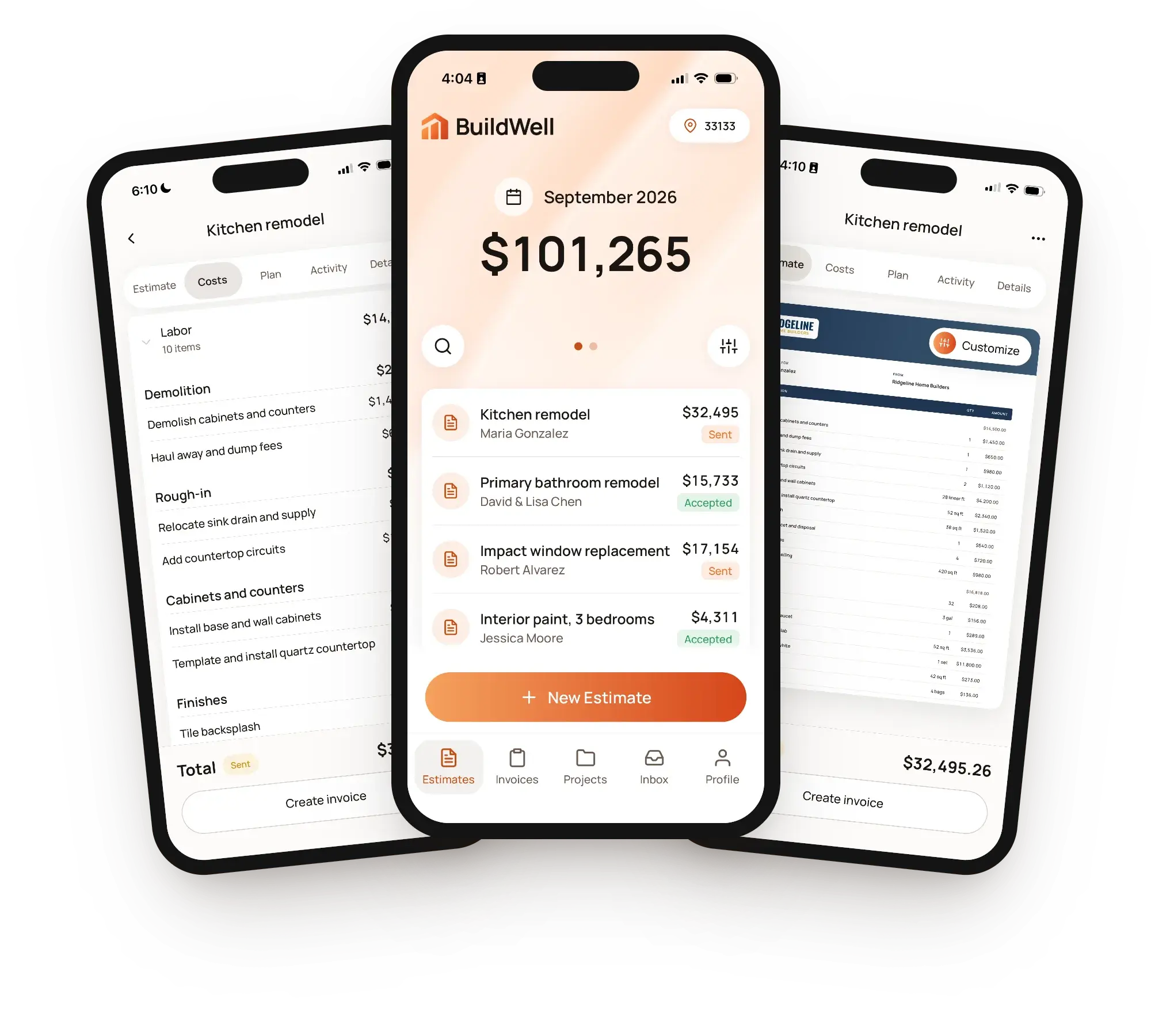
Try BuildWell today
Estimates, invoices, e-signatures and payments in one place, on your phone and on the web.