 BuildWell
How to write a change order
Write a construction change order that gets signed before the work: what to include, how to price it, schedule impact, credits, and a worked example.
Estimates and bids · 9 min read · Updated
The steps, in order
- 1
Stop and document the change
Before doing extra work, write down what changed, why, and who asked for it, with photos if it is a hidden condition.
- 2
Describe the change precisely
State what will be added, removed or done differently, in the same plain terms as the original scope.
- 3
Price it like a small estimate
Price materials, labor, other costs, overhead and profit, the same way as the original job.
- 4
State the schedule impact
Say how many days the change adds, or that it adds none.
- 5
Show the new contract total
List the original contract, previous change orders, this change and the new total.
- 6
Get it signed before the work
Have the client sign and date the change order before you start the changed work.
Every job changes:
- The client sees the tile in the room and wants it on one more wall.
- Demolition uncovers a rotten subfloor.
- The fixture the client picked is discontinued.
A change order is how each of those becomes a written, priced, signed addition to the contract. Without one, it is a verbal promise you hope to be paid for.
Unsigned changes are a classic source of payment disputes at the end of residential jobs. The reason is simple: by then, the client remembers asking for the change but not agreeing to the price.
This guide covers what a change order needs, how to price one, and a worked example with an added cost, a credit and the new contract total. For a blank form, use the free change order generator.
When you need a change order
Write one any time the scope, price or schedule changes from what the client signed:
- Client-requested changes: different materials, added work, a moved fixture.
- Hidden conditions: rot, mold, outdated wiring or plumbing found after demolition.
- Code or inspector requirements not foreseeable at the time of the estimate.
- Allowance overages: the client picks a fixture or finish above the allowance in the estimate.
- Deletions: work the client removes from the job, which calls for a credit.
Your estimate's exclusions decide what counts
The exclusions and assumptions in your original estimate decide which of these are changes. If the estimate said "does not include repair of subfloor damage found after demolition," a rotten subfloor is clearly a change. If it said nothing, expect a debate.
The estimate guide covers how to write those clauses.
What a change order includes
Every change order needs these parts:
- Change order number and date, numbered in sequence for the job.
- Reference to the original contract: estimate or contract number, client name, job address.
- Description of the change: what is added, removed or done differently, in plain words.
- Reason: client request, hidden condition, code requirement.
- Price: the cost of the change, or the credit.
- Schedule impact: days added, or "no change to schedule."
- Contract summary: original contract, previous change orders, this change, new total.
- Payment terms for the change: billed with the next progress payment, or due on signing.
- Signatures and dates from the client and from you.
Step 1: Stop and document
When you find a hidden condition or the client asks for a change, stop before doing the changed work.
Photograph hidden conditions before covering them
Photograph hidden conditions before you cover or remove anything. A photo of the rotten subfloor is worth more than any description. Note who asked for the change and when.
Urgent problems: make it safe, get approval
If the condition is urgent, like an active leak or a safety issue, make it safe. Then get approval for the fix in writing, even a signed text message, before going further.
Step 2: Describe the change precisely
Use the same plain, specific language as the original scope of work.
Example: compare two ways to write the same change.
- Vague: "Fix floor."
- Clear: "Remove and replace approximately 30 square feet of water-damaged subfloor in front of the toilet with 3/4-inch plywood, glued and screwed to existing joists. Does not include joist repair if joists are found damaged."
A clear description protects you
The clear version tells the client exactly what they are paying for. It also protects you if the joists turn out to be rotten too.
Step 3: Price it like a small estimate
Price the change with the same method as the original job:
- Materials at current prices, with your markup
- Labor at your full labor rate
- Other costs
- Overhead and profit
The pricing guide walks through each part.
Two cautions when pricing changes
- Do not price changes at cost. A change interrupts the schedule, adds a trip for materials and takes coordination time. It deserves the same margin as the rest of the job, and often more.
- Include the small costs. A change that needs one more trip to the supply house costs that trip, every time.
Step 4: State the schedule impact
If the change adds time, say how much. "Adds one working day" or "adds three working days pending material delivery" sets expectations and protects you if a completion date was promised.
If it adds no time, say that too.
Step 5: Show the new contract total
Never make the client do the arithmetic. Show:
- The original contract amount
- Each previous change order
- This change
- The new total
A running total on every change order means the final invoice holds no surprises.
Step 6: Get it signed before you do the work
The signature is the point. Get it before you start the changed work, not after.
Client off site? Send it to their phone
If the client is not on site, send the change order to their phone and ask them to sign it there. A link they can open and sign in any browser, the way a client portal handles estimates, makes this a two-minute job instead of a trip.
Worked example: a bathroom remodel with two changes
Example: The original contract is $18,400 for a bathroom remodel. Its estimate excluded "repair of subfloor, framing or plumbing found to be damaged after demolition."
The figures below are example costs for illustration.
Change order 1: subfloor replacement
After the toilet and old tile are removed, about 30 square feet of subfloor in front of the toilet is soft and stained from a long-term leak.
| Line | Amount |
|---|---|
| 3/4-inch plywood, 2 sheets at $62 | $124.00 |
| Subfloor adhesive and screws | $20.00 |
| Materials at cost | $144.00 |
| Material markup, 15% | $21.60 |
| Materials | $165.60 |
| Labor: remove and replace subfloor, 6 hours at $85 | $510.00 |
| Change order 1 total | $675.60 |
Schedule impact: adds one working day.
The checks: 2 × 62 = 124, and 124 + 20 = 144. 144 × 0.15 = 21.60, so materials are 144 + 21.60 = 165.60. Labor: 6 × 85 = 510. Total: 165.60 + 510 = 675.60.
Change order 2: client-supplied faucet (credit)
The client finds a faucet they prefer and wants to buy it themselves. The original estimate included a faucet at a cost of $140 with your 15% material markup. Installation labor stays the same.
| Line | Amount |
|---|---|
| Remove faucet from contract: $140 cost + 15% markup | −$161.00 |
| Change order 2 total | −$161.00 |
Schedule impact: none, if the client's faucet is on site by the trim-out date.
The check: 140 × 1.15 = 161. The credit is the price you charged for the faucet, not just your cost. Add a line that the client-supplied faucet is installed but not covered by your warranty.
The new contract total
| Line | Amount |
|---|---|
| Original contract | $18,400.00 |
| Change order 1: subfloor replacement | $675.60 |
| Change order 2: client-supplied faucet credit | −$161.00 |
| New contract total | $18,914.60 |
The checks: 18,400 + 675.60 = 19,075.60, and 19,075.60 − 161 = 18,914.60.
Each change order shows this running total, and the final invoice lists every change order by number. The client sees exactly how the job got from $18,400 to $18,914.60.
When the change cannot be priced yet
Sometimes the extent of a problem is unknown until more is opened up. If the joists under that subfloor might be damaged too, you cannot give a fixed price for repairing them until you see them.
Never leave the price blank
Do not leave the price blank. Two options work:
- Time and materials with a cap. "Joist repair, if needed, billed at $85 per hour plus materials at cost plus 15%, not to exceed $1,200 without further written approval." The client knows the most they will pay, and you are paid for the time it takes.
- A two-step change order. Price the investigation now ("open floor and assess joists, 2 hours, $170"), then write a second change order with a fixed price once you know what is needed.
Either way, the client signs before you start, and the maximum exposure is in writing.
Talking to the client about a change
How you raise a change matters almost as much as the paperwork. A few habits make it easier:
- Show, then tell. Walk the client to the rotten subfloor or send the photo before you send the price. A cost is easier to accept once you have seen the reason for it.
- Give options where they exist. Repair now, or close it up and accept the risk in writing. Upgrade the fixture, or stay within the allowance.
- Point back to the estimate. If the exclusion was written down, show it. It turns "you are charging me more" into "this is the extra the estimate described."
- Be quick. Price the change the same day. A crew standing idle while the client thinks about it costs you, and a stalled job makes everyone tense.
Change order mistakes that cost money
- Doing the work first and writing it up later. Once the work is done, your leverage is gone.
- Verbal approval. "Go ahead" on a phone call is easy to forget and hard to prove.
- No price on the change order. "Price to be determined" invites a dispute about whatever number you pick later. If the price truly cannot be known yet, write a not-to-exceed amount or a time-and-materials rate.
- Forgetting the schedule. A change that adds days without saying so can turn a missed completion date into your problem.
- Bundling changes into the final invoice. A list of surprise extras at the end looks like padding, even when every item was requested.
Allowances, contingency and change orders
Two estimate tools reduce the number of change orders you need, or make them easier:
- Allowances price items the client has not chosen. If they pick something more expensive, the difference is billed as an allowance overage, a change order the client expected from the start.
- Contingency sets aside an amount for unknowns, especially in older houses. How it is used and what happens to any unused amount should be spelled out in the contract.
Explain both when you send the estimate
Both work best when explained at the estimate stage, so the client knows what could change before anything does.
Change orders, work orders and revisions
A change order changes the contract between you and the client. A work order is an instruction to a crew member or subcontractor to do a task.
Use a change order, then a work order
They are often used together: the client signs the change order, then you issue a work order to the person doing the work.
Or revise and resend the whole estimate
Some contractors handle changes by revising the whole estimate instead of writing separate change orders. In BuildWell, you can change a signed estimate and send it again. The original is kept, and the client signs the new version on their phone.
Either way, the rule is the same: the new price is agreed in writing before the work.
Keep every change order with the job
File each signed change order with the original estimate and the job's invoices. When the final invoice goes out, every change on it should match a signed document by number and amount.
If a question comes up months later, at a warranty call or a sale of the house, the full record is in one place.
Checklist
- Change order numbered and dated, referencing the original contract
- Clear description and reason
- Priced with materials, labor, overhead and profit
- Schedule impact stated
- Original contract, previous changes and new total shown
- Signed and dated by the client before the work starts
Make change orders routine, the same way every time, and they stop being awkward conversations and become just part of how you run a job.
Free tools for this guide
Generators, templates, calculators and definitions. No sign-up.
Common questions
01Does a change order need to be signed?
02What if the client asks for a change and there is no time to write it up?
03Can I charge markup on a change order?
04How do I handle a change that reduces the price?
05What is the difference between a change order and a revised estimate?
Estimates, signatures and invoices in one app
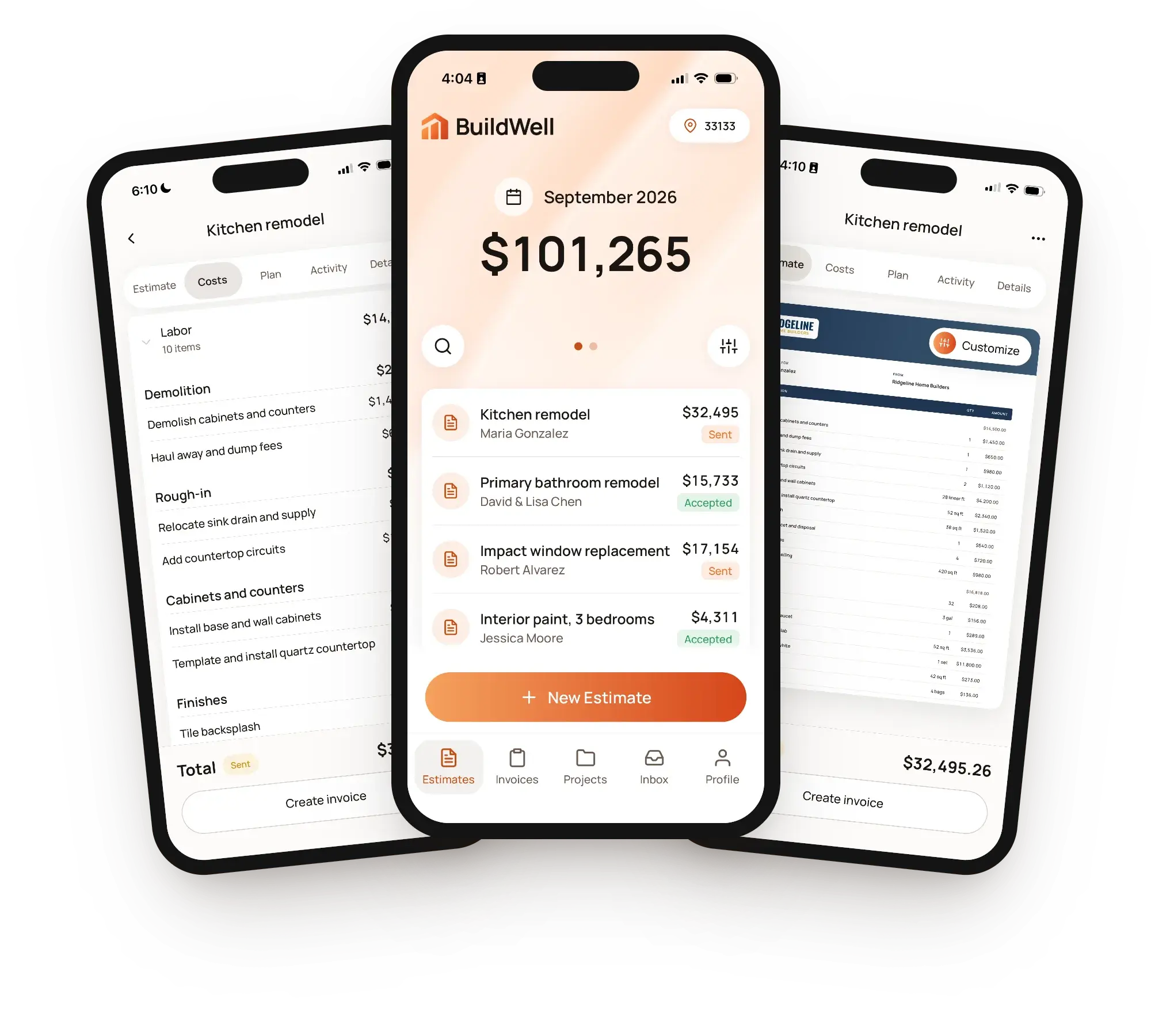
BuildWell prices materials at stores near the job and labor from your metro’s wages plus your overhead and markup, gets the estimate signed on the client’s phone, and turns it into the invoice.
- AI estimates priced for your area
- Estimates, invoices, clients and projects
- Clients sign on any phone
- Card and bank payments, no extra BuildWell fee
- iPhone, Android and the web
- AI estimates priced for your area
- Estimates, invoices, clients and projects
- Clients sign on any phone
- Card and bank payments, no extra BuildWell fee
- iPhone, Android and the web
Both plans include every feature and start with a 3-day free trial. Add a card to start; you’re not charged until the trial ends. Cancel anytime.
Try BuildWell today
Estimates, invoices, e-signatures and payments in one place, on your phone and on the web.