BuildWell

Every lawn care price is built from four pieces:
- Time on site: how long the crew spends on the property, times a rate that covers your costs.
- Materials: seed, fertilizer, mulch and bags, at what they cost you near the job, plus a markup.
- The visit: drive time, loading and setup, covered by your minimum or built into each visit.
- Disposal: leaves, clippings and brush you haul away, if you don't leave them on site.
What goes on a lawn care quote
These are the lines a typical residential lawn care quote carries, and how each is usually counted. BuildWell has no built-in lines for lawn care, so the AI drafts the lines and their hours, and you set them.
| Line item | Usually counted by |
|---|---|
| Mow, trim and blow | Per visit, or by lawn area |
| Edging along walks, drives and beds | Per visit, or by the foot |
| Spring or fall cleanup | Per visit, or by the hour |
| Leaf removal and haul-off | By the hour, or by the load |
| Core aeration | By lawn area |
| Overseeding | By lawn area, plus seed |
| Fertilizer or weed control | By lawn area, plus product |
| Shrub and hedge trimming | Per shrub, or by the hour |
| Bed weeding | By the hour |
| Mulch refresh | By bed area, with mulch by the cubic yard |
| Debris disposal | Per load |
| Trip charge or minimum | Per visit |
Labor and materials keep their own units
In BuildWell, the work on each line is counted by the piece, the square foot or the linear foot:
- A mowing visit is one piece.
- Aeration is square feet of lawn.
- Edging is linear feet.
The materials inside a line, like mulch or seed, use their own units. A mulch line can be square feet of bed with cubic yards of mulch in it.
Measure the property once
Most of a lawn care price comes from area and obstacles. Measure the turf area once, with a measuring wheel or an online map, and keep it in the client's notes. Then note what slows the crew down:
- slopes and banks that need the trimmer instead of the deck
- fence lines, trees and beds to mow and trim around
- gates too narrow for the larger mower
- how far the truck parks from the yard
Time your crew, not the competition
Start from how long your crew really takes, not from what the last company charged. Time a few properties of different sizes and write the minutes down.
Your labor rate covers more than wages
What you pay a crew member isn't your labor rate. Your rate has to cover:
- the wage, or what you pay yourself
- payroll taxes, and workers' comp once you hire
- liability insurance
- the truck, the trailer, fuel and equipment repairs
- unpaid time: driving between stops, loading, rain days and quoting
Then it needs a profit.
How BuildWell prices each hour
BuildWell builds each hour's price in three steps:
- Wage: a local wage from Bureau of Labor Statistics data. BuildWell's wage data covers construction trades, so lawn care lines start from a construction wage, not a groundskeeper wage.
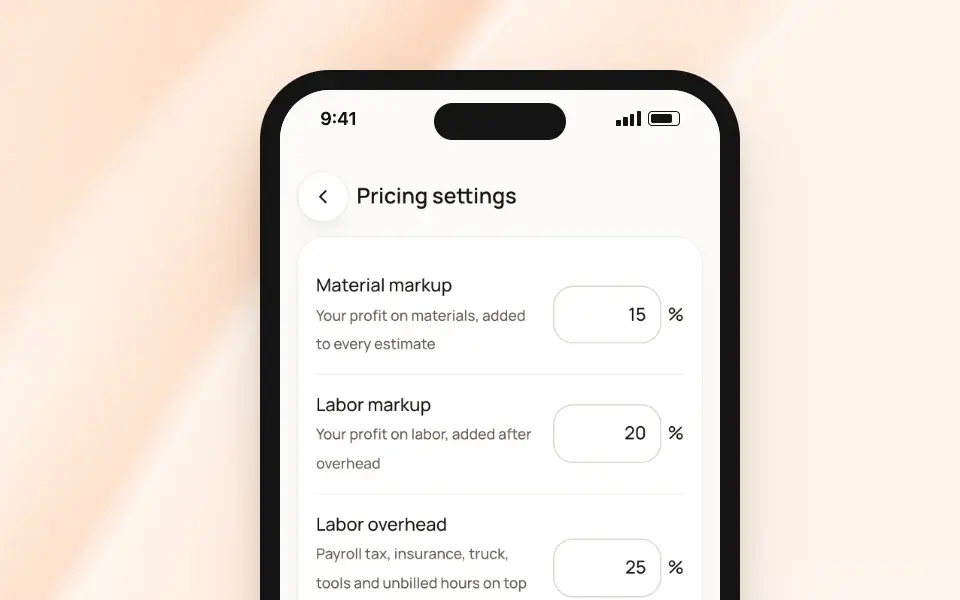
- Overhead: your labor overhead, which starts at 100% and doubles the wage.
- Markup: your labor markup, which starts at 20%.
Set both percentages once in Pricing settings, and change the hours or the price on any line.
What one weekly visit's labor comes to
Example: Say a crew member costs you $20 an hour in wages. Use your real number. Say a weekly visit takes two people 30 minutes on site, one labor hour in total:
- Wages: 1 × $20 = $20
- With 100% overhead: $40
- With 20% markup: $48 for that visit's labor
That's before fuel and the drive between stops.
Bill per visit, per month or per season
Recurring work can be billed three ways:
- Per visit. Simple, and fair in a dry summer when you skip cuts.
- A flat monthly price. The season's visits spread evenly, so the client pays the same each month.
- A season agreement. One price for a set list of services, billed in parts.
Bill a season from one signed estimate
BuildWell doesn't run automatic recurring billing, so pick the way that suits how you send invoices. A common approach: price the season on one estimate, with the visits as a quantity, and get it signed.
Then create an invoice from that estimate each month, adjusted to the visits you made. Or duplicate last month's invoice and change the dates.
Price materials near the job, then mark up
Price seed, fertilizer, mulch and bags at what they cost near the job this week, plus a markup for the pickup, the storage and the leftovers. Material markup starts at 20% in BuildWell; change it per estimate.
Bulk mulch or seed from a landscape supplier gets flagged without a store price. Enter yours once and BuildWell remembers it.
Set a minimum or a trip charge
A small lot across town costs you the same drive as a large one next door. Set a minimum per visit, or a trip charge for properties outside your normal route.
Put it on the quote as its own line so it's clear from the start.
Grow with add-ons the client can pick
Add-ons are where a lawn care business grows: fall aeration, a spring cleanup, a mulch refresh. Offer them as separate lines the client can approve or skip.
A revised estimate keeps the original, and the client signs the new version on their phone.
The guide to pricing lawn care jobs works through per-visit, monthly and seasonal pricing for a weekly account.