 BuildWell
Contractor payment terms explained
Due on receipt, net 15, net 30, 2/10 net 30, progress terms, retainage and late fees, what each means for contractors and how to write terms that get paid.
Invoicing and getting paid · 10 min read · Updated
Payment terms are the part of the contract that decides when your money arrives. They usually get written once, copied onto every estimate and never looked at again, which is a mistake.
The difference between "due on receipt" and "net 30" on a $20,000 final invoice is a month of your cash in someone else's account.
This guide explains, in plain language:
- the common terms and what each one means
- which ones suit residential and commercial work
- how early-payment discounts and late fees actually work out
- how to write terms that leave no room for interpretation
For the short definitions, see payment terms in the glossary.
The common payment terms
Due on receipt for small jobs, final balances
Due on receipt means the invoice is due when the client receives it. It is the standard for small jobs, service calls and final balances on residential work.
It also has a weakness: "on receipt" is not a date, and some clients read it as "soon." Pair it with a specific date or "within 3 days" if you want a firm deadline.
Net 7 to net 15 for progress payments
Payment is due 7, 10 or 15 days after the invoice date. Short net terms are a good fit for progress payments on residential work.
They give the client time to move money without leaving the invoice open for a month. Net 15 is common with small commercial clients.
Net 30 is for business clients
Net 30 means the full amount is due 30 days after the invoice date. It is standard in business-to-business billing: property managers, general contractors, commercial clients.
On residential work it is rarely necessary, and it turns every job into a month-long loan.
Net 60 and longer: price in the wait
Net 60 and longer terms appear on larger commercial work. If a client insists on them, price the wait into the job. Carrying the cost of materials and labor for two months is a real expense.
2/10 net 30 costs more than it looks
The client may take a 2% discount by paying within 10 days; otherwise the full amount is due in 30. It sounds generous and small. It is generous, and it is not small, as the example below shows.
Progress terms tie payments to milestones
On longer jobs, terms attach to milestones instead of a single invoice: a deposit at signing, payments at named stages, and a final payment at completion.
Each progress invoice then carries its own due date, often due on receipt or within a few days. The progress billing guide covers how to build the schedule.
Retainage holds back part of each payment
Retainage holds back a percentage of each payment, commonly 5% or 10% on commercial work, until the job is complete. Some states limit it, especially on public projects.
If you agree to retainage, make sure the contract says exactly what triggers its release.
Pay-when-paid and pay-if-paid in subcontracts
These appear in subcontracts. A pay-when-paid clause says the general contractor pays you after the owner pays them. A pay-if-paid clause tries to make payment conditional on the owner paying at all.
States treat these differently, and some do not enforce pay-if-paid clauses. Read them carefully before you sign.
Worked example: what 2/10 net 30 really costs
The math on a $5,000 invoice
Example: A client owes $5,000 on 2/10 net 30 terms. If they pay on day 10, they pay $4,900. The discount is 5,000 × 0.02 = $100.
That $100 bought payment 20 days sooner than the net 30 due date. To compare it with an interest rate:
- The discount is $100 on the $4,900 actually paid: 100 ÷ 4,900 = 2.04% for 20 days.
- A year has 365 ÷ 20 = 18.25 periods of 20 days.
- 2.04% × 18.25 = about 37% a year.
The precise figure: 2 ÷ 98 = 0.020408, and 0.020408 × 18.25 = 0.3724, or 37.2%.
A 37% yearly rate to get paid early
You are paying the equivalent of a 37% annual rate to borrow your own money for 20 days.
A deposit, progress billing or a short due date gets you paid sooner without giving anything away.
Worked example: what net 30 costs on a final invoice
Interest on a $20,000 final invoice
Example: A $20,000 final invoice can be due on receipt or on net 30. Suppose that while you wait, you are carrying the job's costs on a business line of credit at 10% a year. Thirty days of carrying $20,000 costs:
20,000 × 0.10 × 30 ÷ 365 = $164.38.
The check: 20,000 × 0.10 = 2,000 a year, and 2,000 × 30 ÷ 365 = 164.38.
Ten jobs like that in a year is $1,643.84 of interest paid so clients can pay later. That is before counting the invoices that come in after 30 days rather than on day 30.
Net 30 costs you even without a loan
If you are not borrowing, the cost is still there. It is:
- the materials order you put on a credit card
- the supplier discount you miss
- the next job you cannot start until the money lands
Net 30 is not free just because no one sends you a bill for it.
Late fees
Two conditions make a late fee collectable
A late fee is a charge for paying after the due date. Two conditions make one collectable:
- It is in the signed agreement. A late fee that first appears on an overdue invoice is hard to enforce.
- It is within your state's limits. States regulate late fees and interest on consumer contracts differently. Check yours before choosing a rate.
Spell out how the late charge adds up
Example: A contract allows a late charge of 1.5% per month on overdue balances, assuming your state allows that rate. An $8,000 balance is one month overdue. The late charge is 8,000 × 0.015 = $120.
If it stays unpaid another month, the next charge depends on how the contract words it:
- 1.5% of the original $8,000 again: $120
- 1.5% of $8,120: $121.80
Spell out which.
Use late fees to get paid on time
In practice, late fees work best as a reason to pay on time rather than as income. You may choose to waive the first one for a good client as a goodwill gesture.
Having it in the contract is what matters.
Residential and commercial terms
Homeowners pay when the stage is done
Residential clients are paying with their own money for their own home. They expect to pay when the job or stage is done, not 30 days later. A structure that works well:
- Deposit at signing, within your state's limit
- Progress payments due on receipt, or within 3 to 7 days, at each milestone
- Final balance due on receipt at completion, after the walkthrough
Commercial clients pay on a net 30 schedule
Commercial clients, property managers and general contractors pay through accounts payable departments that run on schedules. Net 30 is standard; net 15 is negotiable.
Business clients will ask for paperwork
Expect paperwork too:
- a W-9
- a certificate of insurance
- sometimes lien waivers with each payment
Businesses that pay you $2,000 or more in a calendar year, for payments starting in 2026, may need to report it on a 1099-NEC.
How to write payment terms that leave no room for argument
Vague terms get read in the client's favor. Specific terms get paid.
Write the amount, the trigger and the date
Example: The same terms, written two ways.
Vague: "Payment due upon completion."
Specific: "Deposit of $1,000 due at signing. Progress payment of $6,000 due within 3 days of passing rough-in inspection. Final balance due on receipt of the final invoice after walkthrough. Balances unpaid 15 days after the due date incur a late charge of 1.5% per month, as allowed by law. Accepted payment methods: card, bank transfer, check, Zelle."
The specific version answers every question a client could ask:
- how much
- when, and what triggers it
- what happens if it is late
- how to pay
Four more rules for clear terms
- Put dates on invoices. "Net 30" plus "Due: April 30" removes any doubt about how days are counted.
- Use the same terms on the estimate and the invoice. If the invoice says net 30 and the signed estimate said due on receipt, the client will choose the friendlier one.
- List payment methods. A term that says when to pay without saying how leaves a gap.
- Say what happens when payment is late, including whether work pauses on a progress payment.
Terms when you are the one paying
Payment terms run both ways. When you hire subcontractors or buy on account at a supply house, you are the client, and the same principles apply.
Agree on terms with subs in writing
Agree on terms in writing before subcontractors start, and pay on time. A sub who gets paid promptly shows up for the next job.
If you pay a sub after the client pays you, say so in the subcontract. Remember that your state's law on pay-when-paid applies to you as well.
Collect a W-9 and insurance first
Get a W-9 before the first payment, and a certificate of insurance before they set foot on the job.
If you pay an unincorporated sub $2,000 or more in a calendar year, for payments starting in 2026, you will generally need to file a 1099-NEC for them.
Collect lien waivers when you pay subs
On larger jobs, collect a lien waiver from each sub and supplier when you pay them. The property owner is protected, and your own final payment is not held up by someone else's claim.
Get paid before supplier statements come due
Trade accounts at supply houses often run on monthly terms. Line your billing up so client payments arrive before the supplier statement is due.
Choosing terms for your business
Match terms to when your costs go out
Start with your cash flow. List what you pay out on a typical job and when:
- materials up front
- labor weekly
- subcontractors on completion of their part
Then set terms that bring money in before or alongside those costs. A deposit and progress payments on residential jobs, and net 15 or net 30 on commercial work with the wait priced in, covers most situations.
Use the same terms on every job
Be consistent. Terms that change from job to job are hard to enforce and harder to remember. The get paid faster guide covers the follow-up schedule that goes with them.
Payment terms in BuildWell
Due dates, deposits and payments on one invoice
BuildWell sets invoice terms to due on receipt, 7, 14 or 30 days, and shows the due date on the invoice.
Deposits and progress payments can be invoiced as percentages of the signed estimate. Each payment is recorded against its invoice so you can see what is outstanding.
You can also print terms and conditions on your estimates, so the payment schedule the client signs is the one you bill against.
Check your terms against real payments yearly
Whatever terms you choose, review them once a year against what actually happened. If clients on net 30 routinely pay on day 45, the terms are not working.
Then a deposit, shorter terms or a card-and-bank-transfer link may do more than a stronger reminder.
Quick reference
| Term | When payment is due | Best fit |
|---|---|---|
| Due on receipt | When the client receives the invoice | Small jobs, final balances |
| Net 7 to net 15 | 7 to 15 days after the invoice date | Residential progress payments, small commercial |
| Net 30 | 30 days after the invoice date | Commercial clients, property managers |
| Net 60 | 60 days after the invoice date | Large commercial work, priced accordingly |
| 2/10 net 30 | 10 days with a 2% discount, otherwise 30 | Rarely worth offering |
| Progress terms | At each milestone in the schedule | Jobs longer than a week or two |
Choose deliberately, write them precisely and use the same ones everywhere. Payment terms are one of the few parts of getting paid you control completely.
Free tools for this guide
Generators, templates, calculators and definitions. No sign-up.
Common questions
01What does net 30 mean?
02What payment terms should a residential contractor use?
03What does 2/10 net 30 mean?
04Are pay-when-paid clauses enforceable?
05Can I change payment terms after the contract is signed?
Estimates, signatures and invoices in one app
BuildWell prices materials at stores near the job and labor from your metro’s wages plus your overhead and markup, gets the estimate signed on the client’s phone, and turns it into the invoice.
- AI estimates priced for your area
- Estimates, invoices, clients and projects
- Clients sign on any phone
- Card and bank payments, no extra BuildWell fee
- iPhone, Android and the web
- AI estimates priced for your area
- Estimates, invoices, clients and projects
- Clients sign on any phone
- Card and bank payments, no extra BuildWell fee
- iPhone, Android and the web
Both plans include every feature and start with a 3-day free trial. Add a card to start; you’re not charged until the trial ends. Cancel anytime.
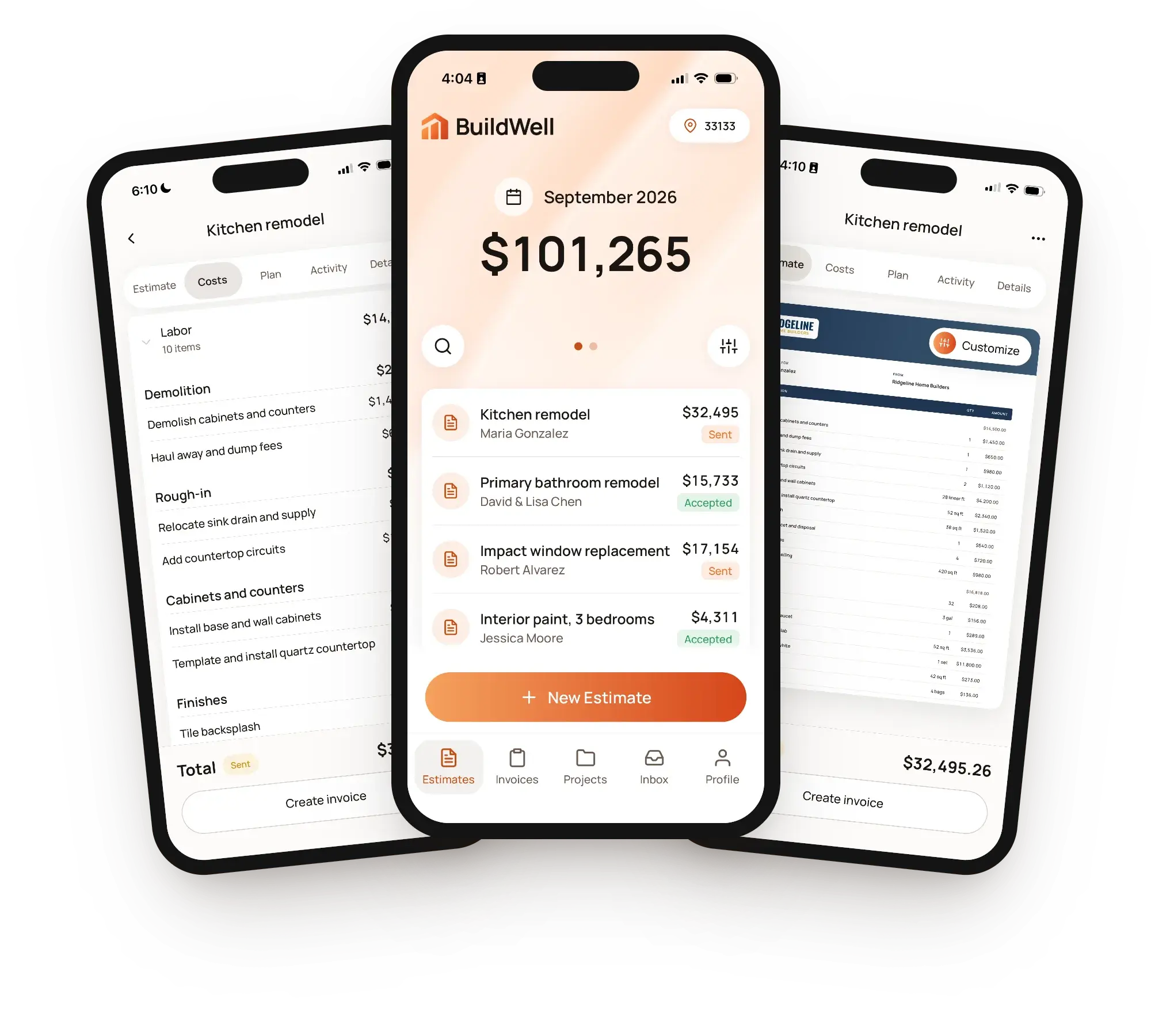
Try BuildWell today
Estimates, invoices, e-signatures and payments in one place, on your phone and on the web.