 BuildWell
How to price cleaning jobs
Price house and commercial cleaning per visit, by the hour, per square foot or monthly, from your own timed visits, with a recurring home worked step by step.
Pricing by trade · 10 min read · Updated
The steps, in order
- 1
Walk the space and note its condition
Count rooms and bathrooms, measure floor area for commercial and post-construction work, and note the condition, pets and clutter.
- 2
Plan labor hours from your own visits
Use your team's timed visits in similar homes and spaces, adjusted for condition, to plan labor hours for the visit and each add-on.
- 3
Add supplies, travel and overhead
Add products and consumables, the drive and setup, then the job's share of overhead for every labor hour.
- 4
Add profit and set the visit price
Mark up the total cost to get a price per visit, and set a minimum so a small job still pays.
- 5
Choose how to bill recurring work
Price a first deep clean, then the recurring visit, and bill per visit or as a monthly price from visits per month.
- 6
Quote add-ons as their own lines
List ovens, refrigerators, cabinets, windows and blinds separately, with exclusions in writing.
A cleaning price has to pay for the time your team spends in the space, the drive to get there, the products you use, the time nobody pays for, and a profit.
The visit price you quote is the sum of those parts, whether you show it as an hourly rate, a flat price per visit, a price per square foot or a monthly contract.
This guide builds a cleaning price from its parts, then shows how to price recurring work and prices a recurring home step by step. It covers the method and the arithmetic, not your rates.
Wages and supply costs vary by metro, so every dollar figure is yours to fill in, and the times in the example are example inputs to replace with your own. For estimating software built for the trade, see the cleaning industry page.
How cleaning work is measured
- Per visit: a standard home clean, priced by the size of the home and its condition.
- By the hour: deep cleans, move-outs and jobs you cannot size up front.
- Square feet: offices, commercial spaces and post-construction cleaning.
- Each: add-ons like the inside of an oven, a refrigerator, a set of cabinets or a window.
- Per month: recurring visits, from visits per month × the visit price.
Condition matters more than size
A small home with pets, clutter and a year of buildup can take longer than a large, tidy one.
The formula for a cleaning price
- Labor hours for the visit, from your own timed visits, adjusted for condition.
- Labor hours × your full hourly labor cost = labor cost. That cost is the wage, or what you pay yourself, plus labor burden: payroll taxes, workers' comp and benefits.
- Supplies: products, cloths, mop heads, liners and anything the visit uses up.
- Travel: the drive and setup, as a share of each visit or as a minimum.
- Overhead for every billable hour: the vehicle, equipment, insurance and bonding, phone, software, training and the hours spent quoting.
- Profit, as a markup on the total cost or a target margin.
The labor rate guide and the labor rate calculator turn pay, burden and billable hours into a full hourly cost.
Count the time nobody pays for
In cleaning, unpaid time is easy to miss:
- The drive between homes
- Cancellations and lockouts
- Training new cleaners
- The walkthroughs that never become clients
Time the work: your own visits are the data
There is no published table of cleaning hours that fits your team. The only numbers worth pricing from are the ones you record:
- Time every visit from arrival to departure, with the number of cleaners.
- Write down the home: bedrooms, bathrooms, floor area, pets and condition.
- Separate first cleans from recurring ones, and the add-ons from the base visit.
Quote from your own pace, then check it
After a few weeks you will see your own pace for a standard home, a deep clean and a move-out, and how much a heavy-condition home adds.
Use those numbers to quote new clients. Then check the first visit against the quote and adjust.
Pricing models for cleaning
Hourly: fair when you can't size the job
You bill the hours you work, times your hourly price. It is fair when you cannot predict the job, such as a hoarding cleanup, but the client does not know the total until you finish. If you quote hourly, give an estimate of the hours.
Flat rate per visit: easiest to sell
One price for a defined visit in a defined home. It is the easiest to sell and the most common for recurring homes.
Build it from your timed hours for that home. Write down what the visit includes, so extras are priced as extras.
Per square foot: build your own pace
Common for offices, commercial spaces and post-construction work. Build your own pace from spaces you already clean: labor hours ÷ floor area.
Then multiply by the area of a new space and check the result against similar accounts. Adjust for restrooms, kitchens and high-traffic floors, which take longer than open office space.
Monthly: use calendar math, not four weeks
Recurring visits billed as one monthly price:
monthly price = visit price × visits per month.
Use calendar math, not four weeks to a month:
- Weekly visits are 52 a year, or 52 ÷ 12 = 4.33 a month.
- Every other week is 26 a year, or 26 ÷ 12 = 2.17 a month.
- Three nights a week for a commercial space is 3 × 52 ÷ 12 = 13 visits a month.
First cleans, recurring visits and seasonal work
A recurring visit usually takes less time than a one-time clean of the same home. A home cleaned every week or two stays easier to clean.
Start new clients with a deep clean
Many cleaning businesses start a new client with a deep clean at a higher price, then quote the recurring visit after it.
Price each from its own hours:
- The first clean: your timed hours for a deep clean of a home like this one.
- The recurring visit: your timed hours for upkeep at the frequency the client chose. Weekly visits take less time than monthly ones.
- Seasonal work: spring cleans, holiday cleans and move-outs are one-time jobs; price them like a first clean.
Put skipped visits and long gaps in writing
Write down how you handle skipped visits, holidays and vacations, and whether a long gap means the next visit is priced as a deep clean.
Worked example: a recurring home
Example: A client asks for a cleaning every other week in a three-bedroom, two-bath home with one dog. You walk it together:
- The home is in fair condition
- The kitchen needs a detailed first clean
- The client wants the inside of the oven done the first time
Example times for each visit
Example inputs only. Say your team takes the times below in this home. They are round numbers chosen to show the arithmetic, not benchmarks and not BuildWell data. Use your own timed visits.
| Visit | Cleaners | Example hours on site | Labor hours |
|---|---|---|---|
| First deep clean | 2 | 4.0 | 8.0 |
| Inside oven, first visit | 1 | 1.0 | 1.0 |
| Recurring visit, every other week | 2 | 1.75 | 3.5 |
Add the drive to every visit
Say the drive adds 20 minutes for each cleaner, 0.67 labor hours per visit:
- The first visit: 8 + 1 + 0.67 = 9.67 labor hours.
- Each recurring visit: 3.5 + 0.67 = 4.17 labor hours.
Price the first and the recurring visit
| Line | How to get it |
|---|---|
| Labor | Labor hours × your full hourly labor cost |
| Overhead | Labor hours × your overhead per billable hour |
| Supplies | Products and consumables for the visit |
| Cost per visit | The sum of the three lines |
| Price per visit | Cost per visit × (1 + your markup) |
Do it twice: once with 9.67 hours for the first clean, and once with 4.17 hours for the recurring visit, V. If V comes out below your minimum, charge the minimum.
Bill 2.17 visits a month
Every other week is 26 visits a year: V × 26 ÷ 12 = 2.17 × V each month. Bill the first clean separately.
The job cost calculator adds the lines up, and the markup vs margin guide shows why a 25% markup is a 20% margin.
Commercial and post-construction cleaning
Commercial accounts are priced the same way, at a larger scale. Walk the space at the hour you would clean it, and count what drives the time:
- Restrooms and fixtures
- Break rooms
- Trash and recycling stations
- Hard floors and carpet
- How much furniture is in the way
Build the commercial price in four steps
- Plan labor hours per visit from your pace on similar spaces.
- Multiply by visits per month, using calendar math.
- Add supplies, including restroom paper and liners if your contract covers them, which can be a large line on its own.
- Add overhead and profit, then divide the monthly price by the floor area as a check against similar accounts.
Price post-construction cleans by phase
Post-construction cleaning is usually priced by floor area and often in phases:
- A rough clean after the trades leave
- A final clean before the walkthrough
- Sometimes a touch-up after the punch list
Ask the builder which phases they expect and price each as its own line.
List what post-construction cleaning includes
- Interior windows
- Stickers and labels
- Paint drips
- Dust in vents and cabinets
Supplies, equipment and minimums
- Supplies: price products and consumables at what they cost near the job this week, as their own line or built into the visit price. If the client provides their own products, say so.
- Equipment: vacuums, floor machines and ladders belong in your overhead. Rent a carpet extractor or a lift as its own line.
- Minimums: the drive, setup and the shortest visit worth making set your minimum. Build it in hours, price it at your full hourly cost, and state it on every quote.
- Cancellations and lockouts: a fee for a late cancellation or a locked door covers a slot you could not fill. Put it in your terms.
Common cleaning pricing mistakes
- Pricing by bedrooms alone. Condition, pets and clutter change the hours more.
- The same price for the first clean and the recurring visit. The first one takes longer.
- Four weeks to a month. Weekly is 4.33 visits a month, not 4.
- Free add-ons. Ovens, refrigerators and cabinets take real time; quote them.
- No cancellation rule. A held slot you could not fill is lost time.
How to present a cleaning quote
- Define the visit: the rooms, the tasks in each, and the frequency. The scope of work entry covers why that matters.
- Price add-ons as their own lines, so the client can choose.
- Separate the first clean from the recurring price.
- State your terms: supplies included or client-supplied, cancellation and lockout fees, and when payment is due. The payment terms guide covers the options.
- Say what is excluded, such as exterior windows, laundry or biohazards.
Free tools for the quote and the invoice
The free quote generator and the estimate template for Excel give you a layout.
The free invoice generator bills a visit, and the free receipt generator confirms a cash payment. The get paid faster guide covers collecting from many small invoices.
Pricing cleaning jobs with BuildWell
BuildWell writes a cleaning quote from a description of the job, by voice, text or photos, such as "move-out clean, three bedrooms, two baths, inside the oven and fridge, inside all kitchen cabinets." Each part becomes its own line.
Cleaning isn't in BuildWell's catalog, so the AI drafts the hours from what you describe. Set your team's real hours on each line, or put your flat price on it.
Supplies are priced at stores near the job, checked within the last 30 days. Labor starts from a local Bureau of Labor Statistics construction wage plus the overhead and markup you set, which may not match what you pay. Products the client provides can be marked client-supplied, listed but not charged.
Repeat clients: duplicate the last invoice
BuildWell doesn't send recurring invoices or book visits, so for a repeat client duplicate the last invoice and change the date. It reminds you when an invoice is due or overdue, and private client notes hold entry codes and pet notes.
A cleaning pricing checklist
- Rooms, floor area and condition noted on the walkthrough
- Hours from your own timed visits
- Travel covered by a minimum or a share of each visit
- Overhead on every billable hour, then profit
- A first-clean price separate from the recurring price
- Monthly prices from calendar math
- Add-ons, exclusions and a cancellation rule in writing
Free tools for this guide
Generators, templates, calculators and definitions. No sign-up.
Common questions
01Should I charge for cleaning by the hour or by the job?
02Why does the first clean cost more than recurring visits?
03How do I price commercial cleaning by the square foot?
04How do I handle cancellations and lockouts?
05Does BuildWell send recurring cleaning invoices?
Estimates, signatures and invoices in one app
BuildWell prices materials at stores near the job and labor from your metro’s wages plus your overhead and markup, gets the estimate signed on the client’s phone, and turns it into the invoice.
- AI estimates priced for your area
- Estimates, invoices, clients and projects
- Clients sign on any phone
- Card and bank payments, no extra BuildWell fee
- iPhone, Android and the web
- AI estimates priced for your area
- Estimates, invoices, clients and projects
- Clients sign on any phone
- Card and bank payments, no extra BuildWell fee
- iPhone, Android and the web
Both plans include every feature and start with a 3-day free trial. Add a card to start; you’re not charged until the trial ends. Cancel anytime.
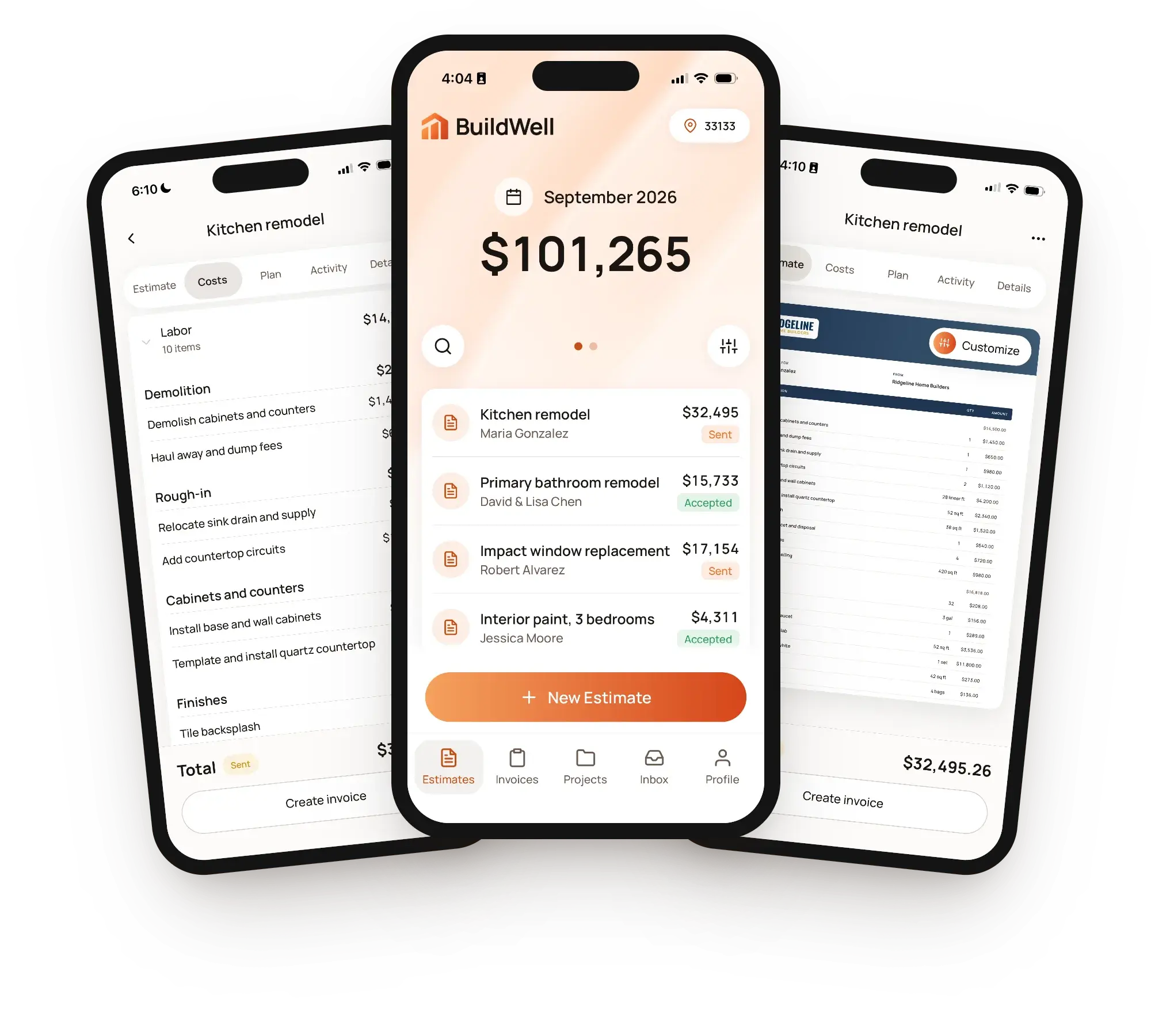
Try BuildWell today
Estimates, invoices, e-signatures and payments in one place, on your phone and on the web.