 BuildWell
How to get paid faster as a contractor
Practical ways for contractors to get paid faster, from deposits and clear terms to same-day invoices, easy payment, follow-up schedules and lien rights.
Invoicing and getting paid · 10 min read · Updated
The steps, in order
- 1
Agree on payment before the work
Put the deposit, payment schedule and due dates in the signed estimate or contract.
- 2
Collect a deposit
Take a deposit at signing, within your state's limits, so the job starts with money in hand.
- 3
Bill progress payments
On longer jobs, invoice at visible milestones so payments keep up with costs.
- 4
Invoice the same day
Send each invoice the day it is earned, from the job site if you can.
- 5
Make paying easy
Offer card and bank transfer from a link, plus the other methods your clients already use.
- 6
Follow up on a schedule
Remind on the due date, then at set intervals, escalating politely and in writing.
- 7
Know your lien rights
Learn your state's notice and filing deadlines before a payment is late, not after.
Getting paid is part of the job, not an afterthought to it. The work that decides when you get paid happens before the first invoice: in the estimate, the payment schedule and the way you send bills.
Getting paid quickly is rarely luck. It comes from a system, run the same way on every job.
This guide covers that system in order:
- terms before the job
- deposits and progress payments during it
- invoicing and easy payment at each step
- a follow-up schedule for late payments
- the last-resort tools when a client will not pay
A worked example shows what the timing of payments does to your bank balance on a single job.
1. Agree on payment before the work
Write the payment plan into the signed estimate
Every payment conversation is easier if it already happened at signing. The signed estimate or contract should state:
- The deposit amount and when it is due
- Each progress payment and its trigger
- When each invoice is due after it is sent
- Accepted payment methods
- What happens when a payment is late: a late fee if your state allows it, and whether work pauses
Unsigned terms are only requests
The payment terms guide covers how to choose and word them. The point here is simple: if it is not in the signed document, it is a request, not a term.
2. Collect a deposit
Set the deposit to cover materials
A deposit means the job starts with money in your account instead of yours in the client's kitchen. Set it to cover materials you must order, within your state's limits.
Check your state's deposit cap
Some states cap home-improvement deposits. In California, a deposit cannot exceed 10% of the contract price or $1,000, whichever is less.
Book nothing until the deposit is paid
Invoice the deposit at signing. Do not order special materials or put the job on the schedule until it is paid.
3. Bill progress payments
Tie payments to milestones the client can see
On any job longer than a week or two, progress payments keep your cash ahead of your costs. Tie them to visible milestones:
- demolition complete
- rough-in inspection passed
- cabinets installed
The deposits and progress billing guide shows how to build the schedule, with a worked kitchen example.
4. Invoice the same day
Send each invoice the day it is earned
The simplest way to get paid a week sooner is to invoice a week sooner. Send each invoice the day it is earned: the day the milestone is reached, the day the job is finished.
On small jobs, send it from the driveway, while the client is looking at the finished work.
Match the estimate and give a due date
The invoice itself should:
- match the signed estimate and change orders exactly
- show the balance due as the largest number on the page
- give a due date as a date
The invoicing guide lists what to include.
5. Make paying easy
Remove every step between the client and paying
Every extra step between the client and paying you is a delay. Remove them:
- Send a link, not just a PDF. A client who can open the invoice on their phone and pay from it can pay right now.
- Accept card and bank transfer. Card is fast for small amounts. Bank transfer (ACH) costs far less on large balances.
- List the other methods your clients use: check, Zelle, Venmo, Cash App, PayPal.
- Print payment details on the invoice itself. "Call for payment options" adds a phone call.
Card or bank transfer: what it costs you
Card fees are the price of speed, and on large invoices they add up.
Example: Using Stripe's standard US rates, 2.9% plus 30¢ for cards and 0.8% capped at $5 for bank transfers, a $12,000 final payment costs:
- By card: 12,000 × 0.029 = $348.00, plus $0.30, for $348.30.
- By bank transfer: 12,000 × 0.008 = $96.00, which is over the cap, so $5.00.
On a $400 repair, the card fee is 400 × 0.029 + 0.30 = $11.90, a small price for being paid before you leave.
Offer both and let the client choose
Offer both payment types. Some clients will pick the bank transfer on a large balance once they see it is an option.
Before adding a surcharge for card payments, check your state's rules and the card networks' rules, which restrict it.
Small jobs: get paid before you leave
On repairs and one-day jobs, the best collection tool is timing. Finish the work, walk the client through it, and send the invoice from your phone before you pack up.
If they can pay from the link by card or bank transfer while you load the truck, the job is closed the same day. There is nothing to follow up on next week.
6. Separate disputes from payment
When a client raises an issue with part of the work, the whole payment can stall while it is sorted out.
Get the undisputed amount paid now
Keep the two apart:
- Agree on the undisputed amount. If the question is about a $600 trim detail on a $9,000 progress payment, ask the client to pay the $8,400 that is not in question while you resolve the rest.
- Fix it fast and document it. Photograph the fix, send it, and reissue the invoice for the remaining amount the same day.
- Put it in writing. A short email confirming what was agreed protects both of you.
One item should not hold up the rest
A dispute about one item should not hold up payment for everything else. A reasonable client will usually agree to that when it is put plainly.
Worked example: what payment timing does to cash flow
The job: a $24,000 deck and patio
Example: A four-week deck and patio job priced at $24,000. Your costs total $18,000:
- $8,000 of materials bought in week 1
- labor of $2,500 a week for four weeks
These are example figures for illustration.
Option A: one invoice at the end, net 30
You pay $8,000 for materials and $2,500 in labor in week 1, then $2,500 each week after. By the end of week 4, you have paid out $18,000 and received nothing.
You invoice on completion with 30-day terms, so the $24,000 arrives about a month later, if it is on time.
For roughly two months, you are carrying up to $18,000 of the client's job.
Option B: deposit, progress payment, final due on receipt
The contract calls for:
- 30% at signing
- 40% at the end of week 2
- 30% on completion, due on receipt
| Point in the job | Money in | Money out | Running balance |
|---|---|---|---|
| Signing | $7,200 | $7,200 | |
| Week 1 | $10,500 | −$3,300 | |
| Week 2 | $2,500 | −$5,800 | |
| End of week 2 payment | $9,600 | $3,800 | |
| Week 3 | $2,500 | $1,300 | |
| Week 4 | $2,500 | −$1,200 | |
| Completion payment | $7,200 | $6,000 |
How the numbers check out
- Payments: 24,000 × 0.30 = 7,200 and 24,000 × 0.40 = 9,600.
- Week 1 out is materials plus labor, 8,000 + 2,500 = 10,500.
- Running balance: 7,200 − 10,500 = −3,300; −3,300 − 2,500 = −5,800; −5,800 + 9,600 = 3,800; 3,800 − 2,500 = 1,300; 1,300 − 2,500 = −1,200; −1,200 + 7,200 = 6,000.
- The ending $6,000 is the job's profit, 24,000 − 18,000.
Option B keeps you $5,800 out, not $18,000
The most you are ever out of pocket in Option B is $5,800, compared with $18,000 in Option A. The job is fully paid on completion instead of a month later. Same job, same price, same client.
In California, the deposit would be capped at $1,000, so the schedule would shift more of the money into the progress payments. The principle holds.
7. Follow up on a schedule
Late invoices are often just forgotten
Many late payments are not refusals. The invoice was forgotten, misplaced or is waiting on a question. A follow-up schedule, run the same way every time, collects those without a fight.
Four follow-ups, due date to day 30
| When | What to send |
|---|---|
| Due date | Friendly reminder with the invoice link: "Just a reminder that invoice 1042 is due today." |
| 7 days late | Second reminder, with the amount and the link, and a question: "Is there anything about the work you would like to discuss?" |
| 14 days late | Phone call, followed by a written summary. Mention the late terms in the contract. |
| 30 days late | Formal written notice: amount, due date, late terms, and the next steps you will take if it is not paid by a date. |
Keep every reminder in writing
Keep every reminder in writing, even after a phone call. If the account ever goes to a lien, small claims or an attorney, that record matters.
8. Track what you are owed
Sort unpaid invoices by how late they are
Your accounts receivable is the total of unpaid invoices. An aging report sorts it by how late each invoice is: current, 1 to 30 days, 31 to 60 and so on.
Check the aging report every week
Look at it every week. An invoice that slips from 30 to 60 days late without anyone noticing is far harder to collect than one followed up on the day it went late.
9. Know your lien rights before you need them
A lien is a claim against the property
A mechanic's lien is a claim against the property for unpaid work. It is one of the strongest collection tools a contractor has, and it is strictly governed by state law.
Miss a deadline, lose the right
Many states require a preliminary notice sent early in the job to preserve lien rights. Every state sets deadlines for filing after work stops. Missing a deadline can cost you the right entirely.
Learn your state's rules when the job starts
Learn your state's rules at the start of the job, not when a payment is 60 days late. For anything beyond the basics, talk to a local construction attorney.
When a client will not pay
Four steps, from demand letter to attorney
If follow-up fails and a legitimate issue is not the cause, the options escalate:
- A formal demand letter stating the amount, the basis and a deadline.
- A mechanic's lien, filed within your state's deadlines.
- Small claims court for amounts within your state's limit.
- A collection agency or an attorney for larger amounts.
Each has costs and rules. Before filing anything, get local legal advice.
Mistakes that slow payment
- Starting work without a signed estimate. There is no agreed amount to collect.
- Unsigned change orders. The client disputes the extras and holds back the whole payment while you argue. See the change order guide.
- Invoicing in batches. Waiting until Friday, or month end, to send invoices adds days to every payment.
- No due date. "Payment due" with no date leaves the timing to the client.
- Leaving the punch list open. An unfinished item gives a client a reason to hold the final payment. Finish it, or agree in writing what remains.
Getting paid with BuildWell
Invoices built from the signed estimate
BuildWell turns the signed estimate into the invoice, bills deposits and progress payments as percentages of the estimate, and records each payment against its invoice.
Clients pay from a text or email link
Clients open invoices from a text or email link, with no app or account. They can pay by card or bank transfer through Stripe when you have connected it, with Stripe's fee passed through at cost and nothing added by BuildWell.
Your Zelle, Venmo, Cash App, PayPal or check details print on every invoice.
See when estimates open and invoices are paid
You see when an estimate is opened, and you are notified when an invoice is paid. See online payments for the details.
Checklist
- Payment terms in the signed estimate
- Deposit collected before materials are ordered
- Progress payments at visible milestones
- Invoices sent the day they are earned
- Card, bank transfer and the other methods your clients use
- A written follow-up schedule
- An aging report checked every week
- Your state's lien deadlines known before the job starts
Free tools for this guide
Generators, templates, calculators and definitions. No sign-up.
Common questions
01What is the fastest way for a contractor to get paid?
02Can I charge a late fee?
03When should I follow up on an unpaid invoice?
04What can I do if a client refuses to pay?
05Should I offer a discount for early payment?
Estimates, signatures and invoices in one app
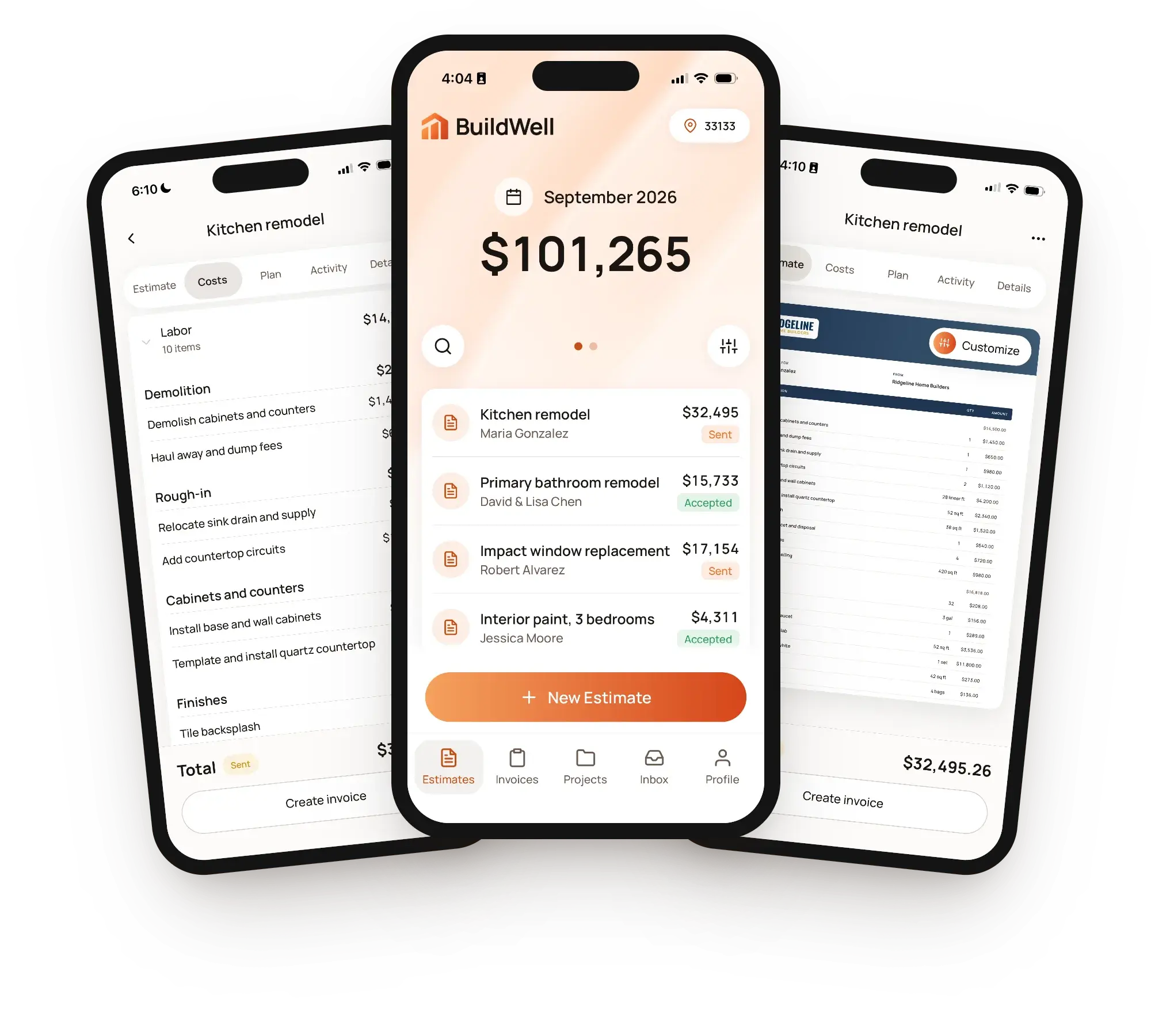
BuildWell prices materials at stores near the job and labor from your metro’s wages plus your overhead and markup, gets the estimate signed on the client’s phone, and turns it into the invoice.
- AI estimates priced for your area
- Estimates, invoices, clients and projects
- Clients sign on any phone
- Card and bank payments, no extra BuildWell fee
- iPhone, Android and the web
- AI estimates priced for your area
- Estimates, invoices, clients and projects
- Clients sign on any phone
- Card and bank payments, no extra BuildWell fee
- iPhone, Android and the web
Both plans include every feature and start with a 3-day free trial. Add a card to start; you’re not charged until the trial ends. Cancel anytime.
Try BuildWell today
Estimates, invoices, e-signatures and payments in one place, on your phone and on the web.