BuildWell

HVAC estimating software that wins more jobs

Estimating and invoicing software for HVAC contractors. Describe the system swap and get it priced and signed before you leave.

  • Store prices near the job
  • Wages for your metro
  • iPhone, Android and web
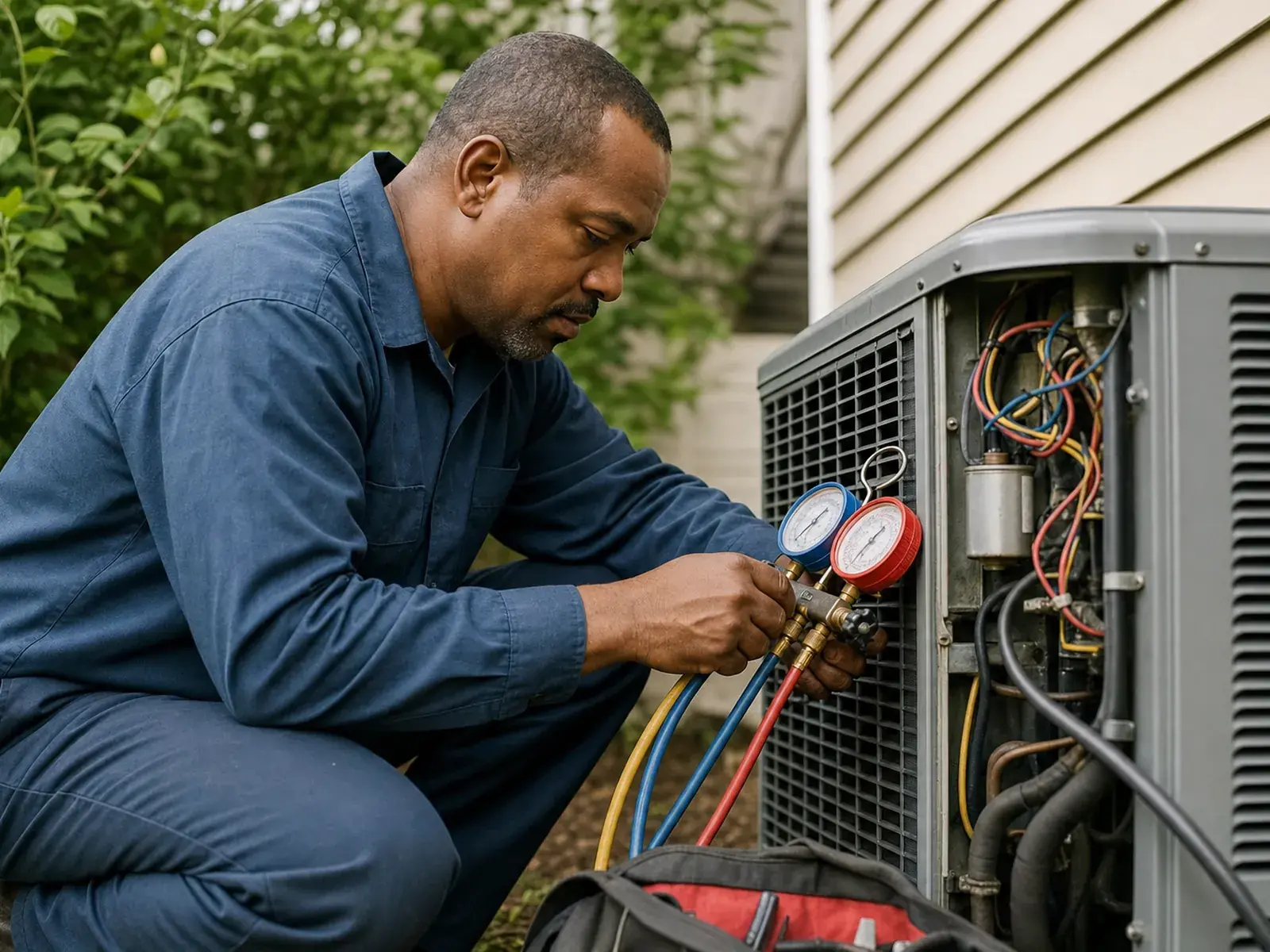
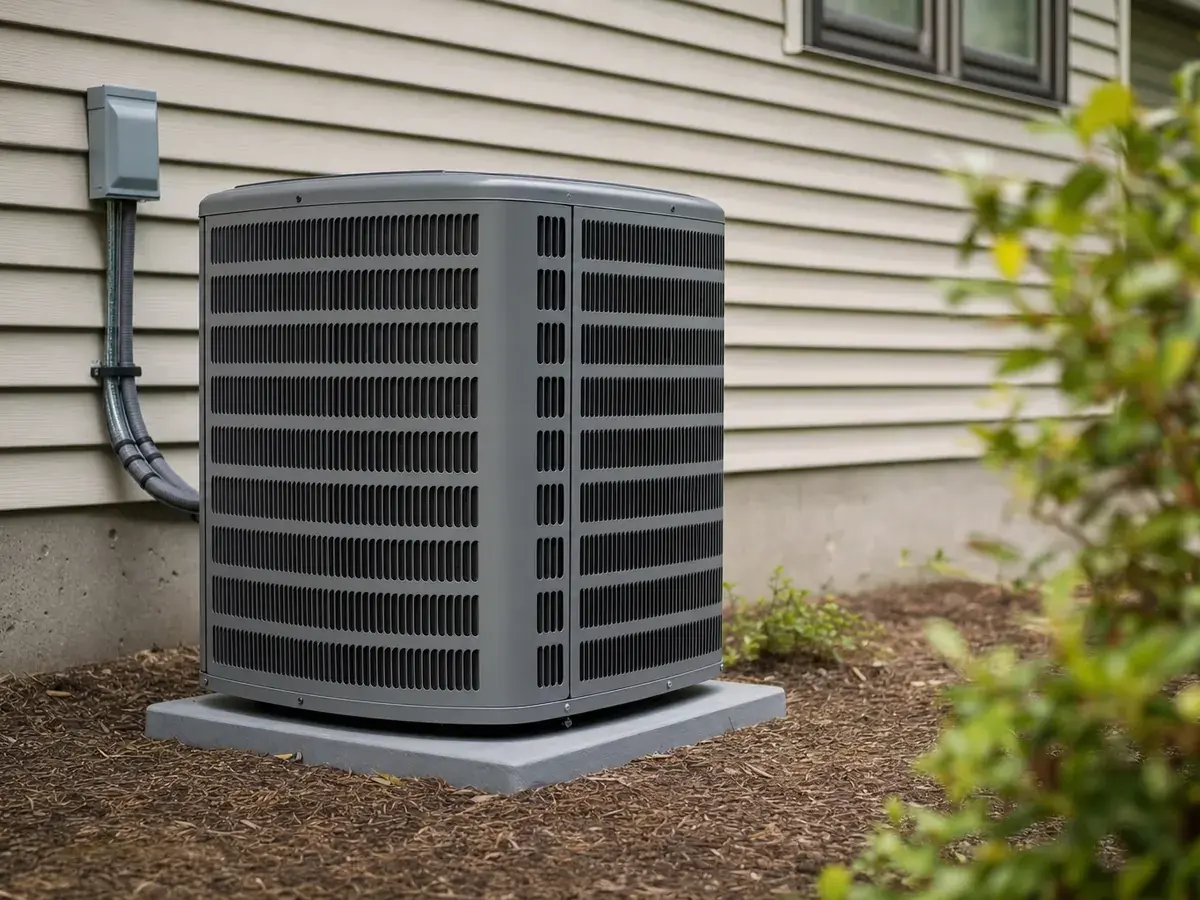
An HVAC technician servicing an outdoor air conditioning condenser with gauges

Run every HVAC job start to finish

Estimate on site, get it signed before you leave, invoice when the work’s done and see the payment land.

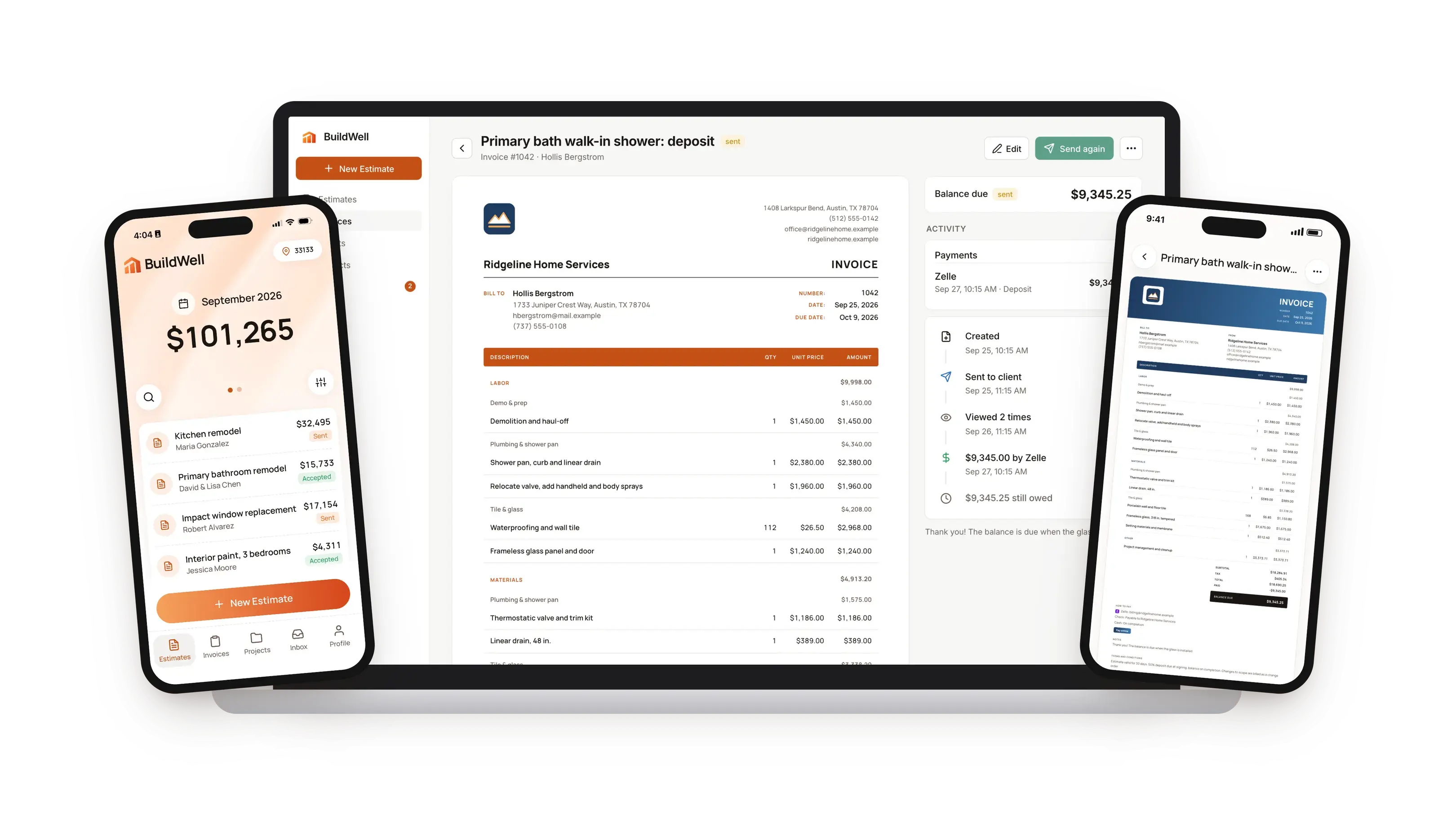
BuildWell on a laptop showing a branded invoice and its payments, the estimates home screen on one phone and an invoice in a different style on another

What is HVAC estimating software?

HVAC estimating software turns what you find on a service call into a priced, itemized quote the homeowner can approve. It replaces the price sheet in the truck, the distributor's quote, and the calculator on your phone.

HVAC work comes in three kinds of quotes

  • Repairs: a diagnostic, then the part and the labor to fix it. A capacitor, a contactor, a blower motor, a refrigerant leak.
  • Maintenance: tune-ups on a schedule, often sold as a yearly agreement.
  • Replacements and new work: furnaces, condensers, heat pumps, mini-splits and ductwork, with removal, electrical, drains, permits and startup.

Replacement quotes are where money gets lost

A repair quote has two or three lines. A replacement quote has a dozen, and each one is a place to leave money behind:

  • the disconnect you assumed was fine
  • the line set that won't flush
  • the condensate pump nobody priced
  • the permit

Flat-rate books and spreadsheets take time

Most HVAC companies price repairs from a flat-rate book and replacements from distributor quotes and a spreadsheet. Both work, but both take time.

The replacement quote often gets written that night instead of in the driveway.

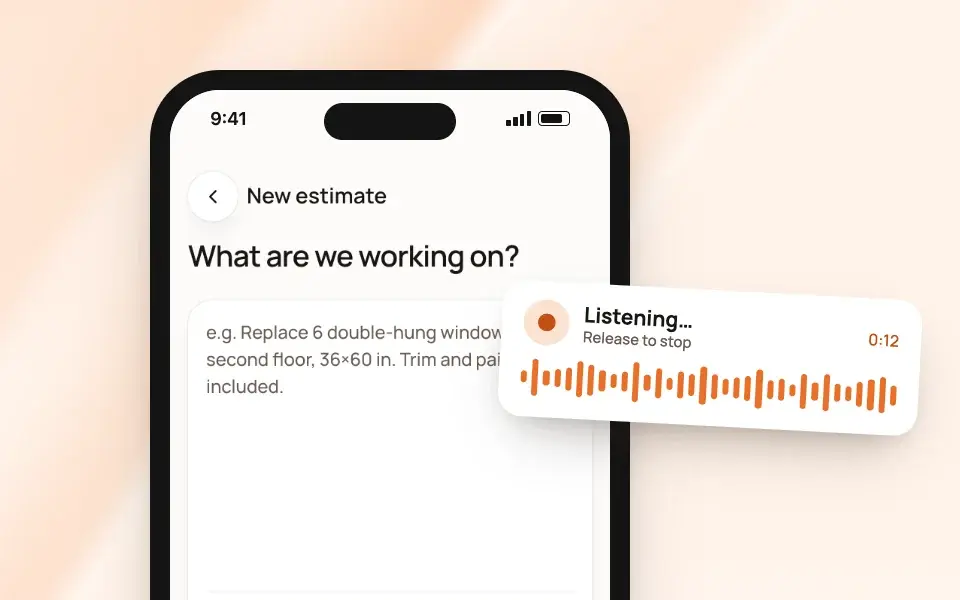
BuildWell builds the quote from what you describe

Each part of the job becomes its own line, with the materials it needs and the hours BuildWell expects. Parts are priced at stores near the job where they're sold, and equipment is priced at the cost you enter.

You review the lines, set the hours and prices you charge, and send it. When the job is done, the signed estimate becomes the invoice.

A new outdoor air conditioning condenser on a pad beside a house

Why HVAC contractors choose BuildWell

You quote while you're still in the house

The itemized quote is ready before you pack up the gauges.

It asks what changes the price

Line set reused? Disconnect the right size? Where does the condensate go?

The homeowner sees every part of the job

Removal, coil, line set, pad, electrical and startup are each listed.

Parts priced nearby, equipment at your cost

Thermostats and fittings priced at a nearby store. Enter equipment cost once.

You set the hours and the rate

AI writes each line. Change the hours and price to match yours.

Deposits come in before you order equipment

Invoice a deposit first, then the balance after startup.

Estimates in English or Spanish

Send each client their estimate and invoice in their language.

Same account on phone and computer

Start on site and finish at your desk. Nothing to sync.

Built for HVAC contractors

What changes when HVAC contractors price jobs from real data instead of memory.

  • A replacement quote on the callDescribe removal, equipment, line set and thermostat. Each becomes its own line.
  • Local parts prices, your equipment costParts priced at a store near the job. Enter equipment cost once.
  • Your hours, your rateAI writes the HVAC lines. Set the hours and price on each.
  • Signed, invoiced and paidBill a deposit before ordering equipment, then the balance after startup.
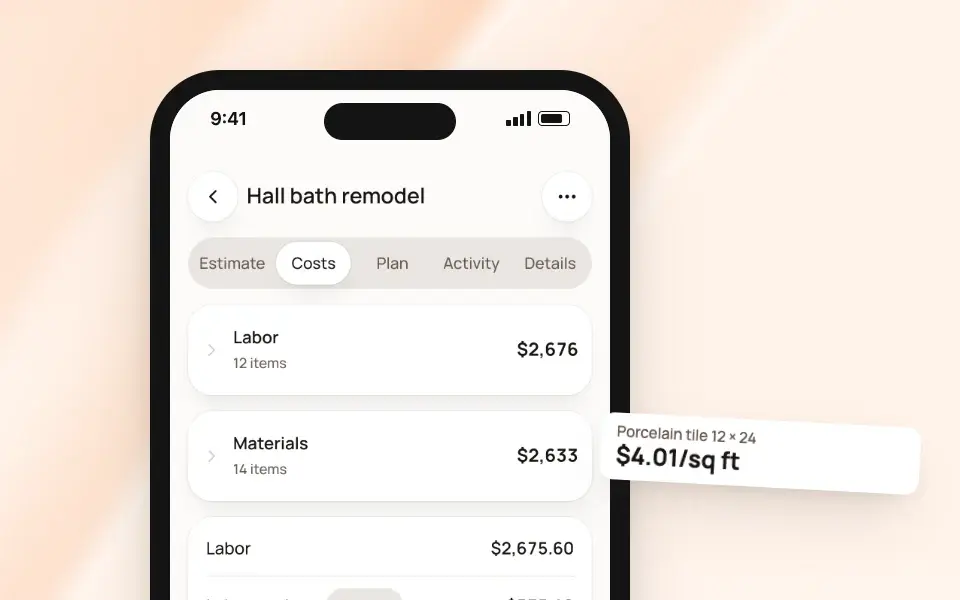
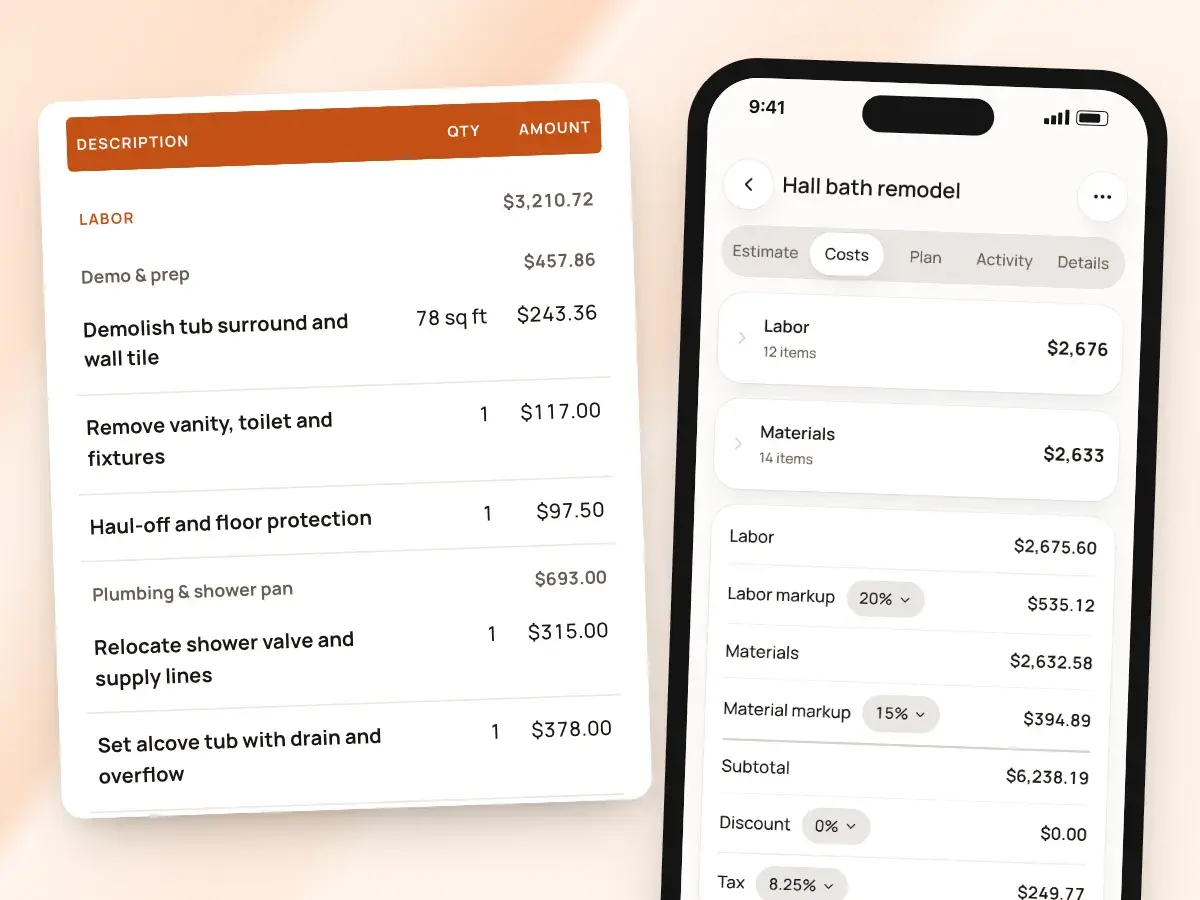
An estimate’s costs on a phone beside its priced lines, grouped by job step

How to price HVAC jobs

Every HVAC price is built from five pieces:

  1. Labor: the hours for each part of the job, times a rate that covers your costs.
  2. Equipment: the units themselves, at your cost plus a markup.
  3. Parts and materials: line set, fittings, refrigerant, pad, disconnect, drain parts, duct and registers.
  4. The visit: the diagnostic or service call fee, and after-hours rates.
  5. Permits and disposal: the permit, the inspection, and recovering and disposing of the old unit.

What goes on an HVAC estimate

These are the lines a typical residential HVAC job carries, and how each is usually counted. BuildWell has no built-in lines for HVAC, so the AI drafts the lines and their hours, and you set them.

Line item Usually counted by
Diagnostic or service call Per visit
Maintenance tune-up Per system
Repair part and labor (capacitor, contactor, motor) Each
Refrigerant recovery and recharge Per job, plus refrigerant by the pound
Remove and dispose of old equipment Per system
Outdoor unit (condenser or heat pump) Each
Furnace or air handler Each
Evaporator coil Each
Line set By the foot
Pad, stand or wall brackets Each
Electrical disconnect and whip Each
Condensate drain or pump Each
Thermostat Each
Duct runs By the foot, or per run
Registers and grilles Each
Permit and inspection Per job
Startup and testing Per system

Labor and materials keep their own units

In BuildWell, the work on each line is counted by the piece, the square foot or the linear foot, and materials keep their own units.

A line set is linear feet, a condenser is one piece, and refrigerant can be pounds inside the recharge line.

Repairs: price the visit, then the fix

Price the visit and the repair separately:

  • The diagnostic or service call covers the drive, the time to find the problem and the truck stock you carry. Charge it on every call.
  • The repair is the part plus the time to install and test it.

Many contractors credit the diagnostic toward the repair if the homeowner goes ahead. Whatever you decide, write it in your terms.

After-hours and weekend calls usually carry a higher rate; add it as its own line.

Replacements: list every part of the job

A changeout quote should list everything the job needs:

  • Removal: recovering the refrigerant, disconnecting and hauling the old unit.
  • Equipment: outdoor unit, indoor unit or furnace, and coil, matched to each other.
  • Line set: reused and flushed, or replaced, with its length.
  • Electrical: disconnect, whip, and whether the circuit is sized for the new unit.
  • Drain: condensate line, trap, pump or safety switch.
  • Controls: the thermostat, and wiring if it needs more conductors.
  • Startup: charging, testing and walking the homeowner through the system.

Size from a load calculation, not the old unit

Size the system from a load calculation, not from the old unit's tonnage. The old unit may not have been sized right, and the right size changes the price.

Your labor rate covers more than wages

What you pay a technician isn't your labor rate. Your rate has to cover:

  • wages, payroll taxes and workers' comp
  • liability insurance
  • the truck, the tools, gauges and recovery equipment
  • the unbilled hours: driving, training, warranty callbacks and quoting

Then it needs a profit.

How BuildWell prices each hour

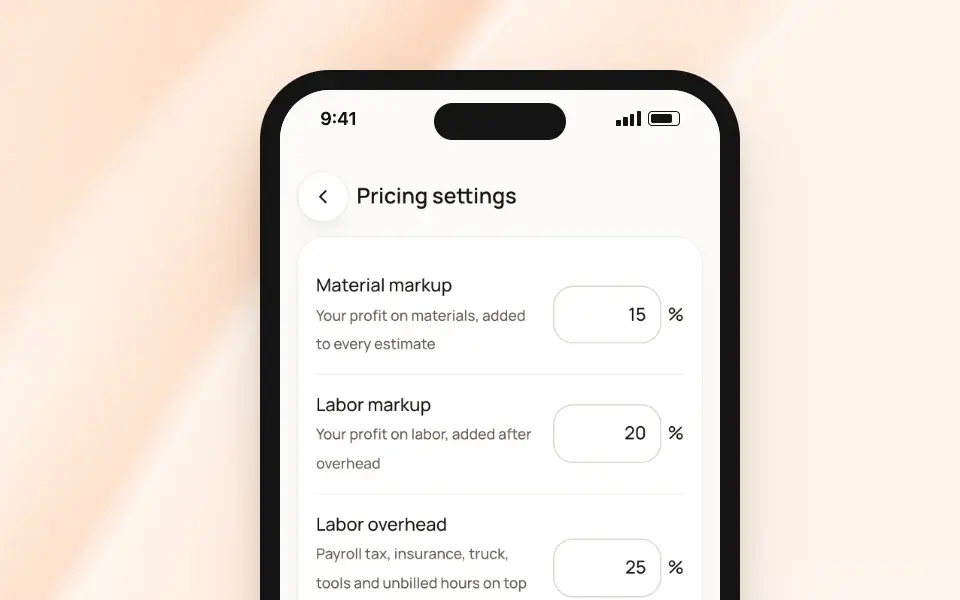
BuildWell builds each hour's price in three steps:

  1. Wage: a local wage from Bureau of Labor Statistics data. BuildWell's wage data covers construction trades, so HVAC lines start from a construction wage, not an HVAC technician wage.
  2. Overhead: your labor overhead, which starts at 100% and doubles the wage.
  3. Markup: your labor markup, which starts at 20%.

What a changeout's labor comes to

Example: Say a technician costs you $30 an hour in wages. Use your real number. Say a straight condenser and coil changeout takes two technicians a full day, 16 hours:

  • Wages: 16 × $30 = $480
  • With 100% overhead: $960
  • With 20% markup: $1,152 for labor

Equipment, parts, permit and disposal come on top.

Price equipment at cost, then mark up

Price equipment at your distributor cost, and parts at what they cost near the job this week. Then add a markup that covers the pickup, the warranty paperwork and the parts that come back.

Material markup starts at 20% in BuildWell; change it on any estimate.

Quote this week's refrigerant prices

Refrigerant and equipment prices have moved as the industry shifts to lower-GWP refrigerants under EPA rules. Price what you can actually buy this week, not what you paid last season.

Put the permit on its own line

Many jurisdictions require a permit to replace HVAC equipment. Add your permit fee as a line. In BuildWell, a flat permit fee is added automatically when the estimate includes permits.

The guide to pricing HVAC jobs prices service calls, tune-ups and a condenser and coil changeout from your own hours.
How to start an HVAC business

Get certified and licensed first

HVAC is one of the more regulated trades:

  • EPA Section 608 certification is required to work on equipment that contains refrigerant, and to buy most refrigerants.
  • Many states license HVAC or mechanical contractors, with experience requirements and an exam. Others leave it to cities and counties.
  • Electrical work on the install may need its own license where you work.

Check with your state's contractor licensing board and the cities where you'll work before your first job.

Form the business and separate the money

Start as a sole proprietor or a single-member LLC. Get a free EIN from the IRS, open a business bank account, and run every deposit and distributor payment through it.

Insure before the first call

  • General liability: a water leak from a drain line or a scratched floor is your problem. Builders will ask for a certificate.
  • Workers' compensation: most states require it once you hire.
  • Commercial auto for the vans and trucks.

Open distributor accounts early

Equipment, parts and refrigerant usually come from HVAC distributors. Open accounts before your first replacement, and know their lead times so your start dates are real.

Decide your service model

Repair calls, maintenance agreements and replacements need different things:

  • Repairs: a fast response.
  • Maintenance: a reminder system for tune-ups.
  • Replacements: a clear quote.

BuildWell handles the quote, the signature and the invoice. Track maintenance visits in your own calendar.

Look professional from the first quote

An itemized quote with your logo, license number and terms beats a number written on the back of a business card. In BuildWell, add your logo, license number and signature once, and every estimate and invoice carries them.

Get your first clients from four places

Early HVAC work tends to come from:

  • Referrals from family, neighbors and past clients.
  • Builders, remodelers and property managers who need an HVAC contractor.
  • Seasonal demand in the first heat wave and the first cold snap.
  • Local search. Set up your free business profile on the map apps homeowners use, and ask every client for a review.

The guide to starting an HVAC business walks through each step in more detail, from planning and insurance to first clients and cash flow.

HVAC contractor pay and taxes

Pay depends on your mix of work

What HVAC contractors earn depends on the mix of work. Pay varies between metro areas, with experience and with certifications. Many HVAC businesses are busiest in the hottest and coldest months.

Owners earn the margin between what they charge and what the work costs. That's why your labor rate and your equipment markup matter more than any wage table.

Self-employment tax is 15.3% of net earnings

As a sole proprietor or single-member LLC, you pay self-employment tax on your net earnings: 15.3% in total.

  • Social Security, 12.4%: applies to net earnings up to the Social Security wage base, which is $184,500 for 2026.
  • Medicare, 2.9%: applies to all of it.
  • Deduction: you can deduct half of the self-employment tax on your income tax return.

That's on top of federal and state income tax. Set aside part of every payment.

Pay quarterly estimated taxes

No one withholds tax from what homeowners pay you, so the IRS expects payments during the year on Form 1040-ES. They're usually due in mid-April, mid-June, mid-September and mid-January.

Track these deductions

HVAC businesses commonly deduct:

  • tools, gauges and recovery equipment
  • the business share of vans and trucks
  • fuel
  • insurance, license and certification fees
  • training
  • phone and software

Keep receipts and log mileage as you go.

Send a 1099-NEC to subcontractors you pay

If you pay an unincorporated subcontractor for services, you'll generally need to send them a Form 1099-NEC. For payments made in 2026 and later, that applies once you've paid them $2,000 or more in a year, up from $600 before 2026.

Collect a Form W-9 before you pay anyone.

Sales tax on equipment depends on your state

States treat HVAC work differently. Some have you pay sales tax when you buy equipment and parts; others have you charge it to the homeowner, and some tax repair labor too.

Check your state's revenue department. In BuildWell, sales tax applies to materials only, not labor, at the rate you set.

This is general information, not tax or legal advice. A tax professional who works with contractors can tell you what applies to your state and business.

Estimates in minutes
talk through the job, get every line priced
Real local prices
materials and labor priced for your ZIP code
Get paid faster
professional invoices clients pay by card or bank
English or Spanish
on your phone and your computer

Pricing for HVAC businesses

One plan with everything, billed weekly or yearly.

Weekly
$7.99 / week
Billed weekly. Cancel anytime.
  • AI estimates priced for your area
  • Estimates, invoices, clients and projects
  • Clients sign on any phone
  • Card and bank payments, no extra BuildWell fee
  • iPhone, Android and the web
Start free trial
Best value
Annual
$79.99 / year
About $6.67 a month, billed yearly
  • AI estimates priced for your area
  • Estimates, invoices, clients and projects
  • Clients sign on any phone
  • Card and bank payments, no extra BuildWell fee
  • iPhone, Android and the web
Start free trial

Both plans include every feature and start with a 3-day free trial. Add a card to start; you’re not charged until the trial ends. Cancel anytime.

HVAC software FAQ

01Can BuildWell estimate a full system replacement?
Yes. Describe the existing system, what's coming out, what's going in and what's being reused, and BuildWell lists removal, equipment, coil, line set, electrical, drain, thermostat and startup as separate lines. You can change every quantity, hour and price before you send it.
02Where do the labor hours come from?
BuildWell has no built-in lines for HVAC work, so the AI writes those lines and estimates their hours from what you describe. Treat them as a draft. You know how long a changeout takes your crew; set those hours on the line.
03What wage does BuildWell use for HVAC labor?
BuildWell's wage data comes from the Bureau of Labor Statistics and covers construction trades. It doesn't include an HVAC technician wage, so HVAC lines start from a local construction wage, then your overhead and markup. Put your own rate on any line; your change stays on that estimate.
04How do I price equipment I buy from a distributor?
Condensers, furnaces, air handlers and coils usually don't have a store price near the job. BuildWell flags those lines, and you enter your cost. It remembers the price for later estimates, and your material markup goes on top.
05Can I use flat-rate pricing?
Yes. Put your flat-rate price on the line, or write a custom line for the repair at your price. BuildWell doesn't import a flat-rate price book, so you set each price on the estimate.
06Can I show good, better and best options?
BuildWell doesn't put options side by side on one estimate. Make a separate estimate for each system option, and the homeowner signs the one they choose.
07Does BuildWell manage maintenance agreements?
No. BuildWell doesn't schedule tune-ups or bill memberships automatically. For each maintenance visit, start an invoice from scratch or duplicate the last one and change what's different. BuildWell reminds you when an invoice is due and when it's overdue.
08Can I offer financing?
BuildWell doesn't offer consumer financing. Clients pay from the invoice link by card or US bank transfer if you've connected Stripe, or by the Zelle, Venmo, Cash App, PayPal or check details you list.
09Can I send estimates in Spanish?
Yes. Any estimate or invoice can be printed in English or Spanish, and the app works in both languages.
10How much does it cost?
BuildWell costs $7.99 a week or $79.99 a year, with a 3-day free trial. One subscription works on iPhone, Android and the web.

Price your next HVAC job today

Estimates, invoices, e-signatures and payments in one place, on your phone and on the web.

Start for free →3-day free trial. Cancel anytime.