 BuildWell
How to start an HVAC business
Start an HVAC business step by step, from EPA certification, licensing and insurance to tools, pricing, first customers, estimates, invoices and cash flow.
Starting a trade business · 10 min read · Updated
The steps, in order
- 1
Plan the work and the market
Decide between service and repair, replacements, new construction or commercial work, and set a service area.
- 2
Get certified and licensed
Hold EPA Section 608 certification for refrigerant work, and confirm with your state's licensing board what license you need to contract.
- 3
Set up the business and insurance
Form the business, get an EIN and a business bank account, and put liability, workers' comp, auto and any required bond in place.
- 4
Equip the van and open distributor accounts
Buy gauges, a recovery machine, a vacuum pump and hand tools, and open accounts with equipment distributors.
- 5
Work out your prices
Build a labor rate, then set your diagnostic fee, repair prices and how you price replacements.
- 6
Find your first customers
Start with referrals, builders, property managers and seasonal demand, with a complete local business profile.
- 7
Estimate, invoice and protect cash flow
Take a deposit before ordering equipment, collect at completion on service calls, and keep a reserve for slow seasons.
An HVAC business sells comfort when it matters most: the first heat wave, the first cold night. That makes the work seasonal, urgent and expensive for the homeowner, and it makes the business side as important as the technical one. These decide whether a good technician becomes a lasting company:
- Certification and licensing
- Insurance
- Distributor accounts
- Pricing
- Cash flow
This guide walks through those steps in the order you will need them. It stays general on purpose, because licensing and insurance rules depend on your state and city, so treat each step as a set of questions to answer where you work.
The general guide to starting a contracting business covers the parts every trade shares in more depth.
Plan the work and the market
HVAC businesses usually lead with one kind of work.
Five kinds of HVAC work
- Service and repair: diagnostic calls and repairs, paid on completion, built on response time.
- Replacements: system changeouts, large tickets sold on trust and a clear quote.
- Maintenance: tune-ups and plans that bring customers back every year.
- New construction: installs for builders, priced tight and paid on the builder's schedule.
- Commercial: rooftop units, refrigeration and controls, with different equipment and terms.
Set an area you can reach fast
Set a service area you can reach quickly. A homeowner without heat or cooling calls whoever can come soonest.
Write a short plan with real quotes
Write a short plan: the work, the area, the customers, the startup costs and how you will find the first jobs. List startup costs one by one with real quotes:
- Certification and licensing
- Insurance
- The van and its shelving
- Gauges and recovery equipment
- Tools
- Opening parts stock
- A phone and software
- A cash reserve for the slow season
Certification and licensing
EPA Section 608 for anyone handling refrigerant
EPA Section 608 certification is required to work on equipment that contains refrigerant, and to buy most refrigerants. Make sure you and every technician who handles refrigerant hold the certification type that matches the equipment you service.
Licensing to contract varies by state
Many states license HVAC or mechanical contractors, often with experience requirements and an exam; others leave it to cities and counties.
Electrical work on an install, such as a new circuit or disconnect, may need its own license where you work.
Three questions to answer before you advertise
- Ask your state's licensing board what license you need to do the work and to own the business.
- Ask the building departments where you will work about local licenses and permit rules for equipment replacements.
- Ask whether a bond is required for your license.
Set up the business
- Choose a structure. A sole proprietorship is simple; an LLC can separate business debts from personal assets. An accountant can tell you which fits.
- Get an EIN from the IRS. It is free, and you give it to builders and property managers on a W-9.
- Open a business bank account and run every payment and distributor bill through it.
- Set up bookkeeping from day one, with income and costs recorded by job.
Insurance and bonds
Five kinds of coverage to price
- General liability: covers damage and injuries your work causes, such as a leaking drain line or a damaged ceiling. Builders will ask for a certificate.
- Workers' compensation: most states require it once you have employees.
- Commercial auto: for the vans. A personal policy may not cover business use.
- Tools and equipment coverage: gauges and recovery machines are expensive to replace.
- Bonds: a license bond where your state or city requires one.
Tell the agent exactly what you do
Get quotes from an agent who insures HVAC contractors, and describe exactly what you do. Each of these can change the coverage:
- Commercial refrigeration
- Rooftop work
- Gas piping
Equip the van and open distributor accounts
Tools, testers and stock for the van
- Refrigerant tools: gauges or a digital manifold, a recovery machine and cylinders, a vacuum pump and micron gauge, and a leak detector.
- Electrical testing: a multimeter with capacitance and temperature, and a clamp meter.
- Combustion and airflow: a combustion analyzer for furnace work and the instruments you use to check airflow.
- Hand and power tools: flaring and swaging tools, tubing cutters, a brazing kit, cordless drills and a reciprocating saw.
- Moving equipment: a dolly or hand truck, and straps for condensers.
- Stock: the capacitors, contactors, filters, fittings and parts you use most, kept lean.
Open distributor accounts before the first replacement
Open accounts with HVAC distributors before your first replacement. Ask about credit terms, warranty registration and lead times, so your install dates are real.
Price your work before your first call
Five pricing steps before your first call
- Add up your overhead: vans, fuel, insurance, licenses, certification, training, tools, phone, software and marketing.
- Work out your labor rate: wages, payroll taxes, workers' comp and overhead, spread over the hours you will actually bill. HVAC has many unbilled hours, including driving, training and warranty work. The labor rate guide and the labor rate calculator walk through it.
- Set a diagnostic fee for every service call, and a written rule for whether it is credited toward the repair.
- Decide how you price repairs, flat rate or time and materials, from your own hours and parts costs.
- Know your break-even month by month, since HVAC is seasonal. The break-even calculator does the math.
Price calls and changeouts line by line
The HVAC pricing guide works through service calls, tune-ups and a full changeout line by line.
Maintenance plans and the seasons
HVAC demand follows the weather. Calls pile up in the hottest and coldest weeks and slow in between.
Tune-ups level out the slow weeks
Maintenance work is how many HVAC businesses level that out: cooling tune-ups in spring, heating tune-ups in fall, booked in the quiet weeks before the rush.
Decide four things before selling a plan
If you sell a yearly plan, decide before you sell the first one:
- What it includes: visits per year, what each visit covers, and any repair discount or priority service.
- How it is paid: up front for the year, or per visit.
- How you will remind and book members, with a calendar or a system you will actually keep up.
- What happens on cancellation, in writing.
Price it from real tune-up time
Price the plan from your real tune-up time, the drive and the discount you promise, then overhead and profit.
A plan that is sold but never serviced is a refund and a bad review, so start small and service every member on time.
Safety on the job
HVAC work mixes refrigerant, electricity, gas, brazing torches, ladders, roofs and hot attics.
Write a short safety policy
Write a short safety policy for your shop that covers:
- How circuits are de-energized and locked out
- How refrigerant is recovered and stored
- How gas work is checked for leaks
- How technicians stay safe in attics and on roofs
Train every technician on it, keep a record, and buy the protective equipment the work calls for.
Get your first customers
- Referrals: everyone you have worked with or for. Ask every happy customer to pass your name along.
- Builders, remodelers and property managers who need a reliable HVAC contractor.
- Seasonal demand: the first heat wave and the first cold snap bring calls. Be reachable, and give a clear diagnostic fee on the phone.
- Tune-up reminders: a customer you serviced last year is your best lead this year.
- Local search: a complete free business profile on the map apps homeowners use, with your service area and license number, and a request for an honest review after every job.
Track where each lead came from
Keep track of where each lead came from, and put your time where the good work comes from.
Estimating and invoicing
One number for "new AC" is hard to trust and easy to undercut.
List every part of a replacement
A replacement quote should list every part of the job:
- Removal
- Equipment
- Line set
- Electrical
- Drain
- Controls
- Permit
- Startup
Have three documents ready
- An itemized estimate with equipment models, the warranty terms and exclusions. The estimate guide covers what goes in it, and the estimate template for Excel gives you a layout.
- One estimate per option when you offer more than one system, so the homeowner compares complete jobs.
- An invoice sent the day the system is started and tested. The free invoice generator will do for the first jobs.
Cash flow
Seven habits for a seasonal trade
- Collect at completion on service calls.
- Take a deposit before ordering equipment on replacements. The progress billing guide covers deposits and staged payments.
- Pay distributors on time to keep credit terms.
- Put an expiration date on every replacement quote. Equipment and refrigerant prices change, and a quote accepted months later should be repriced.
- Watch builder terms, which often pay at stages and later than homeowners.
- Build a reserve during peak months for the shoulder seasons, when calls slow but the van payment does not.
- Set aside tax money from every payment. The self-employment tax calculator shows how much to plan for.
Hiring technicians
Check certification and licenses first
When you add technicians, check that each holds the right EPA certification and any license your state requires for the work they will do.
Employees and subs bring different paperwork
- Employees bring payroll taxes and workers' comp.
- Subcontractors need a W-9, a certificate of insurance and a written scope.
Whether someone is an employee or a contractor depends on how you direct the work, so ask an accountant before you pay anyone.
Warranties and callbacks
Set your labor warranty and register equipment
Decide your labor warranty before your first install, and keep it separate from the manufacturer's equipment warranty. Register equipment warranties as soon as the job is done.
Record readings so callbacks start with facts
Every callback is an unbilled trip, so your overhead has to carry them. Record the model and serial numbers, refrigerant charge and test readings on every job, so the next visit starts with the facts.
HVAC work by the numbers
According to the Bureau of Labor Statistics' Occupational Outlook Handbook (Heating, Air Conditioning, and Refrigeration Mechanics and Installers, last modified August 27, 2026), the median annual wage for HVAC mechanics and installers was $61,010 in May 2025, and employment in the occupation is projected to grow 11% from 2025 to 2035.
Wage figures describe workers, not owners
Those figures describe technicians who work for wages, not business owners. They are a useful reference for what you may pay a technician and for the pay part of your labor rate.
What an owner earns is the margin between what the business charges and what the work costs.
Starting with BuildWell
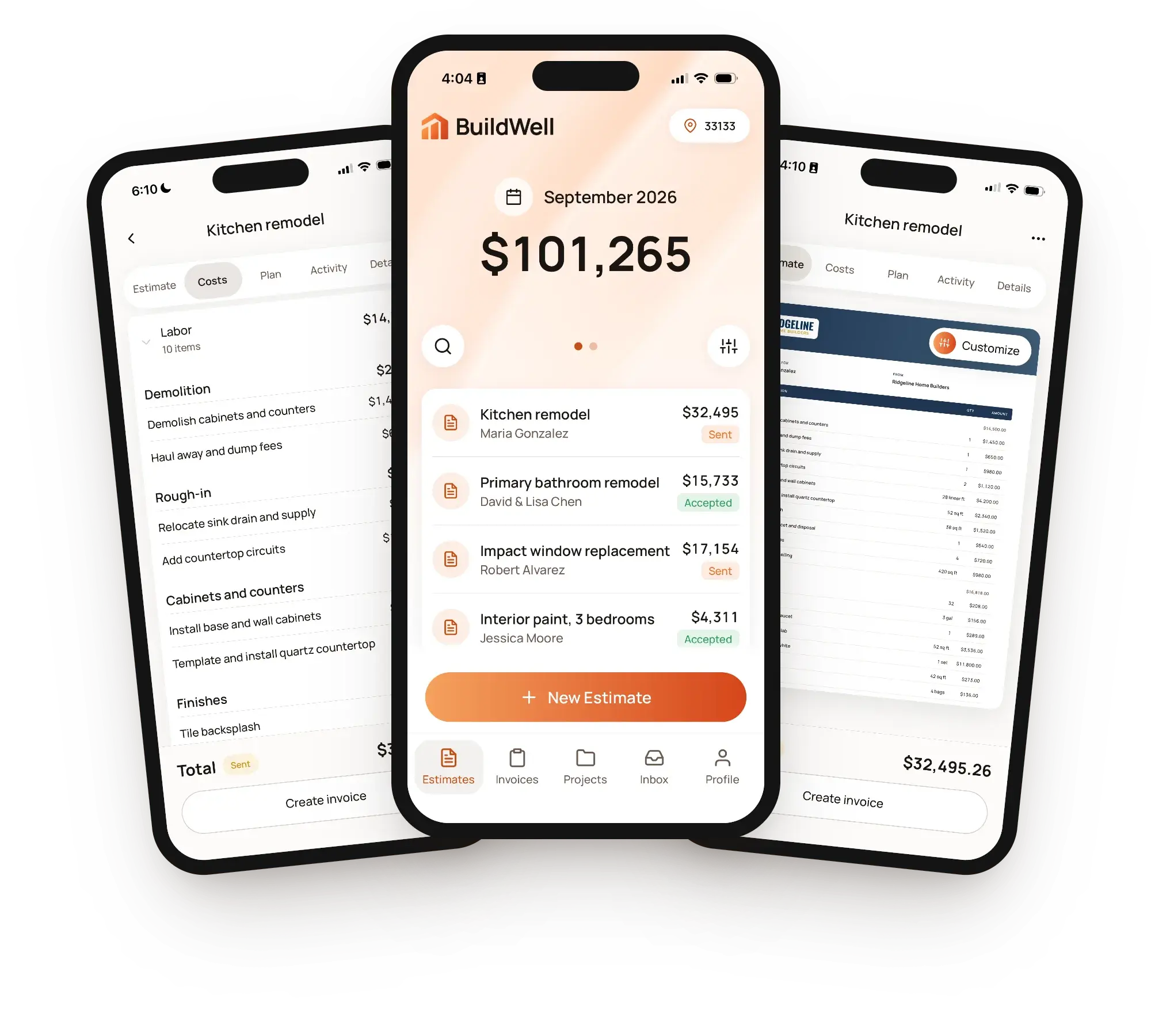
BuildWell handles the estimate-to-payment paperwork from your phone. Describe the job by voice, text or photos, and it writes an itemized estimate with parts priced at stores near the job, checked within the last 30 days.
Enter your own equipment cost and hours
Distributor equipment without a store price is flagged so you enter your cost. HVAC isn't in BuildWell's catalog, so the AI drafts the hours; set your own on each line.
Labor starts from a local Bureau of Labor Statistics construction wage plus the overhead and markup you set. Add your logo, license number and terms once.
The signed estimate becomes the invoice
The homeowner signs on their phone, and the signed estimate becomes the invoice, with a deposit before you order equipment.
BuildWell doesn't schedule tune-ups or manage maintenance agreements, so invoice each visit when you do it. The HVAC industry page shows how it works for HVAC contractors.
An HVAC startup checklist
- Work, service area and customers chosen
- EPA Section 608 certification for everyone who handles refrigerant
- Licensing confirmed with your state's licensing board and local building departments
- Business entity, EIN, bank account and bookkeeping
- General liability, workers' comp, commercial auto and any required bond
- Refrigerant tools, testers and lean parts stock
- Distributor accounts with known lead times
- Labor rate, diagnostic fee and repair pricing worked out
- A deposit policy and a reserve for slow seasons
Free tools for this guide
Generators, templates, calculators and definitions. No sign-up.
Common questions
01What certification do I need to start an HVAC business?
02Do I need a license to run an HVAC business?
03Should a new HVAC company sell maintenance plans?
04How do I handle slow seasons?
05Do I need accounts with distributors?
Estimates, signatures and invoices in one app
BuildWell prices materials at stores near the job and labor from your metro’s wages plus your overhead and markup, gets the estimate signed on the client’s phone, and turns it into the invoice.
- AI estimates priced for your area
- Estimates, invoices, clients and projects
- Clients sign on any phone
- Card and bank payments, no extra BuildWell fee
- iPhone, Android and the web
- AI estimates priced for your area
- Estimates, invoices, clients and projects
- Clients sign on any phone
- Card and bank payments, no extra BuildWell fee
- iPhone, Android and the web
Both plans include every feature and start with a 3-day free trial. Add a card to start; you’re not charged until the trial ends. Cancel anytime.
Try BuildWell today
Estimates, invoices, e-signatures and payments in one place, on your phone and on the web.