


BuildWell

Carpentry estimating software that wins more jobs

Estimating and invoicing software for carpenters. Describe the trim job and get base, casing and crown priced.

  • Store prices near the job
  • Wages for your metro
  • iPhone, Android and web
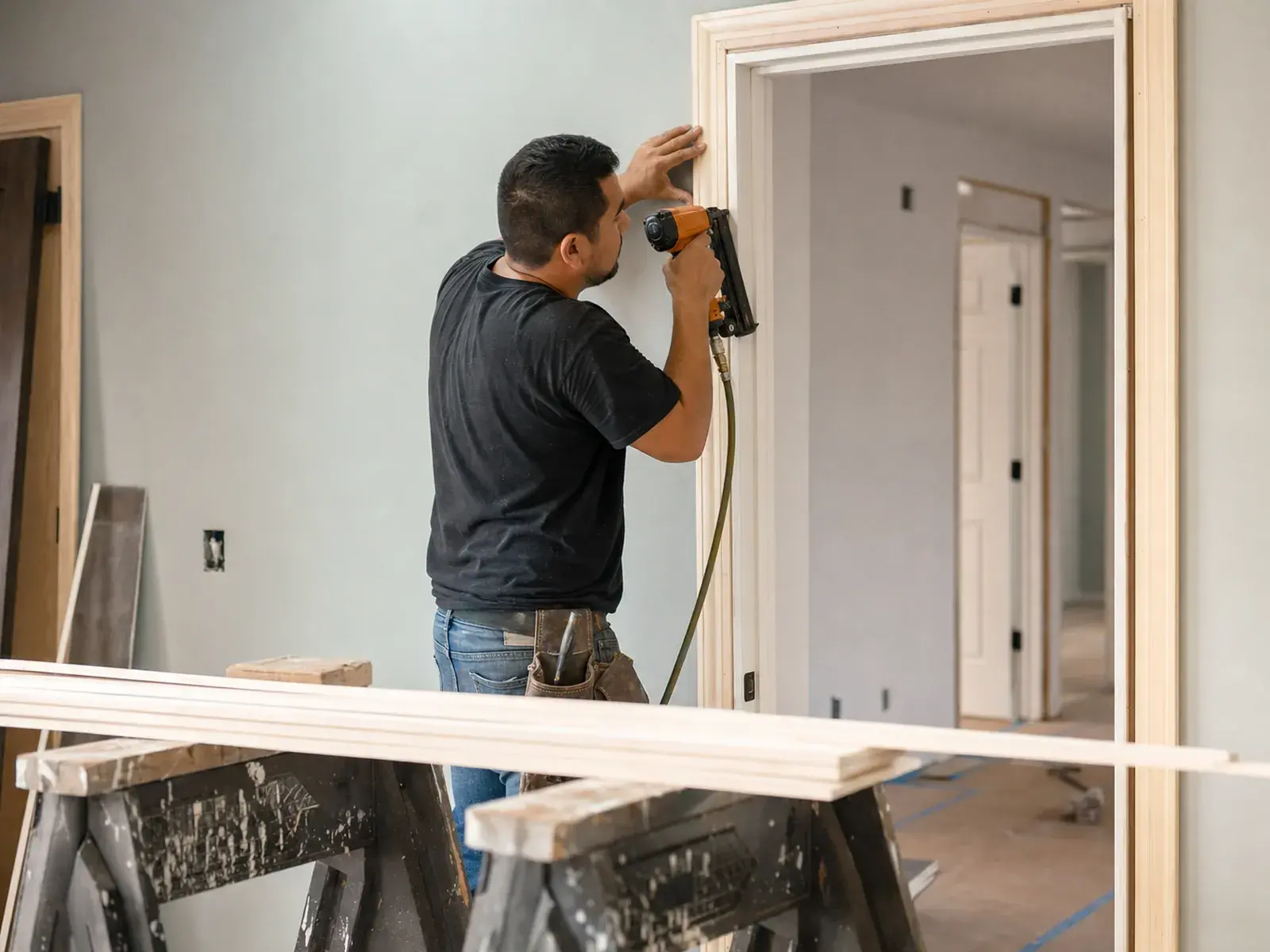
A carpenter fitting new interior door casing with a trim nailer

Run every carpentry job start to finish

Estimate on site, get it signed before you leave, invoice when the work’s done and see the payment land.

BuildWell on a laptop showing a branded invoice and its payments, the estimates home screen on one phone and an invoice in a different style on another

What is carpentry estimating software?

Carpentry estimating software turns measurements and a description of the work into a priced estimate. For trim and finish carpenters, that means a takeoff:

  • how many feet of each profile
  • how many openings
  • how many doors
  • what each costs to buy and to install

Finish carpentry is priced three ways at once

Finish carpentry is priced in three units at once:

  • By the linear foot: baseboard, shoe, crown, chair rail, handrail and skirt board.
  • By the opening or the piece: door casing, window casing with stool and apron, cased openings, prehung doors, stair treads and mantels.
  • By the square foot: wainscot, beadboard and shiplap walls.

A whole-house trim job mixes all three, and each has its own waste and its own speed. A running foot of crown takes much longer than a foot of baseboard. An inside corner takes longer than a straight run.

Flat rates hide costs; full takeoffs eat evenings

Most carpenters price trim one of two ways:

  • A rate per foot or per opening carried from job to job. It's quick, but it hides the difference between paint-grade MDF and stain-grade oak, and between a square room and a hallway full of corners.
  • A full takeoff for every bid. It's right, but it eats an evening per job.

BuildWell builds the takeoff from your description

BuildWell builds the takeoff from what you describe. Each part of the job is its own line:

  • tear-out
  • base and shoe
  • crown
  • casings and doors
  • fill and caulk

Each has its own labor hours and its material priced at a store near the job. You review the feet and the counts, change anything you know better, and send it.

The signed estimate becomes the invoice

When the last piece of shoe is down, the signed estimate becomes the invoice. If the client added a closet or two more windows halfway through, you bill the revision they signed.

New painted built-in bookshelves and trim in a living room

Why carpenters choose BuildWell

Your takeoff is done before you leave

Talk through the rooms, doors and windows. BuildWell lays out every line.

It asks what changes a trim price

Paint or stain grade? Old trim coming off? Prehung doors or slabs?

The client sees why crown costs more

Base, shoe, crown, casing and caulk each show as their own line.

Moulding is priced at stores near the job

Anything without a store price is marked for you to set.

Each line is priced at the right wage

Carpenter wage to install, helper wage for tear-out, painter wage to paint.

Clients see the room before they pay

Attach a before-and-after render of the wainscot or shiplap to the estimate.

Estimates in English or Spanish

Send each client their estimate and invoice in their language.

Same account on phone and computer

Start on site and finish at your desk. Nothing to sync.

Built for carpenters

What changes when carpenters price jobs from real data instead of memory.

  • A trim takeoff from a descriptionDescribe the rooms and openings. BuildWell lists the trim, materials and hours.
  • Moulding and doors at local pricesBase, casing, crown and doors priced at a store near the job.
  • Carpenter hours at your metro's wageInstall at carpenter wage, tear-out at helper wage, painting at painter wage.
  • Show the room, then price itAttach a before-and-after render, and the client signs on their phone.
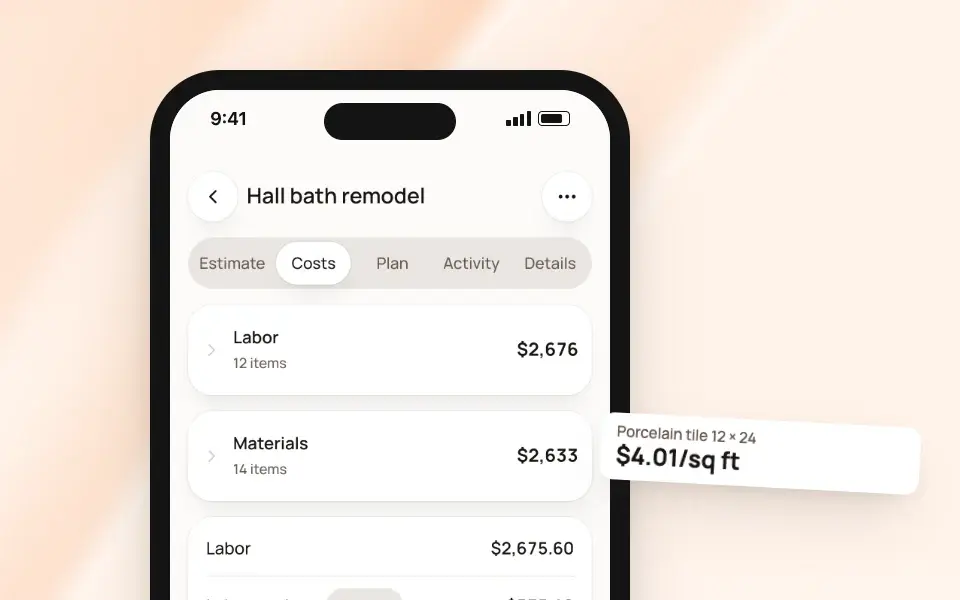
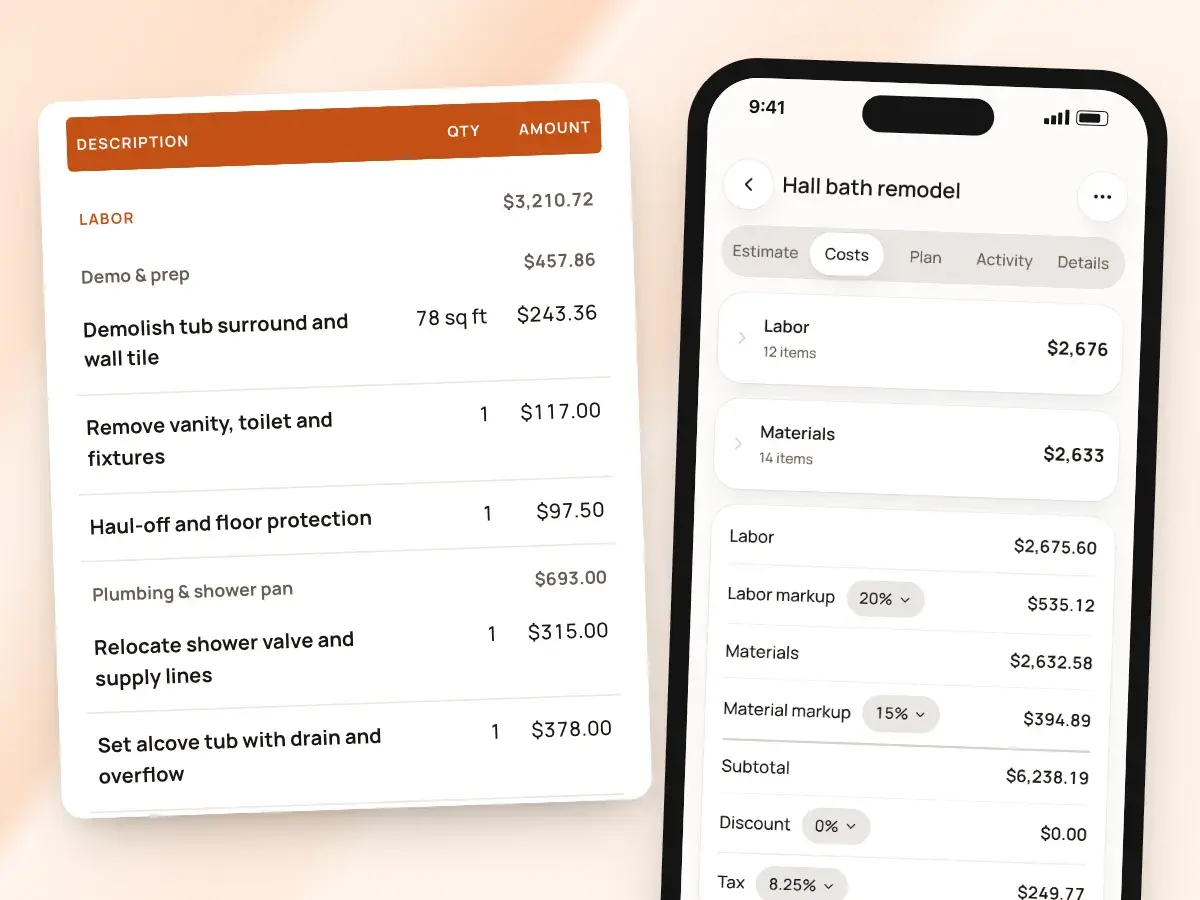
An estimate’s costs on a phone beside its priced lines, grouped by job step

How to price carpentry jobs

A trim price is built from five pieces:

  1. Tear-out and prep: removing the old base and casing, and protecting the floors.
  2. Running trim: base, shoe, crown and chair rail, priced by the foot.
  3. Openings and pieces: doors, casings, windows, mantels and stair parts, priced by the piece.
  4. Wall treatments: wainscot, beadboard and shiplap, priced by the square foot.
  5. Finish: filling, caulking and paint, if it's in your scope.

Measure the run, then add waste

Measure each room's perimeter:

  • Base and shoe: take out the door openings.
  • Crown: take the full perimeter.

Then add waste for cuts, copes and short pieces. A room with many corners wastes more than a long hallway. Enter the feet after waste, so what you price is what you buy.

Common line items and how each is measured

These are the common lines on a trim carpentry estimate. Each is measured one of three ways:

  • By the linear foot: running trim and handrail.
  • By the square foot: wall treatments.
  • By the each: doors, casing sets, stair treads and built-ins.

The hours and prices are yours to set. You know your own pace, and every line's hours are editable.

Line itemMeasured in
Remove existing baseboard and shoe moldingLinear feet
Install primed mdf baseboardLinear feet
Install shoe molding at baseboardLinear feet
Install primed crown moldingLinear feet
Install chair rail moldingLinear feet
Install beadboard wainscot panelingSquare feet
Install shiplap accent wall boardsSquare feet
Install prehung interior door unitEach
Install interior door casing setEach
Install window casing with stool and apronEach
Install cased opening jamb and trimEach
Build melamine closet shelving unitEach
Install oak stair tread and riserEach
Install wood handrail with wall bracketsLinear feet
Install fireplace mantel shelfEach
Fill nail holes and caulk trim jointsLinear feet
Each one its own line on the estimate. The hours and prices are yours to set.

Crown eats a third of a room's hours

Example: Here's a 12 by 14 foot living room with about 50 feet of base after the door opening, 52 feet of crown, two windows and one door to case. The hours below are example figures; say your own records show you need:

Work Your hours
Remove old base and shoe, 50 feet 2.5
New MDF baseboard, 50 feet 4
Shoe molding, 50 feet 2
Crown, 52 feet 7
Window casing with stool and apron, 2 4
Door casing, 1 set 1.5
Total 21

Crown is a third of the room's hours on its own.

That's why a single per-foot trim rate loses money in rooms with crown.

Your labor rate is more than the wage

What you pay a carpenter isn't your labor rate. Your rate has to cover:

  • the wage
  • payroll taxes plus your workers' comp and liability premiums
  • the miter saw, the compressor, the nailers and the truck
  • the unpaid hours: measuring, bidding, picking up material and coming back for the punch list

Then it needs a profit.

How BuildWell sets each line's rate

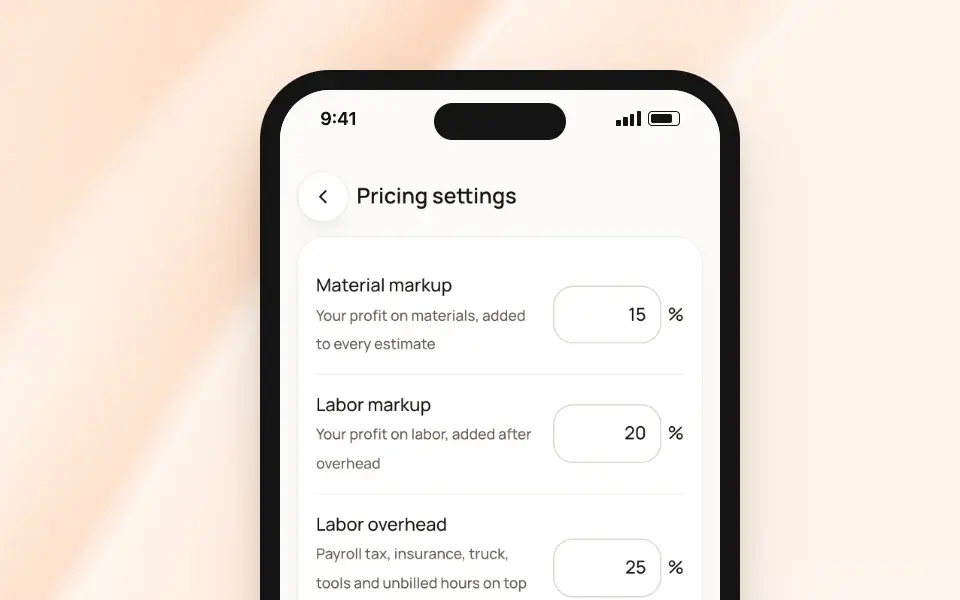
In BuildWell, every line's hourly rate comes from three numbers:

  1. Wage: the metro median for that line's trade: carpenter, carpenter helper or painter.
  2. Overhead: your labor overhead, set at 100% to begin with, so the wage doubles.
  3. Markup: your labor markup, set at 20% to begin with.

Example: Say your carpenter costs you $30 an hour. Use your real number. The 21 hours in that living room work out like this:

  • Wages: 21 × $30 = $630
  • With 100% overhead: $1,260
  • With 20% markup: $1,512 for labor

In BuildWell, the tear-out line starts from the carpenter helper wage instead, so your real number will differ a little. Painting the new trim comes on top.

Paint grade and stain grade are different jobs

Paint-grade and stain-grade trim go up at different speeds:

  • Paint grade: MDF and finger-jointed pine go up fast, take caulk and get painted.
  • Stain grade: oak or poplar needs tighter joints, more time per cut and no filler showing.

Price the material at what it costs near the job this week. If you're installing stain-grade, raise the hours to match.

BuildWell asks about material quality, starts material markup at 20%, and lets you change it per estimate.

List client-bought doors without charging

When the client buys the doors or the mantel, mark them client-supplied. They're listed so the scope is clear, but they aren't charged.

Plan for lead, crooked walls and rot

  • Homes built before 1978: pulling old base and casing disturbs paint. The EPA's Renovation, Repair and Painting rule requires lead-safe work practices by a certified renovator. Price the setup and cleanup as their own line; in BuildWell, ticking a pre-1978 home adds it.
  • Out-of-square walls and floors: old houses mean scribing, shimming and more caulk. Add time, or say in your terms how you'll handle it.
  • Rot: a window stool or a door jamb can hide water damage. State what's included and how you'll price a repair.

How to start a carpentry business

Check what your state requires

Licensing for carpenters varies:

  • Many states require a contractor or home improvement license or registration for residential work, often above a dollar amount per job.
  • Some states leave it to cities and counties.
  • A few license specialty contractors separately.

Check your state's licensing board and the cities you'll work in before you sign your first contract.

Get lead-safe certified for older homes

Trim work in a house built before 1978 almost always disturbs paint. The EPA requires your firm to be certified and the work done by a certified renovator.

Form the business and keep money separate

Most carpenters start as a sole proprietor or a single-member LLC. Get a free EIN from the IRS, open a business bank account, and pay for every board and box of nails from it.

Insure before you start

  • General liability: builders, designers and homeowners will ask for a certificate of insurance.
  • Workers' compensation: required in most states as soon as you hire.
  • Commercial auto: for the truck and the trailer of saws.

Pick builder work, homeowner work, or both

Finish carpenters often work for builders and remodelers at a per-foot or per-opening rate, and for homeowners on a full estimate:

  • Builder work is steady but tightly priced.
  • Homeowner work pays better per hour but takes more selling.

Know your numbers for both before you take either.

Photograph every finished room

Trim is visual. Photograph every finished room: the coped corners, the mitered returns, the stool and apron.

A portfolio does more selling for finish work than anything you can say.

Look professional from the first estimate

An itemized estimate with your logo, license number and terms tells the client you'll be just as careful with their casing. BuildWell puts them on every estimate and invoice once you've added them.

Where your first jobs come from

Early carpentry work tends to come from:

  • Builders and remodelers who need a reliable trim carpenter.
  • Interior designers with clients who want wainscot, built-ins and accent walls.
  • Referrals from finished rooms.
  • Local search. Claim your free listing on the map apps, add photos of finished rooms, and ask for reviews.

Carpenter pay and taxes

Pay depends on your market and your counts

What carpenters earn depends on the market and the work. Wages vary between metro areas and between rough and finish carpenters. Owners earn the margin between what they charge and what the work costs.

For trim carpenters that margin lives in how accurately you count feet and openings. It also lives in how well you price crown, stairs and stain-grade work.

Self-employment tax is 15.3%

As a sole proprietor or single-member LLC, you pay self-employment tax on your net earnings: 15.3% in total.

  • Social Security, 12.4%: applies to net earnings up to the Social Security wage base, which is $184,500 for 2026.
  • Medicare, 2.9%: applies to all of it.
  • Deduction: you can deduct half of the self-employment tax on your income tax return.

You'll owe federal and state income tax as well, so hold back part of every payment you receive.

Pay estimated taxes every quarter

Nobody withholds tax from what clients pay you, so the IRS expects payments during the year on Form 1040-ES. They're usually due in mid-April, mid-June, mid-September and mid-January.

Track these deductions as you go

Carpentry businesses commonly deduct:

  • saws, nailers, compressors and hand tools
  • blades, bits and consumables
  • the business share of your truck
  • fuel
  • insurance and license fees
  • lead-safe training and certification
  • phone and software

Keep receipts and log mileage as you go.

Send a 1099-NEC to subs you pay

If you pay an unincorporated subcontractor for services, you'll generally need to send them a Form 1099-NEC. For payments made in 2026 and later, that applies once you've paid them $2,000 or more in a year, up from $600 before 2026.

Get a Form W-9 before the first payment, whether it's a helper or a painter you sub to.

Sales tax on materials depends on your state

States treat carpentry contractors differently:

  • Some have you pay sales tax when you buy materials.
  • Others have you charge it to the client, on materials or on the whole job.

Check your state's revenue department. In BuildWell, sales tax applies to materials only, not labor, at the rate you set.

This is general information, not tax or legal advice. A tax professional who works with contractors can tell you what applies to your state and business.

Estimates in minutes
talk through the job, get every line priced
Real local prices
materials and labor priced for your ZIP code
Get paid faster
professional invoices clients pay by card or bank
English or Spanish
on your phone and your computer

Pricing for carpentry businesses

One plan with everything, billed weekly or yearly.

Weekly
$7.99 / week
Billed weekly. Cancel anytime.
  • AI estimates priced for your area
  • Estimates, invoices, clients and projects
  • Clients sign on any phone
  • Card and bank payments, no extra BuildWell fee
  • iPhone, Android and the web
Start free trial
Best value
Annual
$79.99 / year
About $6.67 a month, billed yearly
  • AI estimates priced for your area
  • Estimates, invoices, clients and projects
  • Clients sign on any phone
  • Card and bank payments, no extra BuildWell fee
  • iPhone, Android and the web
Start free trial

Both plans include every feature and start with a 3-day free trial. Add a card to start; you’re not charged until the trial ends. Cancel anytime.

Carpentry software FAQ

01Can BuildWell price trim by the linear foot?
Yes. Baseboard, shoe, crown, chair rail, handrail and skirt board are linear-foot lines, so you enter the feet you measured, after your waste, and BuildWell prices the material and the hours from that. Doors, casings, windows and mantels are priced per piece.
02How do I measure a room for base and crown in BuildWell?
Measure the perimeter, take out door openings for the base, and add your waste for cuts and short lengths before you enter the quantity. On iPhone Pro models with LiDAR you can scan the room for its measurements, and you can always type them in by hand.
03Does it price casing per door or per foot?
Per opening. A casing set for an interior door, a window casing with stool and apron, and a cased opening are each one line, with the material and hours for the whole opening. That's how most finish carpenters think about it on the job, too.
04Can I price painting the trim, or leave it to the painter?
Either. Filling, caulking and painting trim are their own lines, priced at the painter wage for your metro. Keep them if you paint your own work, or delete them and note in your terms that the trim is left ready for paint.
05What about older homes and lead paint?
For trim work, BuildWell's site-conditions question includes a home built before 1978. Tick it and the estimate gets a lead-safe work area setup and cleanup line, because pulling old casing and base disturbs painted surfaces. You can change its hours like any other line.
06The client is supplying the doors. Can I price labor only?
Yes. Mark the doors as client-supplied. They stay on the estimate, so the client sees what you're installing, but they aren't charged. Your hours, casing and hardware are still priced.
07Can I show the client the finished room?
Yes. Take a photo of the room, describe the change, like board and batten to chair-rail height painted white, and BuildWell makes a before-and-after render you can attach to the estimate.
08Can I take a deposit for the material?
Yes. Invoice a percentage of the signed estimate as a deposit before you buy the moulding and doors, then invoice the balance when you've finished. Each invoice shows what's been paid.
09Does BuildWell work in Spanish?
Yes. Use the app in English or Spanish and print any estimate or invoice in either one.
10How much is BuildWell?
It's $7.99 a week or $79.99 a year, after a 3-day free trial. One subscription covers iPhone, Android and the web.

Price your next carpentry job today

Estimates, invoices, e-signatures and payments in one place, on your phone and on the web.

Start for free →3-day free trial. Cancel anytime.