BuildWell
Every cleaning price is built from four pieces:
- Labor: the hours the job takes, times a rate that covers your costs.
- Supplies: products, cloths, liners and anything the job uses up, plus a markup.
- The visit: travel, setup and a minimum, so a small job still pays.
- The condition: how dirty the space is, which changes the hours more than its size does.
What goes on a cleaning quote
These are the lines a typical cleaning quote carries, and how each is usually counted. BuildWell has no built-in lines for cleaning, so the AI drafts the lines and their hours, and you set them.
| Line item | Usually counted by |
|---|---|
| Standard cleaning visit | Per visit, by home size |
| Deep cleaning | By the hour, or by home size |
| Move-in or move-out cleaning | By the hour, or by home size |
| Inside oven | Each |
| Inside refrigerator | Each |
| Inside cabinets | Per kitchen, or by the hour |
| Interior windows | Each, or by the hour |
| Blinds and baseboards detail | By the hour |
| Post-construction rough clean | By floor area |
| Post-construction final clean | By floor area |
| Office or commercial cleaning | By floor area, per visit |
| Supplies | Per visit, or built into the price |
| Trip charge or minimum | Per visit |
In BuildWell, the work on each line is counted by the piece, the square foot or the linear foot. A visit or an oven is one piece, and a post-construction clean can be square feet of floor.
Time the work, then price it
The most reliable cleaning price starts from time. Track how long your team really takes on homes of different sizes and conditions, and write it down.
Condition changes the clock:
- A first deep clean takes far longer than the same home on its third regular visit.
- A move-out with empty rooms goes fast on the floors and slow in the kitchen.
Pick how the client sees the price
Then decide how you'll show the price:
- Hourly: fair for jobs you can't predict, but the client doesn't know the total until you're done.
- Flat rate by home size: easy to quote and easy to compare, as long as you adjust it for condition.
- By the square foot: common for post-construction and commercial work.
Whichever you use, quote the add-ons separately. The base price stays simple and the extras pay for themselves.
Price recurring visits below a one-time clean
Most cleaning businesses price recurring visits lower than a one-time clean, because a home cleaned every week or two stays easier to clean. Many start with a deep clean at a higher price, then quote the recurring visit after that.
Bill repeat clients by duplicating invoices
BuildWell doesn't send recurring invoices. A simple way to bill repeat clients:
- Quote the recurring visit once and get it signed.
- After each visit, or at the end of the month, duplicate the last invoice and change the date and anything that's different.
- Watch your reminders for invoices that are due or overdue.
Your labor rate is more than the wage
What you pay a cleaner isn't your labor rate. Your rate has to cover:
- wages and payroll taxes, or what you pay yourself
- workers' comp once you hire
- liability insurance, and a bond if your clients ask for one
- travel between homes, fuel and your vehicle
- unpaid time: quoting, scheduling, training and cancellations
Then it needs a profit.
How BuildWell prices each hour
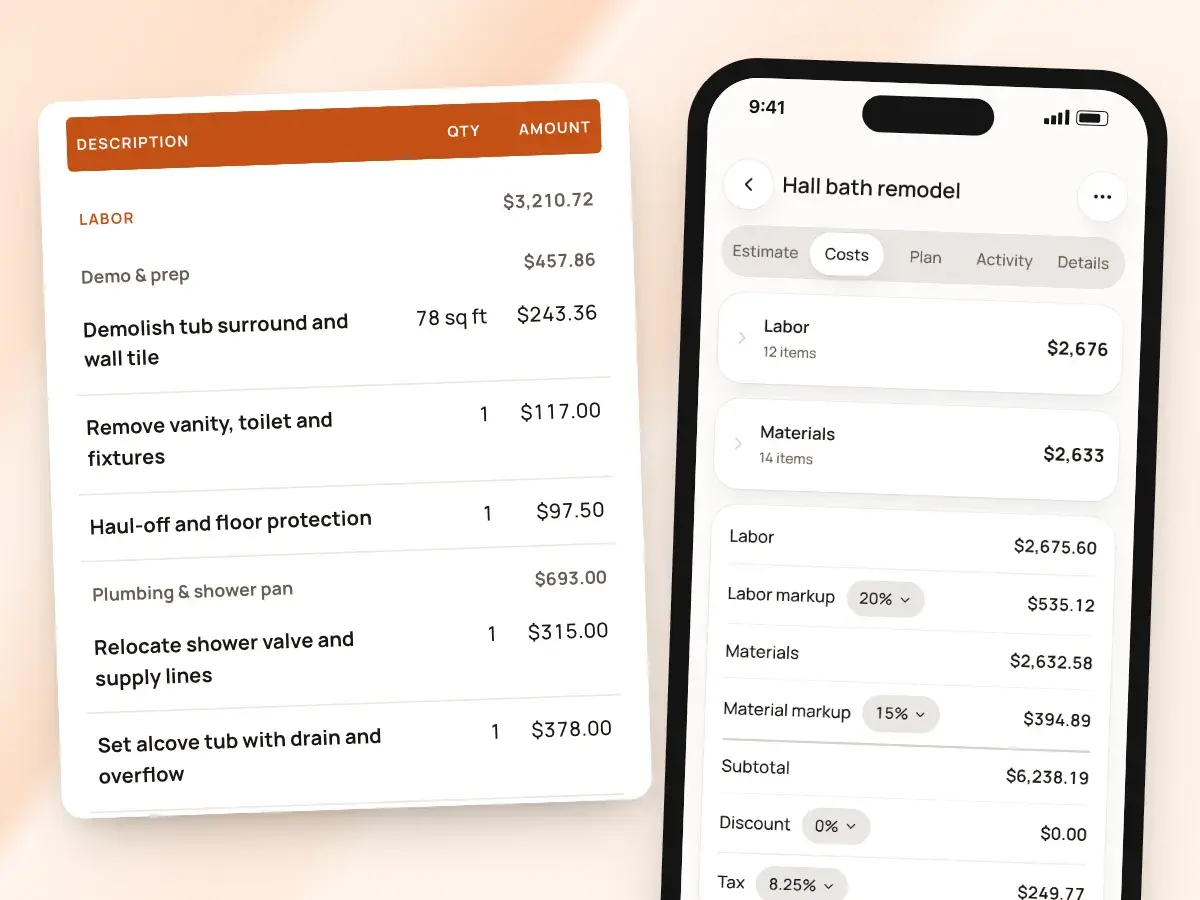
BuildWell builds each hour's price in three steps:
- Wage: a local wage from Bureau of Labor Statistics data. BuildWell's wage data covers construction trades, not cleaners, so this starting wage may be higher or lower than what you pay. Check it.
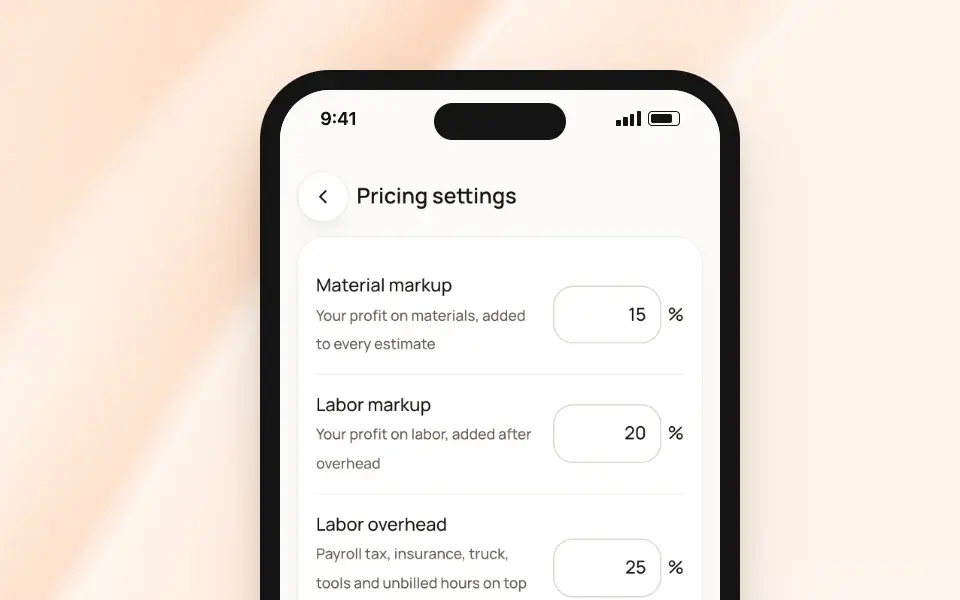
- Overhead: your labor overhead, which starts at 100% and doubles the wage.
- Markup: your labor markup, which starts at 20%.
Example: Say a cleaner costs you $18 an hour in wages. Use your real number. Say a move-out clean takes two people four hours, 8 hours in total:
- Wages: 8 × $18 = $144
- With 100% overhead: $288
- With 20% markup: $345.60 for labor
Supplies and travel come on top.
If that number is well above what you've been charging, look at the hours you've been leaving off the quote.
Mark up supplies to cover store runs
Price supplies at what they cost near the job this week. Add a markup that covers the store runs and the products that run out early.
Material markup starts at 20% in BuildWell; change it on any estimate. If the client provides their own products, mark them client-supplied. They're listed so the scope is clear, but not charged.
Price post-construction cleans by phase
Post-construction work is usually priced by the square foot, and often in phases:
- a rough clean after the trades leave
- a final clean before the walkthrough
- sometimes a touch-up after the punch list
Ask the builder which phases they expect, and price each as its own line.
Spell out what the clean includes
Say what's included:
- windows inside and out
- stickers and labels
- paint drips
- dust in vents and cabinets
The guide to pricing cleaning jobs prices recurring home and commercial work from your own timed visits.