 BuildWell
How to start a contracting business
Start a contracting business the right way: licensing, insurance, business entity, taxes, pricing, paperwork and finding your first clients, step by step.
Running the business · 10 min read · Updated
The steps, in order
- 1
Choose your work and market
Decide which trade and which kinds of jobs you will take, and where.
- 2
Get licensed and registered
Find out what licenses, registrations and permits your state, county and city require for your work, and get them before you advertise.
- 3
Set up the business entity
Choose a sole proprietorship, LLC or other structure, get an EIN, and open a separate business bank account.
- 4
Get insured
Get general liability insurance, workers' compensation if required, commercial auto, and any bonds your state or clients require.
- 5
Plan for taxes
Set aside money for self-employment and income tax, and make quarterly estimated payments.
- 6
Set your prices
Work out your overhead, labor rate and markup before you price your first job.
- 7
Set up your paperwork
Have estimate, contract, change order and invoice forms ready, with your terms.
- 8
Find your first clients
Start with people who already know your work, then build a local presence online.
Starting a contracting business is mostly about the parts that are not the work. You already know how to frame a wall or set a toilet. What decides whether the business lasts is the stuff nobody teaches on a job site:
- Licensing
- Insurance
- Pricing
- Paperwork
- Taxes
- Getting paid
This guide walks through those parts in the order you will need them. It is general: licensing, insurance and tax rules depend on your state and city, so treat each step as questions to answer where you work, with your state's licensing board, an insurance agent and an accountant.
Step 1: Choose your work and your market
Start narrow. "Bathroom remodels within 20 miles" is easier to price, market and do well than "anything anyone asks for."
Decide four things before you start
- Which trade or trades. Your strongest skills, and whether they require a license.
- Which jobs. Small repairs, full remodels, new construction, service calls. Each has a different pace, risk and paperwork load.
- Which area. Drive time is unbillable time, so a tight service area is more profitable than a wide one.
- Which clients. Homeowners, property managers, general contractors. Each pays on different terms.
See how each trade prices and starts
The industries pages show how estimating and pricing work across common trades if you are deciding where to focus.
There are trade-by-trade start-up guides too, for roofing, plumbing, electrical, HVAC, painting and landscaping businesses.
Step 2: Get licensed and registered
Licensing is set by states and often by counties and cities too.
Licenses and permits you may need
Depending on where you work and what you do, you may need:
- A trade license for regulated trades like electrical, plumbing and HVAC, usually with experience requirements and an exam.
- A contractor license or home-improvement registration for residential remodeling, often above a dollar threshold per job.
- A local business license from your city or county.
- A sales tax permit if your state requires contractors to collect sales tax on some or all of their work. The sales tax guide covers the questions to ask.
- Certifications for specific work, such as EPA RRP certification for renovation that disturbs paint in pre-1978 homes.
Get licensed before you advertise
Start with your state's contractor licensing board, then your city or county. Get licensed before you advertise or sign contracts.
In some states, an unlicensed contractor cannot enforce payment for work that required a license.
Step 3: Set up the business
Choose a structure that fits your risk
The common choices for a small contractor:
- Sole proprietorship: the default if you do nothing. Simple, but no separation between business and personal liability.
- LLC: a separate legal entity that can shield personal assets from many business debts. Simple to run, with state filing fees.
- S corporation election: a tax election that an LLC or corporation can make, which can reduce self-employment tax at higher profit levels, at the cost of running payroll and more bookkeeping.
The right choice depends on your risk, income and state. A short meeting with an accountant before you file is money well spent.
Get a free EIN from the IRS
An Employer Identification Number from the IRS is free and takes minutes online. You will need one to hire employees.
It is useful even without them: give clients and general contractors your EIN on a W-9 instead of your Social Security number.
Run every job through a business account
Open a separate business bank account and run every job's money through it. Mixing business and personal money makes taxes harder and weakens the liability protection of an LLC.
Step 4: Get insured
Insurance is not optional. One accident without it can end the business.
The coverage a contractor usually needs
- General liability covers damage to a client's property and injuries to others caused by your work. Clients, general contractors and many licensing boards require it, and they will ask for a certificate of insurance.
- Workers' compensation covers employees injured on the job. Most states require it once you have employees; rules for owners and subcontractors vary.
- Commercial auto covers the truck you use for work. A personal policy may not cover business use.
- Tools and equipment coverage protects what is in the truck.
- Bonds, such as a license bond or a surety bond, may be required by your state or by certain clients.
Get quotes from an agent who knows contractors
Get quotes from an independent agent who works with contractors. Tell them exactly what work you do; coverage and price depend on it.
Step 5: Plan for taxes
When you work for yourself, nobody withholds taxes from your pay. You have to plan for them.
What you owe, and when it's due
- Self-employment tax is 15.3% on net self-employment earnings: 12.4% for Social Security on earnings up to the wage base, which is $184,500 for 2026, and 2.9% for Medicare on all of it. It is figured on 92.35% of net earnings.
- Income tax, federal and in most states, comes on top.
- Quarterly estimated payments on Form 1040-ES are usually due in mid-April, mid-June, mid-September and mid-January. Missing them can mean penalties.
Self-employment tax on $80,000 of profit
Example: If the business makes $80,000 of net profit in a year:
- Taxable base: 80,000 × 0.9235 = $73,880
- Self-employment tax: 73,880 × 0.153 = $11,303.64
That is before any income tax.
Move a fixed share of every payment
A simple habit keeps the tax bill from becoming a surprise. Move a fixed percentage of every client payment into a separate tax account the day it arrives.
Your accountant can tell you what percentage fits your situation.
1099s go both ways at $2,000
If you pay an unincorporated subcontractor $2,000 or more in a year, for payments starting in 2026, you will generally need to collect their W-9 and file a 1099-NEC. Businesses that pay you that much may send you one too.
Either way, all your business income is reportable, whether or not a 1099 arrives.
Step 6: Set your prices before your first job
New contractors often price by guessing what the market will bear, or by copying someone else. Both leave out your actual costs.
Work out four numbers first
Before you price anything:
- Add up your overhead: truck, fuel, insurance, phone, software, tools, licensing, accounting, marketing.
- Estimate your billable hours: not 2,080, but the hours you will actually bill after estimating, driving, supply runs and paperwork.
- Work out your labor rate: pay, taxes, insurance and overhead divided by billable hours, plus profit. The labor rate guide works through it, and the labor rate calculator does the arithmetic.
- Know your break-even: how many jobs a month cover your fixed costs. Try the break-even calculator.
Price each job from its parts
Then price each job from its parts, as the pricing guide shows.
Underpricing early is easy and hard to undo. Clients who hired you cheap expect cheap again.
Step 7: Set up your paperwork
Every job needs the same documents. Have them ready before your first one:
- Estimate or proposal with scope, exclusions, price, terms and a signature line. The estimate guide covers what goes in it.
- Contract terms: payment schedule, change order process, warranty, and anything your state requires in home-improvement contracts.
- Change order form for anything that changes after signing.
- Invoice with your terms and payment methods.
- Lien waivers and receipts for when payments are made.
Start with free forms, then check state rules
A free estimate generator and invoice generator will get you through the first jobs.
Some states require specific language in home-improvement contracts, such as cancellation rights, so check your state's requirements.
Step 8: Find your first clients
You do not need a big marketing budget to start. You need people to know you exist and trust your work.
Six ways to land the first jobs
- Start with who you know. Friends, family, former employers and coworkers. Tell them what you do and ask them to pass your name along.
- Set up a complete online business profile with your service area, hours, phone number and photos of your work. Ask happy clients to leave an honest review there.
- Photograph every job, before and after. Real photos of your own work are your best marketing.
- Work the neighborhood. After a job, let neighbors know you are working nearby. A clean truck and a tidy job site are advertising.
- Build referral relationships with other trades, property managers and real estate agents. A painter who needs a reliable drywall finisher sends work both ways.
- Respond fast. Answer the phone, call back the same day, and send estimates while the client is still thinking about the job.
Track where each lead came from
Keep track of where each lead came from. After a few months, you will know whether referrals, your online profile or neighbors near your jobs bring in the work worth having.
Then you can put your limited time where it pays. Turn down jobs that do not fit; a bad first client costs more than an empty week.
Tools, vehicle and starting money
Buy for the work you chose
Make a list of what you truly need for the work you chose in Step 1. Buy for that list, not for the jobs you might take someday. These come first:
- Tools you already own
- A reliable vehicle that can carry materials
- Safety equipment
Rent specialized equipment until you use it often enough to justify buying.
Keep a few months of costs in the bank
You will pay for insurance, licensing and tools before your first payment arrives. On early jobs you may buy materials before the client pays.
Keep enough in the business account to cover a few months of fixed costs. Then one slow month or one late payment does not force you to take a bad job.
Deposits and progress payments, covered in the progress billing guide, keep material costs from coming out of that cushion.
Keep the books from day one
Record every payment in and every expense out, by job if you can, and keep receipts. At tax time, and when you want to know which jobs actually made money, those records are the only source of truth.
Your first 90 days
| When | What to finish |
|---|---|
| Before the first job | Licensing, registration, insurance, entity, EIN, bank account |
| Before the first estimate | Overhead, labor rate, estimate and contract forms |
| First month | Online profile, job photos, bookkeeping set up |
| First quarter | First estimated tax payment, review prices against actual job costs |
Running it with BuildWell
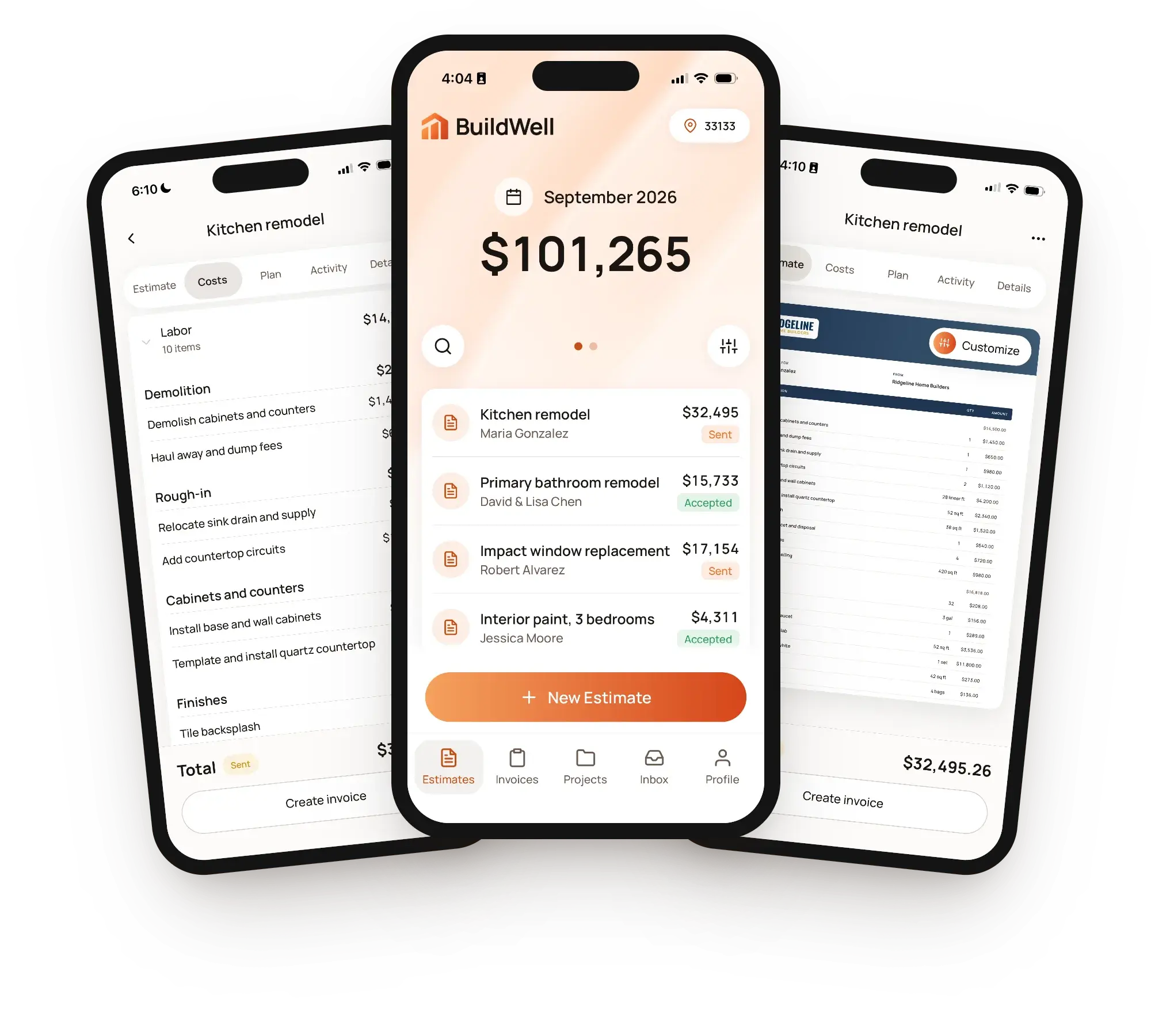
BuildWell handles the estimate-to-payment paperwork from your phone. Describe a job and it builds an itemized estimate:
- Materials priced at stores near the job, checked within 30 days.
- Labor from your metro's median wage, plus the overhead and markup you set.
Clients sign, and it becomes the invoice
Clients sign on their phone, and the signed estimate becomes the invoice, with deposits and progress payments. They pay by card or bank transfer through Stripe, or with your listed Zelle, Venmo, Cash App, PayPal or check details.
What it costs, and what it isn't
It runs on iPhone, Android and the web, in English and Spanish, at $7.99 a week or $79.99 a year after a 3-day free trial.
It is not bookkeeping or payroll software, so you will still want an accountant and a bookkeeping system.
Checklist
- Trade, jobs, service area and clients chosen
- Licenses, registrations and permits in place
- Entity, EIN and business bank account
- General liability, workers' compensation if required, commercial auto, bonds
- A tax account and quarterly estimated payments planned
- Overhead, labor rate and break-even worked out
- Estimate, contract, change order and invoice forms ready
- A plan for the first clients
Do these in order and you start the business with the boring parts handled, which leaves you free to do the work.
Free tools for this guide
Generators, templates, calculators and definitions. No sign-up.
Common questions
01Do I need a license to be a contractor?
02Should a contractor form an LLC?
03What insurance does a new contractor need?
04How much should I set aside for taxes?
05How do new contractors find clients?
Estimates, signatures and invoices in one app
BuildWell prices materials at stores near the job and labor from your metro’s wages plus your overhead and markup, gets the estimate signed on the client’s phone, and turns it into the invoice.
- AI estimates priced for your area
- Estimates, invoices, clients and projects
- Clients sign on any phone
- Card and bank payments, no extra BuildWell fee
- iPhone, Android and the web
- AI estimates priced for your area
- Estimates, invoices, clients and projects
- Clients sign on any phone
- Card and bank payments, no extra BuildWell fee
- iPhone, Android and the web
Both plans include every feature and start with a 3-day free trial. Add a card to start; you’re not charged until the trial ends. Cancel anytime.
Try BuildWell today
Estimates, invoices, e-signatures and payments in one place, on your phone and on the web.