 BuildWell
Free Mileage Log Generator
Log each business trip, see the miles and the total as you type, and download a PDF for your records. Free, no account.
Everything stays in this browser. Nothing you type is sent to BuildWell.
How to use the free mileage log generator
The free mileage log generator turns business driving into a clean, dated record. Enter the vehicle, the driver and the odometer readings, then a line per trip with the date, route, business purpose and miles. Set a rate per mile and the log adds up the miles and the amount. The IRS business rate is 76¢ a mile from July 1 to December 31, 2026, and 72.5¢ from January 1 to June 30 (IRS, checked October 2, 2026); you can enter any rate. Below the tool: a worked example, what a log should record, the mistakes that weaken one, and common questions. It’s a recordkeeping tool, not tax advice.
- 1
Add the vehicle and driver
Enter the vehicle, who drove it, and the odometer at the start and end of the period.
- 2
Set the period and rate
Name the period, such as a month, and enter your rate per mile: the IRS rate for the dates you drove, or your own.
- 3
Add each trip
For every business trip, enter the date, the route, the business purpose and the miles.
- 4
Note parking and tolls
Write business parking and tolls in the notes, and keep the receipts.
- 5
Sign and keep it
Download the PDF at the end of each period, sign it, and file it with your tax records.
Who uses a mileage log
Anyone who drives to jobs, estimates and supply runs has business miles to record. These trades drive the most.
Handymen
Several small jobs a day means several short trips. A dozen five-mile trips add up faster than one long drive.
Handyman software →Plumbers
Service calls, parts runs and inspection visits are trips of their own. Each call’s work order is a check on the date and address.
Plumbing software →HVAC technicians
Maintenance routes repeat each season. A monthly log shows the pattern, and the odometer readings back it up.
HVAC software →Lawn care businesses
Weekly routes cover the same ground. Log each day’s route with its stops, not one total for the week.
Lawn care software →Cleaning businesses
Cleaners drive between several homes or offices a day. Record each leg, and supply runs as trips of their own.
Cleaning software →Pressure washing businesses
The rig goes out to quote jobs as well as do them. Log the trip even when the job doesn’t book.
How to make a mileage log: an example
Here is a filled-in mileage log for the first half of September 2026, made with the generator above. The business, vehicle, addresses and miles are invented. The rate is the IRS business rate for the second half of 2026, 76¢ a mile.
- One line per trip, in date orderEach trip has its date, places, purpose and miles: the details the IRS says to record for business use of a vehicle.
- A purpose anyone could follow“Estimate: deck repair, Moreno” says why the trip was business. “Work” wouldn’t.
- Multi-stop days as one routeSeptember 14 covers two jobs and the drive back, as one route with both stops.
- The odometer at both endsThe readings show all the driving, so the business miles are a believable share of it.
- Parking kept separateThe IRS lets business parking and tolls be deducted on top of the standard rate, so parking is noted with its receipt, not added to the miles.
Before you sign and file it, check it has
- The vehicle, and who drove it
- The period the log covers
- Odometer readings at the start and end
- The date of each trip
- Where each trip started and went
- The business purpose of each trip
- Miles per trip, the total and the rate
- Business parking and tolls, with receipts
What goes into a strong mileage log
The parts every mileage log needs, and why each one matters to anyone who checks it later.
The vehicle and driver
Which vehicle and who drove it. A separate log per vehicle keeps the totals clean.
A set period
A month or half a month per log is easy to keep up with and to total at year-end.
Odometer readings
At the start and end of the period, so your business miles have a total to be measured against.
Dates
The day of each trip. A log filled in on the day beats one rebuilt from memory at tax time.
Places
Where you started and went, with every stop on a multi-stop day. An address or client name is enough.
Business purpose
Why the trip was for the business: an estimate, a job, a supply run. It’s the detail most logs leave out.
Miles and the rate
Miles per trip, the total and the rate per mile, so anyone can check the amount.
Parking, tolls and a signature
Business parking and tolls with receipts, and your signature saying the log was kept as you went.
Common mileage log mistakes
And how to avoid them, so the document does its job the first time.
Rebuilding the log at tax time
A log written months later from memory is the weakest record. Fill it in daily, or weekly from your calendar.
No business purpose
Dates and miles without a reason don’t show the trips were for business. Write a few words for each.
Counting the commute
The IRS doesn’t allow commuting as a deduction. A home office or a temporary site can change what counts, so ask your tax preparer.
One rate all year
The IRS rate can change mid-year: it went from 72.5¢ to 76¢ on July 1, 2026. In a log that spans a change, set each trip’s own rate.
Mixing vehicles in one log
Two work vehicles need two logs, each with its own odometer readings.
Rounding every trip up
Trips padded to the nearest ten miles add up, and look like it. Use the odometer or a map’s distance.
Mileage Log templates you can create
The generator has 6 layouts and 12 colors. Here is the example above in three of them; pick yours in “Look” at the bottom of the form.
Features of the free mileage log generator
Live preview
The document redraws as you type, in the same layout BuildWell itself sends.
Your logo and colors
Upload a PNG, JPG, SVG or WebP up to 2 MB, and pick from 12 colors.
6 templates
Classic, Headline, Banner, Statement, Minimal and Letterhead.
Miles times your rate
Enter each trip’s miles and a rate per mile. The log adds up the miles and the amount to the cent, and prints the rate in the header.
Private by default
What you type stays in this browser and is remembered on this device. Nothing is sent to BuildWell.
A PDF with no account
Download the PDF from your browser’s print dialog and send it however you like. No sign-up.
Tracking and follow-up in BuildWell
BuildWell doesn’t log miles. It does keep each client’s address with the estimates and invoices you make for them, and every document is dated, so at the end of a month you can check your mileage log against the jobs you priced and billed and catch the trips you missed. How the client portal works.
- Opened, and how oftenSee when the client opens your estimate and how many times.
- Accepted or declinedGet notified when the client accepts and signs on their phone, or declines.
- PaidGet notified when the client pays an invoice, and see what’s still owed.
- Sent from your phoneText or email the link in your own words. Clients need no app or account.
- Estimate E-1042 sent by textMon 9:14 AM
- Opened by the client · viewed 3 timesMon 7:52 PM
- Accepted and signedTue 8:03 AM
- Deposit invoice sentTue 8:10 AM
- Deposit paid by bank transferWed 11:26 AM
Skip the typing. Let it price the job.
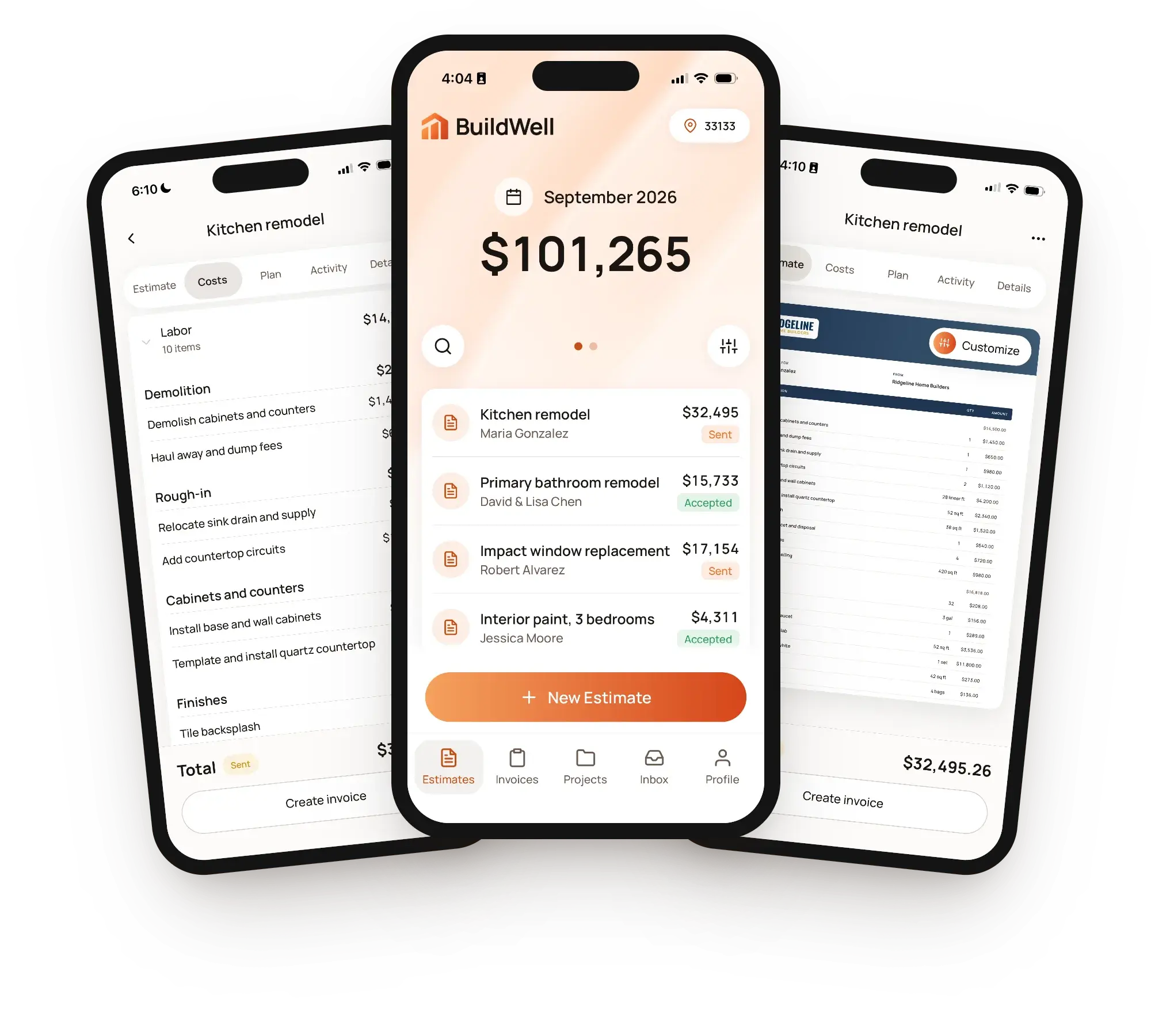
Describe the job by voice or photos. BuildWell lists the work, prices it for your area, gets it signed on the client’s phone, and turns it into the invoice.
- AI estimates priced for your area
- Estimates, invoices, clients and projects
- Clients sign on any phone
- Card and bank payments, no extra BuildWell fee
- iPhone, Android and the web
- AI estimates priced for your area
- Estimates, invoices, clients and projects
- Clients sign on any phone
- Card and bank payments, no extra BuildWell fee
- iPhone, Android and the web
Both plans include every feature and start with a 3-day free trial. Add a card to start; you’re not charged until the trial ends. Cancel anytime.
Mileage Log FAQ
01Is it really free, with no sign-up?
02What is the IRS mileage rate for 2026?
03What does the IRS want in a mileage log?
04Can I use the standard mileage rate for my truck or van?
05Can I deduct parking and tolls too?
06Is driving from home to a job site business mileage?
07Can I use this log to reimburse my crew?
08How do I save it as a PDF?
09Will my details be here next time?
Sources
Figures on this page come from these official pages, checked on October 2, 2026. Rates and rules change; check the source for the dates you need.
- IRS: Standard mileage rates (checked 2026-10-02)
- IRS: Topic no. 510, Business use of car (checked 2026-10-02)
- IRS: Publication 463, Travel, Gift, and Car Expenses (checked 2026-10-02)
Free resources
Guides, calculators and definitions. No sign-up.
Guides for this document
Try BuildWell today
Estimates, invoices, e-signatures and payments in one place, on your phone and on the web.