 BuildWell
How to start an electrical business
Start an electrical contracting business step by step, from licensing and insurance to tools, pricing, first customers, estimates, invoices and cash flow.
Starting a trade business · 10 min read · Updated
The steps, in order
- 1
Plan the work and the market
Decide between residential service, remodels, new construction, commercial or a specialty, and set a service area.
- 2
Get licensed to contract
Confirm with your state's licensing board what license you need to run your own shop and pull permits, and get it before you advertise.
- 3
Set up the business and insurance
Form the business, get an EIN and a business bank account, and put liability, workers' comp, auto and any required bond in place.
- 4
Equip the van
Buy testers, benders, hand and power tools, safety gear and a lean stock of devices and wire for the work you will take.
- 5
Work out your prices
Build a labor rate, then set your trip charge, minimum and the way you price service and installs.
- 6
Find your first customers
Start with referrals, remodelers, property managers and the jobs homeowners search for by name.
- 7
Estimate, invoice and protect cash flow
Put permits and exclusions on every estimate, take deposits on large jobs, and invoice when the inspection passes.
Starting an electrical business takes two kinds of qualification. One is the license and the skill to do the work safely. The other is the business side:
- Licensing to contract
- Insurance
- Pricing
- Finding customers
- Getting paid
Electricians who know the first well often learn the second the hard way. This guide walks through the business steps in the order you will need them.
It stays general on purpose, because electrical licensing and insurance rules depend on your state and city. Treat each step as a set of questions to answer where you work. The general guide to starting a contracting business covers the parts every trade shares in more depth.
Plan the work and the market
Electrical work splits into businesses that run very differently.
Five kinds of electrical business
- Residential service: repairs, devices, fixtures, panel upgrades, EV chargers and generators. Short jobs, paid on completion, sold on response time and trust.
- Remodels: rough-in and trim for kitchens, baths and additions, often for remodelers.
- New construction: wiring houses for builders, priced per house or per opening, paid on the builder's schedule.
- Commercial and light industrial: larger services, different codes, longer payment terms and more paperwork.
- Specialties: low-voltage, solar, generators or controls, each with its own customers and sometimes its own license.
Keep the service area tight
Then set a service area. A tight area means less unbilled driving and a name that spreads faster.
Start where the cash comes fastest
Be honest about cash, too. Service work pays the day it is done.
Builder and commercial work can bring larger jobs, but you buy the wire and gear first and wait for payment on someone else's schedule. Many new shops start with service and remodel work and add builder work once they have a cushion.
Write a short plan with real quotes
Write a short plan: the work, the area, the customers, the startup costs and how you will find the first jobs. List startup costs one by one with real quotes:
- Licensing and bonds
- Insurance
- The van and its shelving
- Tools and testers
- Opening stock
- A phone and software
- A cash reserve for a few months of fixed costs
Licensing and permits
Electrical licensing usually comes in levels, from apprentice to journeyman to master or contractor, with supervised experience and an exam along the way. Running your own shop and pulling permits often needs a license beyond the one to do the work.
A few places leave licensing to cities and counties. The details vary widely, so check them where you work, not where you trained.
Four questions to answer before you advertise
- Ask your state's licensing board what license you need to own the business and pull permits.
- Ask the building departments where you will work about local registration and permit rules.
- Check specialty licenses if you plan low-voltage, solar or fire alarm work.
- Ask whether a bond is required. Some states and cities require a license bond or a surety bond.
Know which code edition applies
The National Electrical Code is updated on a regular cycle, and states adopt new editions on their own schedules. Know which edition your jurisdiction enforces, and plan for the continuing education many licenses require.
Build permits and inspections into the price
Most electrical work beyond simple repairs needs a permit and an inspection. Know the rules where you work, and build the permit and the inspection visit into your price.
Safety as part of the business
Electrical work can injure or kill in an instant, and a single serious incident can end a small company.
Run safety as a written system
Treat safety as a business system, not a habit you hope everyone shares:
- Write a short safety policy: when work is done de-energized, how circuits are locked out and tagged, and who may work near energized equipment.
- Train every person on it before their first job, and keep a record that they were trained.
- Buy the protective equipment the work calls for, and replace it when it is worn.
- Plan each job's hazards before you start: the panel, the attic, the ladder, the weather.
Insurers and clients will ask about it
OSHA sets workplace safety rules for construction, and your insurer and your clients may ask about your safety program. Having one written down helps with both.
Set up the business
- Choose a structure. A sole proprietorship is simple; an LLC can separate business debts from personal assets. An accountant can tell you which fits.
- Get an EIN from the IRS. It is free, and you give it to builders and property managers on a W-9.
- Open a business bank account and run every payment and supply house bill through it.
- Set up bookkeeping from day one, with income and costs recorded by job.
Insurance and bonds
Five kinds of coverage to price
- General liability: covers damage and injuries your work causes. General contractors and property managers will ask for a certificate.
- Workers' compensation: most states require it once you have employees, including apprentices.
- Commercial auto: for the van. A personal policy may not cover business use.
- Tools and equipment coverage: for testers, tools and stock.
- Bonds: a license bond where your state or city requires one.
Tell the agent exactly what you do
Get quotes from an agent who insures electricians, and describe exactly what you do. Each of these can change the coverage and the price:
- Commercial work
- Industrial work
- Solar work
Equip the van
Tools, testers and stock for the van
- Testing: a multimeter, a non-contact tester, a circuit tracer, a receptacle tester and an insulation tester when your work calls for one.
- Hand tools: strippers, linesman's pliers, drivers, fish tape and rods, and conduit benders for the sizes you run.
- Power tools: a cordless drill and impact driver, hole saws, a reciprocating saw and a hammer drill.
- Access: step ladders and an extension ladder, rated for electrical work.
- Safety: eye protection, insulated gloves, and arc-rated clothing for any work near energized equipment, with training to match.
- Stock: the devices, boxes, connectors, breakers and wire you use most, kept lean and restocked from each job.
Price your work before your first call
Five pricing steps before your first call
- Add up your overhead: the van, fuel, insurance, licenses, continuing education, tools, phone, software and marketing.
- Work out your labor rate: wages, payroll taxes, workers' comp and overhead, spread over the hours you will actually bill. The labor rate guide and the labor rate calculator walk through it.
- Set a trip charge or minimum so a short service call still pays for the drive.
- Choose how you price service work: flat rate per task, or time and materials, built from your own hours and parts costs.
- Know your break-even: the break-even calculator shows how many jobs a month cover your fixed costs.
Price line by line, and date every estimate
The electrical pricing guide works through device, circuit and panel pricing line by line. Wire and breaker prices move, so put an expiration date on every estimate.
Get your first customers
- Referrals: everyone you have worked with or for. Ask every happy customer to pass your name along.
- Remodelers and general contractors who need a reliable electrician for rough-in and trim-out.
- Property managers with steady repair lists.
- Jobs homeowners search for by name, such as panel upgrades, EV chargers and generator hookups. A clear page or profile listing for each helps.
- Local search: a complete free business profile on the map apps homeowners use, with your license number, and a request for an honest review after every job.
Track leads and answer fast
Keep track of where each lead came from, and put your time where the good work comes from.
Answer the phone, call back the same day and send the estimate while the homeowner is still thinking about the job. A fast, clear estimate with your license number on it often wins over a lower number that arrives a week later.
Estimating and invoicing
An electrical estimate should show what the homeowner is paying for and what they are not.
Have three documents ready
- An itemized estimate with circuits, devices, the panel work, the permit and the inspection, plus exclusions such as drywall patching or utility work. The estimate guide covers what goes in it, and the electrical estimate template gives you a layout.
- A change order for anything you find behind the wall that changes the work.
- An invoice with your payment terms, sent when the job is done or the inspection passes. The free invoice generator will do for the first jobs.
Cash flow
Six habits that keep cash moving
- Collect at completion on service calls.
- Take a deposit on panel upgrades, generators and remodel work before you buy the equipment. The progress billing guide covers deposits and staged payments.
- Bill in stages on longer jobs, such as rough-in, then trim and final.
- Open a supply house account and pay it on time.
- Watch builder terms, which often pay later than homeowners.
- Set aside tax money from every payment. The self-employment tax calculator shows how much to plan for.
Hiring apprentices and helpers
Check supervision rules before you hire
Licensing rules usually set who may do electrical work and under whose supervision, including how many apprentices a licensed electrician may supervise. Check them with your licensing board before you hire.
Employees and subs bring different paperwork
- Employees bring payroll taxes and workers' comp.
- Subcontractors need a W-9, a certificate of insurance and a written scope.
Whether someone is an employee or a contractor depends on how you direct the work, so ask an accountant before you pay anyone.
Warranties and callbacks
Keep your warranty separate from the maker's
Decide your workmanship warranty before your first job, and keep it separate from the manufacturer's warranty on devices and equipment.
Records that cut the cost of callbacks
Every callback is an unbilled trip, so your overhead has to carry them.
- Label panels clearly.
- Photograph rough-in before the walls close.
- Keep each customer's history together.
Electrical work by the numbers
According to the Bureau of Labor Statistics' Occupational Outlook Handbook (Electricians, last modified August 27, 2026), the median annual wage for electricians was $63,190 in May 2025, and employment of electricians is projected to grow 9% from 2025 to 2035.
Wage figures describe workers, not owners
Those figures describe electricians who work for wages, not business owners. They are a useful reference for what you may pay a licensed electrician and for the pay part of your labor rate.
What an owner earns is the margin between what the business charges and what the work costs.
Starting with BuildWell
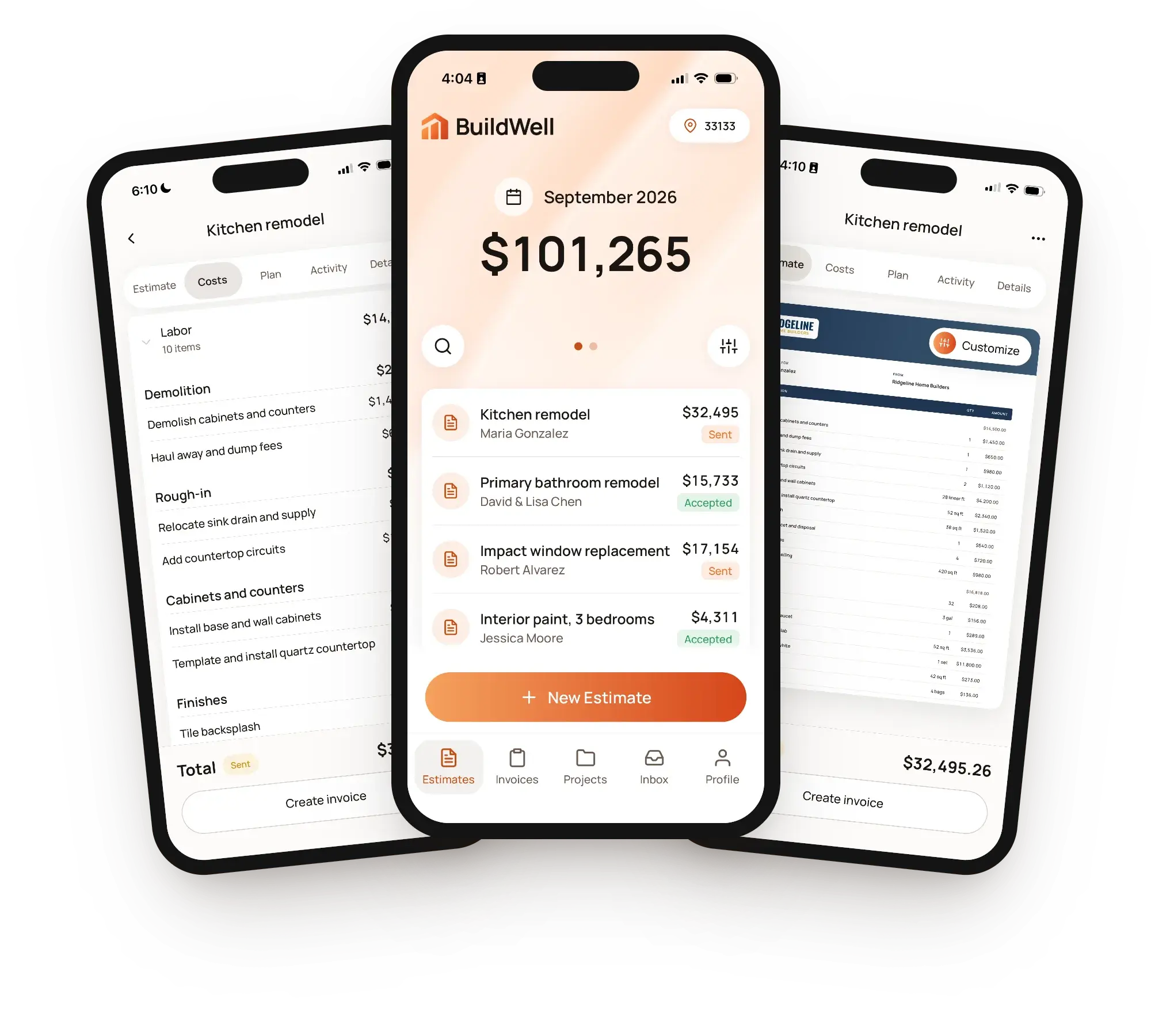
BuildWell handles the estimate-to-payment paperwork from your phone. Describe the job by voice, text or photos, and it writes an itemized estimate:
- Materials priced at stores near the job, checked within the last 30 days.
- Labor starting from your metro's median wage for the trade, plus the overhead and markup you set.
Change any line, then send it
Change any line before you send it. Add your logo, license number and terms once.
The signed estimate becomes the invoice
The customer signs on their phone, and the signed estimate becomes the invoice, with deposits and progress payments as the work moves.
The electrical industry page shows how it works for electricians. BuildWell is not bookkeeping or payroll software, so you will still want a bookkeeping system and an accountant.
An electrical startup checklist
- Work, service area and customers chosen
- Licensing confirmed with your state's licensing board and local building departments
- Business entity, EIN, bank account and bookkeeping
- General liability, workers' comp, commercial auto and any required bond
- Testers, tools, safety gear and lean stock
- Labor rate, trip charge and service pricing worked out
- Estimate, change order and invoice ready, with permits on every estimate
- A supply house account and a deposit policy
Free tools for this guide
Generators, templates, calculators and definitions. No sign-up.
Common questions
01Do I need a license to start an electrical business?
02Can a journeyman electrician start a business?
03What should a new electrical business specialize in?
04What insurance does an electrical contractor need?
05How do I handle permits on my estimates?
Estimates, signatures and invoices in one app
BuildWell prices materials at stores near the job and labor from your metro’s wages plus your overhead and markup, gets the estimate signed on the client’s phone, and turns it into the invoice.
- AI estimates priced for your area
- Estimates, invoices, clients and projects
- Clients sign on any phone
- Card and bank payments, no extra BuildWell fee
- iPhone, Android and the web
- AI estimates priced for your area
- Estimates, invoices, clients and projects
- Clients sign on any phone
- Card and bank payments, no extra BuildWell fee
- iPhone, Android and the web
Both plans include every feature and start with a 3-day free trial. Add a card to start; you’re not charged until the trial ends. Cancel anytime.
Try BuildWell today
Estimates, invoices, e-signatures and payments in one place, on your phone and on the web.