 BuildWell
How to start a roofing business
Start a roofing business step by step, from planning, licensing and insurance to equipment, pricing, first clients, estimates, invoices and cash flow.
Starting a trade business · 10 min read · Updated
The steps, in order
- 1
Plan the work and the market
Decide whether you will do reroofs, repairs, new construction or commercial work, where, and for which clients.
- 2
Check licensing with your state
Ask your state's licensing board and your city or county what registration or license roofing work needs before you advertise.
- 3
Set up the business and insurance
Form the business, get an EIN and a business bank account, and get liability, workers' comp and auto coverage in place.
- 4
Buy or rent the equipment
Start with safety gear, ladders and hand tools, and rent lifts and dump trailers until you use them often.
- 5
Work out your prices
Build your labor rate and overhead, then price roofs line by line from squares, edges and details.
- 6
Find your first clients
Start with referrals, general contractors, inspectors and a complete local business profile.
- 7
Estimate, invoice and protect cash flow
Send itemized estimates, take a deposit before ordering material, and invoice the balance the day the roof is done.
Starting a roofing business takes more than knowing how to shingle a roof. What decides whether the business lasts is planning, licensing, insurance, pricing and cash flow. And a roofing company carries more risk than most trades:
- The work is at height.
- The material bills are large.
- The weather sets the schedule.
- A mistake shows up as a leak months later.
This guide walks through those steps in the order you will need them. It is general on purpose: licensing, insurance and tax rules depend on your state and city, so treat each step as questions to answer where you work.
The general guide to starting a contracting business covers the parts every trade shares in more depth.
Plan the work and the market
Start with what you will do and for whom. Each kind of roofing work has its own pace, risk and paperwork.
Four kinds of roofing work
- Residential reroofs: tear-off and replacement for homeowners. Large jobs, high material costs, sold on trust.
- Repairs: leaks, flashing and storm damage. Small jobs, fast decisions, good for building a client list.
- New construction: roofing for builders, often as a subcontractor, priced tight and paid on the builder's schedule.
- Commercial and low-slope: different materials, different equipment and often different licensing.
Keep the service area tight
Then decide your service area. Drive time is unbillable, and a tight area also means your trucks and yard signs are seen by the same neighborhoods again and again.
Write a short plan that's honest about money
Write a short plan that covers:
- The work you will take
- The area
- The clients
- Your startup costs
- How you will find the first ten jobs
It does not need to be long. It needs to be honest about the money.
Get a quote for each startup cost
List the startup costs line by line, with a quote for each rather than a guess:
- licensing, registration and any bond
- the first insurance premiums or down payments
- safety equipment, ladders and tools
- a truck and trailer, or the payments on them
- a phone, software, a logo and yard signs
- a cash reserve for a few months of fixed costs and the first material orders
Licensing and registration
Roofing licensing varies more than in most trades. Depending on where you work:
- Some states license roofing contractors specifically, often with an exam and proof of insurance.
- Some cover roofing under a general contractor or home-improvement registration.
- Some leave licensing to cities and counties.
Check the state board, then the city
Many places also require a local business license, and some require a bond. Check your state's licensing board first, then your city or county building department, before you advertise or sign a contract.
In some places, a contractor who works without a required license cannot enforce payment.
Ask about rules for storm insurance claims
If you plan to work on insurance claims after storms, ask your licensing board and your state's insurance department what rules apply. Several states regulate what contractors may do in a claim.
Set up the business
- Choose a structure. A sole proprietorship is simple; an LLC can separate business debts from personal assets. An accountant can tell you which fits your situation.
- Get an EIN from the IRS. It is free, and you give it to builders on a W-9 instead of your Social Security number.
- Open a business bank account and run every deposit and supplier payment through it.
- Set up bookkeeping from the first day, with income and costs recorded by job.
Insurance and safety
Roofing insurance is expensive because roofing is dangerous. Budget for it before you price your first job.
Four policies a roofer needs
- General liability: covers damage to a client's property and injuries to others. Homeowners and builders will ask for a certificate of insurance.
- Workers' compensation: most states require it once you have employees, and for a roofer it is one of the largest costs in the labor rate.
- Commercial auto: for the trucks and trailer. A personal policy may not cover business use.
- Tools and equipment coverage: for what is in the truck and on the roof.
Tell the agent exactly what you do
Get quotes from an agent who insures roofers, and describe the work exactly. These all change the coverage:
- Steep roofs
- Commercial work
- Torch-applied systems
Make safety part of every job
Safety is part of the business plan, not an extra. OSHA sets fall protection rules for construction work.
- Buy the harnesses, anchors and guardrails your work needs.
- Train your crew.
- Make the safety plan part of every job.
Equipment and vehicles
Buy for the work you planned, and rent the rest until you use it often.
- Safety: harnesses, lanyards, roof anchors, guardrail kits and hard hats.
- Access: extension ladders, ladder stabilizers and roof brackets.
- Tools: nail guns and a compressor, hoses, tear-off shovels, utility knives, chalk lines, tin snips and a brake for metal flashing.
- Hauling: a truck and a dump trailer, or a dumpster service for tear-offs.
- Lifts: a shingle lift or conveyor, rented at first.
- Measuring: a tape, a pitch gauge, and aerial measurement reports when you need them.
Price your work before your first bid
New roofers often copy a competitor's price per square. That price carries their costs, not yours.
Work out three numbers first
Before your first bid:
- Add up your overhead: insurance, trucks, fuel, tools, licensing, phone, software and marketing.
- Work out your labor rate: wages, payroll taxes, workers' comp and overhead, spread over the hours you will actually bill. The labor rate guide and the labor rate calculator walk through it.
- Know your break-even: how many roofs a month cover your fixed costs. The break-even calculator does the math.
Price each roof line by line
Then price each roof line by line, from squares, edges and details, with the dumpster, permit and a decking allowance.
The roofing pricing guide works through a full tear-off, and the roofing calculator turns roof area into squares and bundles.
Get your first clients
- Referrals: friends, family and anyone you have worked for. Ask every happy client to pass your name along.
- Neighbors: a reroof is visible to the whole street. A yard sign during the job and a note to the neighbors bring calls.
- General contractors and remodelers who need a reliable roofer.
- Home inspectors and real estate agents, who see roofs that need work before a sale.
- Local search: a complete free business profile on the map apps homeowners use, with photos of your own work, and a request for an honest review after every job.
The first clear estimate often wins
Answer fast. A homeowner with a leak calls several roofers, and the first clear estimate often wins.
Estimating and invoicing
A roofing estimate wins or loses the job. One number for "new roof" invites comparison with the cheapest bid.
Itemize so the price explains itself
An itemized estimate explains why your price is your price. It shows:
- Tear-off
- Underlayment
- Shingles
- Edges
- Flashing
- Ventilation
- Disposal
Have three documents ready
Have these ready before your first job:
- An estimate with scope, exclusions, a decking allowance, your warranty and a signature line. The estimate guide covers what goes in it, and the roofing estimate template gives you a layout.
- A change order for rotten decking beyond the allowance and anything else that changes.
- An invoice with your payment terms, sent the day the roof is done. The free invoice generator will do for the first jobs.
Cash flow
Roofing cash flow is tight because the material bill comes before the payment. A full roof's shingles, underlayment and flashing can be a large share of the job price.
Five ways to keep cash moving
- Take a deposit before you order material, where your state allows it. Some states limit deposits on home-improvement work, so check.
- Open a supplier account with credit terms, and pay it on time to keep it.
- Invoice the balance the day the job is done, not at the end of the week. The progress billing guide covers deposits and staged payments.
- Build a reserve for weather. Rain weeks and slow winters still have insurance and truck payments.
- Set aside tax money from every payment. The self-employment tax calculator shows how much the IRS will expect.
Hiring a crew or using subcontractors
Few roofs are a one-person job, so you will need help early. There are two common ways to get it:
- Employees: you direct the work, pay wages and run payroll, with payroll taxes and workers' comp on top. You control the quality and the schedule.
- Subcontractors: another business does part of the work for an agreed price. Collect a W-9 before you pay them, get their certificate of insurance, and put the scope in writing. The free subcontractor agreement generator gives you a starting point, and the 1099-NEC entry explains the year-end filing.
Control of the work decides the label
Whether someone is an employee or a contractor depends on how the work is controlled, not on what you call them. Getting it wrong can mean back taxes and penalties, so ask an accountant before you pay anyone.
Train everyone before they go up
Either way, train every person on your safety plan before they go up.
Warranties and callbacks
A roof is judged in the first heavy rain.
Set your workmanship warranty before you sell
Decide your workmanship warranty before you sell your first roof:
- What it covers
- For how long
- What voids it
Put it on every estimate, and keep it separate from the manufacturer's warranty on the shingles.
Budget for callbacks and photograph every stage
Every warranty visit is an unbilled day for a crew, so your overhead has to carry them.
Photograph each stage of every job, especially flashing and underlayment before they are covered. Those photos settle most disputes and help you find the cause of a leak quickly.
Roofing by the numbers
According to the Bureau of Labor Statistics' Occupational Outlook Handbook (Roofers, last modified September 14, 2026), the median annual wage for roofers was $55,440 in May 2025, and employment of roofers is projected to grow 5% from 2025 to 2035.
Wage figures describe workers, not owners
Those figures describe roofers who work for wages, not business owners. They are useful as a reference for what you may pay a crew member and for the pay part of your labor rate.
What an owner earns is the margin between what the business charges and what the work costs.
Starting with BuildWell
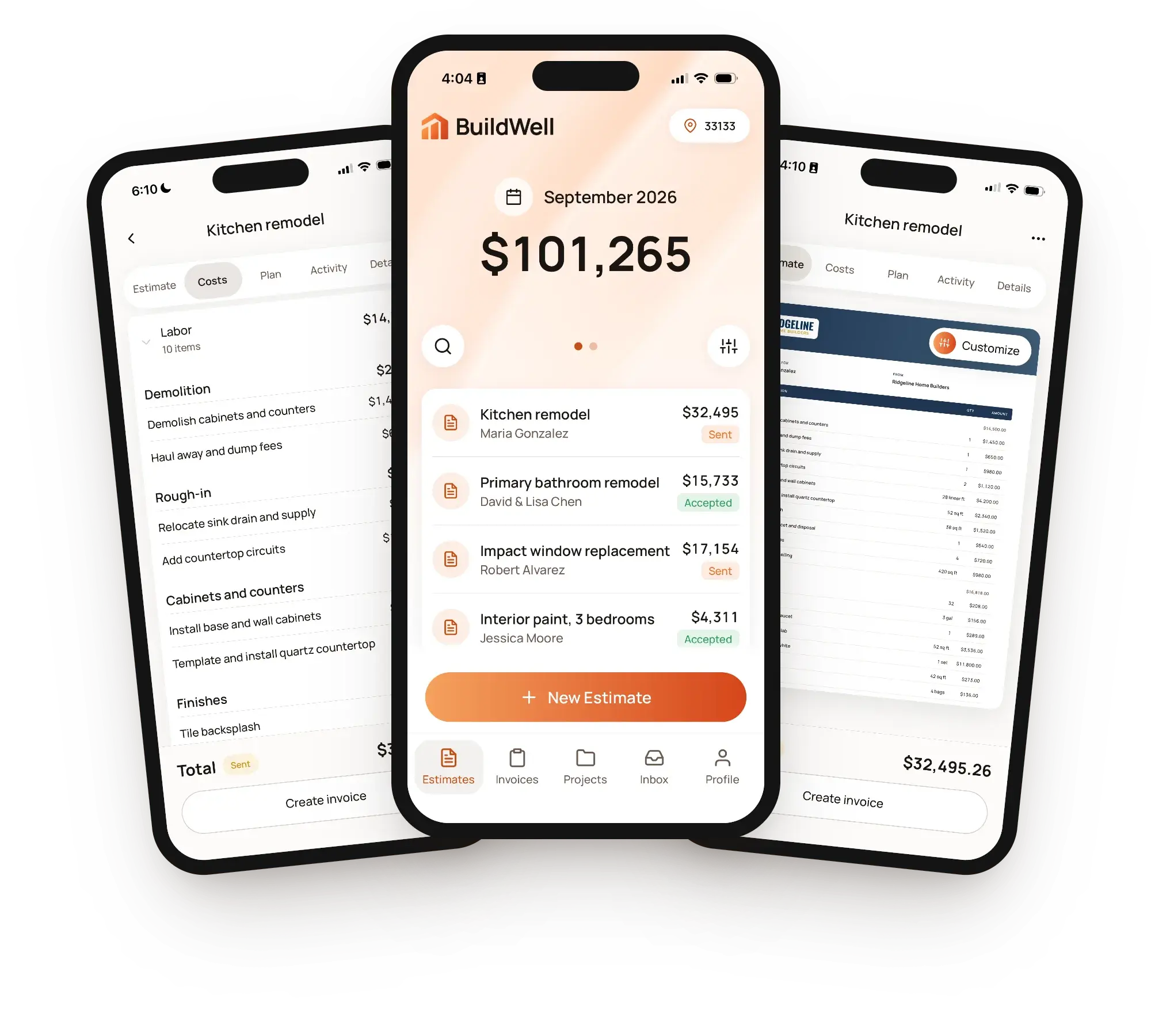
BuildWell handles the estimate-to-payment paperwork from your phone. Describe the roof by voice, text or photos, and it writes an itemized estimate:
- Materials priced at stores near the job, checked within the last 30 days.
- Labor starting from your metro's median wage for the trade, plus the overhead and markup you set.
Change any line, then send it
Change any line before you send it. Add your logo, license number and terms once.
The signed estimate becomes the invoice
The homeowner signs on their phone, and the signed estimate becomes the invoice, with a deposit up front and the balance at the end. Clients pay by card or bank transfer through Stripe, or by the Zelle, Venmo, Cash App, PayPal or check details you list.
The roofing industry page shows how it works for roofers. BuildWell is not bookkeeping or payroll software, so you will still want a bookkeeping system and an accountant.
A roofing startup checklist
- Work, service area and clients chosen
- Licensing checked with your state's licensing board and your city
- Business entity, EIN, bank account and bookkeeping
- General liability, workers' comp and commercial auto in place
- Safety equipment and a written safety plan
- Overhead, labor rate and break-even worked out
- Estimate, change order and invoice ready
- Deposit terms and a supplier account set up
- A plan for the first ten jobs
Free tools for this guide
Generators, templates, calculators and definitions. No sign-up.
Common questions
01Do I need a license to start a roofing business?
02What insurance does a new roofing company need?
03Should a new roofer work as a subcontractor first?
04How do I handle insurance claim work?
05How much money do I need to start a roofing business?
Estimates, signatures and invoices in one app
BuildWell prices materials at stores near the job and labor from your metro’s wages plus your overhead and markup, gets the estimate signed on the client’s phone, and turns it into the invoice.
- AI estimates priced for your area
- Estimates, invoices, clients and projects
- Clients sign on any phone
- Card and bank payments, no extra BuildWell fee
- iPhone, Android and the web
- AI estimates priced for your area
- Estimates, invoices, clients and projects
- Clients sign on any phone
- Card and bank payments, no extra BuildWell fee
- iPhone, Android and the web
Both plans include every feature and start with a 3-day free trial. Add a card to start; you’re not charged until the trial ends. Cancel anytime.
Try BuildWell today
Estimates, invoices, e-signatures and payments in one place, on your phone and on the web.