 BuildWell
Preliminary notice
A preliminary notice is a document sent early in a job telling the owner and others that you are supplying labor or materials, often required to keep lien rights.
Owners usually know their general contractor but not every sub and supplier on site. A preliminary notice tells them you’re there and expect to be paid. In many states, a sub or supplier without a direct contract with the owner has to send one to keep lien rights.
The name, deadline and content vary by state. California uses a 20-day preliminary notice; Florida uses a Notice to Owner; other states call it a notice of furnishing or a pre-lien notice, and some don’t require one at all. Deadlines are often counted from when you first supplied labor or materials, so the clock may start on your first day on site.
Send it to everyone your state requires, often the owner, the general contractor and the construction lender, by a delivery method you can prove, such as certified mail. Keep copies and proof of delivery.
A notice isn’t an accusation, and many contractors send one on every job as routine. Check your state’s lien law for the exact requirements, or use a service that handles notices; a notice sent late or to the wrong party may not count.
How a preliminary notice works
A preliminary notice is the first step in protecting lien rights in many states. It tells the property owner, and often the general contractor and the construction lender, that you are supplying labor, materials or equipment to the job and expect to be paid. It doesn’t claim that anyone owes you money yet.
Who must send one depends on the state. The rule usually targets parties without a direct contract with the owner: subs, sub-subs and material suppliers. In some states, contractors who do contract directly with the owner have notice duties too, and some states exempt certain parties or job types.
The content is usually short and often set by statute. A typical notice includes:
- Your company name and address, and who hired you.
- The owner’s name, the general contractor and any construction lender.
- The property address or legal description.
- A description of the labor, materials or equipment you are supplying.
- In some states, an estimate of the total value of what you’ll supply, and statutory warning language for the owner.
Timing is the part that trips people up. Deadlines are usually counted from the first day you furnished labor or materials, not from the contract date or the first invoice. In some states, a notice sent late still protects work furnished within a set window before it was sent, but not anything earlier.
Preliminary notices and other lien notices
The preliminary notice goes by different names: California uses a 20-day preliminary notice, Florida uses a Notice to Owner, and other states use a notice of furnishing or a pre-lien notice. It is also easy to confuse with the other notices that come up in a lien process.
| Notice | Who sends it | When | What it does |
|---|---|---|---|
| Preliminary notice (notice to owner, notice of furnishing) | Subs and suppliers, sometimes direct contractors | Early, counted from first furnishing | Keeps lien rights and tells the owner who is on the job |
| Notice of commencement | The owner, in some states | Before work starts | Records the project and parties so notices reach the right people |
| Notice of intent to lien | An unpaid claimant | Before recording a lien, where required or used | Warns the owner a lien is coming |
| Notice of completion | The owner, in some states | When the work ends | Can shorten the time left to record a lien |
Not every state uses every notice, and the deadlines tied to each differ. Check your state’s lien statute for which ones apply to you.
Why preliminary notices matter to each party
For subs and suppliers
In states that require it, the notice is the price of admission for lien rights. Skip it or send it late, and a lien may be unavailable even if you did the work and were never paid. It costs little to send and can be worth the full contract amount later.
For homeowners and property owners
A preliminary notice tells you who else is working on your property and could lien it. It isn’t a sign of trouble. Keep each one, and before you make a payment, ask the general contractor for lien waivers from every party that sent you a notice.
For general contractors and lenders
Notices show who is on the job and what their work is worth. A general contractor can match them against its own sub list and collect waivers from each party before paying. Lenders use them to decide whose waivers to require before releasing a draw.
How to send a preliminary notice step by step
- Before you start, check whether the job’s state requires a notice from a party in your position, and what the deadline is.
- Get the job information in writing: the legal owner, property address, general contractor and construction lender. Check the owner against the property records, not just what the general contractor tells you.
- Use the statutory form if the state has one, and fill in every required field, including any estimated value.
- Note your first day of furnishing labor or materials, since the deadline usually runs from it.
- Send the notice to every required party by a method you can prove, such as certified mail, well before the deadline.
- Keep a copy of the notice and the proof of delivery in the job file.
- If your scope or value changes significantly, check whether your state calls for an updated notice.
Many contractors send a notice on every job where it’s required, as routine. That avoids the awkward decision of whether a particular client deserves one, and it means the paperwork is already done if a payment problem ever comes up.
Preliminary notice example with numbers
Say a lumber supplier sells a framing package to a framing sub on a new house, delivered in three loads. For illustration, say the job’s state has a rule that a late notice covers only materials furnished within 20 days before it was sent, plus anything after. Real windows and rules vary, so check your state’s statute.
| Delivery | Day | Amount | Covered? |
|---|---|---|---|
| Load 1 | Day 1 | $4,000 | No, more than 20 days before notice |
| Load 2 | Day 25 | $3,000 | Yes, within the window |
| Load 3 | Day 40 | $2,000 | Yes, after the notice |
The supplier sends its notice on day 30. Under the rule above, the window reaches back to day 10. Load 2 on day 25 and load 3 on day 40 are covered, so $3,000 + $2,000 = $5,000 is protected. Load 1 on day 1 falls outside the window, so $4,000 of the $9,000 total has no lien protection.
If the framing sub never pays, the supplier can lien for $5,000 at most, and has to chase the other $4,000 under its account terms with the framer. Had the notice gone out on day 2, all $9,000 would have been protected.
Common preliminary notice mistakes
- Counting the deadline from the contract or the first invoice instead of the first day on site or first delivery.
- Naming the wrong owner, often a tenant or the general contractor’s idea of the owner instead of the owner of record.
- Leaving out the construction lender when the state requires notice to it.
- Sending it by regular mail or email when the state requires a provable delivery method.
- Skipping it for repeat clients, then needing lien rights on the one job that goes wrong.
- Treating the notice as a threat and apologizing for it, instead of explaining it’s routine.
Most of these are avoided with a short checklist on every new job: who must receive the notice, by when, and how. Fill it in on the first day, not when the first payment is late.
Common questions
01Is a preliminary notice the same as a lien?
02Do general contractors need to send a preliminary notice?
03What happens if you send a preliminary notice late?
04Should a homeowner worry about getting a preliminary notice?
05Do you need a preliminary notice on a public project?
Estimates, signatures and invoices in one app
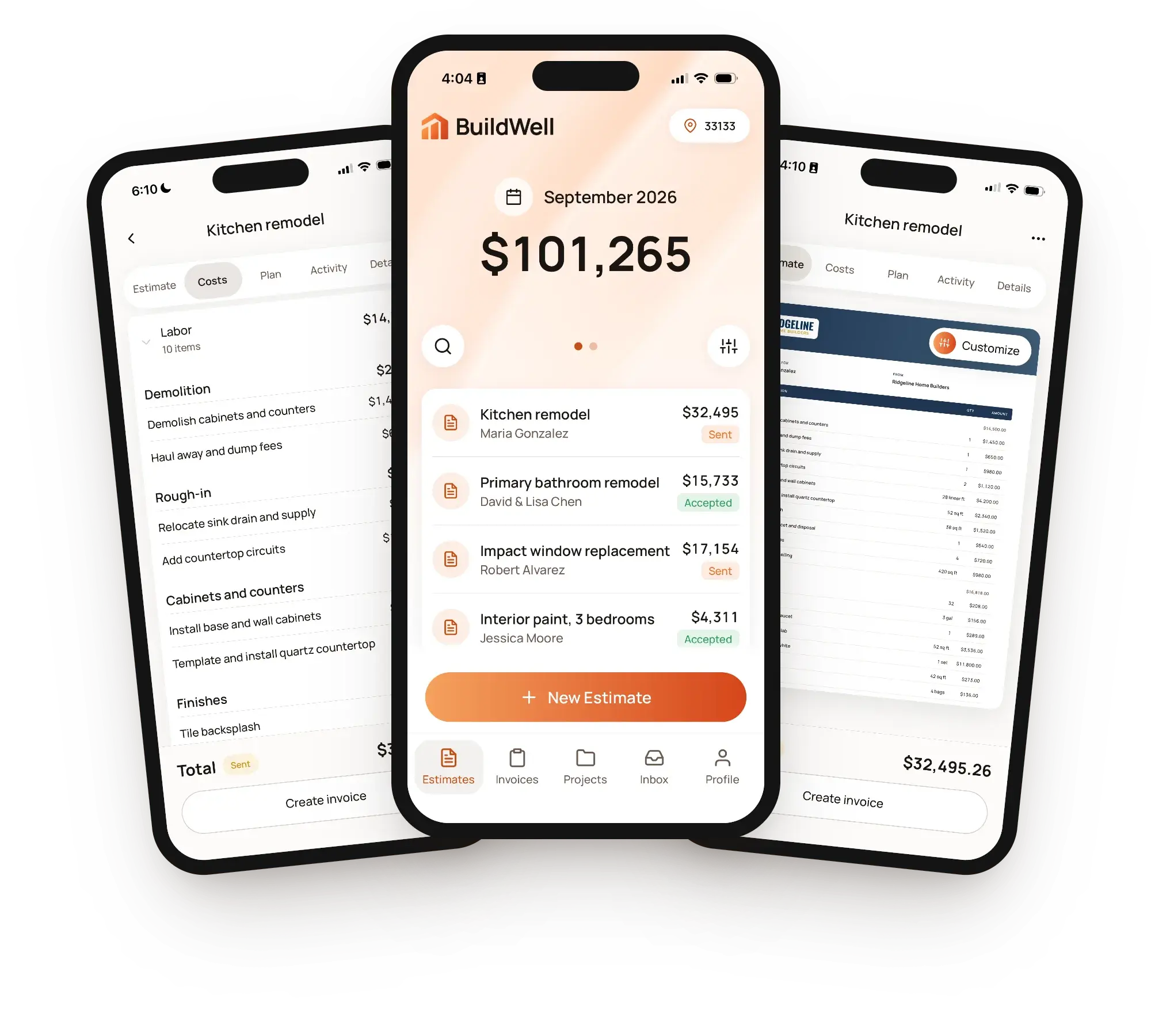
BuildWell writes itemized estimates priced for your area, gets them signed on the client’s phone, and turns them into invoices.
- AI estimates priced for your area
- Estimates, invoices, clients and projects
- Clients sign on any phone
- Card and bank payments, no extra BuildWell fee
- iPhone, Android and the web
- AI estimates priced for your area
- Estimates, invoices, clients and projects
- Clients sign on any phone
- Card and bank payments, no extra BuildWell fee
- iPhone, Android and the web
Both plans include every feature and start with a 3-day free trial. Add a card to start; you’re not charged until the trial ends. Cancel anytime.
Try BuildWell today
Estimates, invoices, e-signatures and payments in one place, on your phone and on the web.