 BuildWell
How to invoice for construction work
What a construction invoice must include, when to send deposit, progress and final invoices, and a worked final invoice with a change order and card fees.
Invoicing and getting paid · 9 min read · Updated
The steps, in order
- 1
Start from the signed estimate
Use the signed estimate and any signed change orders as the source for every line, so the invoice matches what the client agreed to.
- 2
Add the invoice details
Give the invoice a unique number, the issue date, the due date, the job address and a short description of the work billed.
- 3
List what is being billed
Show the contract amount, approved changes, payments already received and the balance due now.
- 4
State the terms and how to pay
Say when payment is due, what late terms apply under the contract, and every way the client can pay.
- 5
Send it the day the milestone is reached
Invoice the day the deposit is due, the milestone is passed or the job is finished, while the work is fresh.
- 6
Record the payment and follow up
Mark payments against the invoice as they arrive, and follow up on a schedule if they do not.
An invoice is a request for money that the client already agreed to pay. The work of getting paid mostly happens before the invoice: a signed estimate, clear payment terms and a payment schedule. The invoice's job is to make paying easy and arguing hard.
This guide covers:
- What a construction invoice needs
- When to send each kind
- How to handle deposits and changes on the final bill
- How payment methods affect what you actually receive
It ends with a worked final invoice for a bathroom remodel. For a blank one, use the free invoice generator or an invoice template.
What a construction invoice must include
The lines every invoice needs
Every invoice needs:
- Your business name, address, phone and email, and your license number if your state or city requires it on billing documents.
- The word "Invoice" and a unique invoice number. Numbers that run in sequence make records and taxes easier.
- Issue date and due date. "Due on receipt" or a specific date. A due date written as a date leaves less room for interpretation than "net 30."
- Client name and billing address, and the job address if they differ.
- A reference to the contract: the estimate or contract number it bills against.
- What is being billed: the deposit, the progress payment for a named milestone, or the final balance.
- Contract total, approved change orders, payments received and balance due.
- Sales tax, if your state requires you to charge it.
- Payment terms and methods.
Construction invoices bill against a contract
Construction invoices differ from retail invoices in one important way: they bill against a contract over time.
The client needs to see where this invoice sits in the whole job: what the total is, what has been paid and what is left.
The three kinds of construction invoice
Deposit invoice: sent at signing
Sent at signing, before work starts. It bills a fixed amount or percentage of the contract, as the payment terms say. Deposits pay for materials and secure a spot on your schedule.
Some states cap home-improvement deposits. In California, it cannot exceed 10% of the contract price or $1,000, whichever is less. The deposits and progress billing guide covers how to set them.
Progress invoice: sent at each milestone
Sent when a milestone in the payment schedule is reached, such as:
- Demolition done
- Rough-in inspection passed
- Cabinets set
On larger jobs, progress invoices may follow a schedule of values, billing the percentage of each line completed.
Final invoice: sent when the work is complete
Sent when the work is complete. It shows:
- The full contract amount
- Every approved change order
- Every payment received
- The balance due
Close the punch list before the final bill
If the job had a punch list, finish it, or agree in writing what remains, before sending the final bill. An open punch list is a common reason a final payment stalls.
How to write the invoice, step by step
Build the numbers from signed paperwork
- Start from the signed estimate. Every line on the invoice should trace back to something the client signed. If you retype the scope from memory, small differences creep in and give the client a reason to question the bill.
- Add every signed change order. List each by number with its amount. If a change was not signed, now is the worst time to discover it; the change order guide covers how to avoid that.
- Subtract payments received. List the deposit and each progress payment with dates.
- Show the balance due now as the largest number on the page.
Make paying easy
- State the terms: when it is due and any late terms your contract includes.
- List every way to pay: card, bank transfer, check, and any payment apps you accept, with the details the client needs.
- Attach what helps: photos of the finished work, a lien waiver if the client or lender asked for one, warranty information.
Worked example: a final invoice for a bathroom remodel
Example: The contract was $18,400 for a full bathroom remodel. The payment schedule called for a 25% deposit at signing and a 35% progress payment when the rough-in inspection passed. During the job, the client signed one change order to add an electric heated floor mat for $1,250.
| Line | Amount |
|---|---|
| Original contract | $18,400.00 |
| Change order 1: electric heated floor mat | $1,250.00 |
| Adjusted contract total | $19,650.00 |
| Less deposit received, 25% of original contract | −$4,600.00 |
| Less progress payment received, 35% of original contract | −$6,440.00 |
| Balance due on completion | $8,610.00 |
Check the math line by line
- 18,400 × 0.25 = 4,600
- 18,400 × 0.35 = 6,440
- 18,400 + 1,250 = 19,650
- Payments received: 4,600 + 6,440 = 11,040
- Balance: 19,650 − 11,040 = 8,610
Deposit and progress use the original contract
Notice that the deposit and progress payment are percentages of the original contract, as the payment schedule said. The change order is billed in full on the final invoice.
Some contractors bill change orders on the next progress invoice after they are signed instead. Either is fine as long as the contract says which.
California's cap changes the deposit
A California contract would have started with a deposit of no more than $1,000, because of the state's home-improvement cap. The difference would move into later progress payments.
Card vs bank transfer on this invoice
Example: If the client pays the $8,610 balance by card through Stripe at its standard US rate of 2.9% plus 30¢, the fee is 8,610 × 0.029 = $249.69, plus $0.30, for $249.99. You receive $8,360.01.
If the client pays by US bank transfer (ACH) through Stripe at 0.8% capped at $5, the fee would be 8,610 × 0.008 = $68.88, which hits the cap, so it is $5.00. You receive $8,605.00.
On large invoices, the difference is real. Offer both, and let the client choose.
Small jobs and time-and-materials invoices
Not every job has a contract and a payment schedule. Repairs and service calls are often billed on time and materials: hours at an agreed rate, plus materials.
Show how you reached the total
The invoice has to show the client how the total was reached, because they did not see a number in advance.
Example: A leak repair under a kitchen sink, billed at $95 an hour with materials marked up 20%:
| Line | Amount |
|---|---|
| Labor, 3.5 hours at $95 | $332.50 |
| Materials: trap, supply lines, valve, fittings ($48.00 cost + 20%) | $57.60 |
| Total due on receipt | $390.10 |
The checks: 3.5 × 95 = 332.50. 48 × 1.20 = 57.60. 332.50 + 57.60 = 390.10.
Get paid before you leave
On small jobs, the best time to get paid is before you leave. Send the invoice from your phone at the job, and let the client pay by card or bank transfer while you pack up.
A $390 invoice that goes in the mail tonight may be paid in three weeks. The same invoice sent from the driveway is often paid before you reach the truck.
Log your hours and keep receipts
Write down the start and stop times on site and keep the material receipts. If a client questions the hours, a clear record settles it quickly.
Payment methods to offer
The more ways a client can pay, the fewer reasons they have to pay later.
- Card. Fast and familiar, with the highest fees. Good for smaller invoices and clients who want to pay right now.
- Bank transfer (ACH). Lower fees and well suited to large balances. Takes a few business days to clear.
- Check. Still common for residential work. Free to accept, but slow, and you have to deposit it.
- Payment apps such as Zelle, Venmo, Cash App and PayPal. Convenient for clients who already use them. Check each service's terms for business use.
Put payment details on the invoice
Whichever you accept, put the details on the invoice itself. An invoice that says "call for payment options" adds a phone call between the client and paying you.
Lien waivers and final payment
Some clients ask for a lien waiver
On jobs where a lender or a careful homeowner is involved, the client may ask for a lien waiver with the final invoice. It is a document giving up your right to file a mechanic's lien for the amount paid.
Sign a conditional waiver, not an unconditional one
Use a conditional waiver that takes effect only when payment actually clears, not an unconditional one before the money is in your account.
Lien rules and waiver forms are set by state law, so use your state's form where one is required.
Record-keeping after the invoice
Record each payment the same day
When the payment arrives, record it against the invoice the same day, with the date and method. Send a receipt; a receipt generator works if your invoicing tool does not send one. Keep invoices, receipts and signed change orders together by job.
Business clients may need a 1099-NEC
If a business client pays you $2,000 or more in a calendar year starting with payments made in 2026, they may need to report it on Form 1099-NEC, and will ask for your W-9.
Homeowners paying for work on their personal residence generally do not file 1099s. Either way, your income is reportable, so your own records are what matter at tax time.
Invoicing commercial clients and general contractors
Business clients pay through an accounts payable process, and invoices that do not fit the process wait.
Ask these before the first invoice
- Who receives invoices, and at which email address
- What reference they need: a purchase order number, a job number or a contract number on every invoice
- What must come with it: a W-9, a certificate of insurance, lien waivers, a pay application in a specific format
- When their payment runs are, for example twice a month
A wrong reference number gets sent back
An invoice that arrives with the wrong reference number can be sent back unpaid weeks later. Getting these answers once saves a delay on every invoice after it.
Common invoicing mistakes
- Invoicing late. Every day between finishing and invoicing is a day added to when you get paid.
- Invoices that do not match the estimate. Different wording, different line items or a different total invite questions.
- Unsigned change orders on the final bill. Billing for work the client never approved in writing is how final payments turn into disputes.
- No due date. "Payment due" with no date is a suggestion.
- One payment method. The client who only has a card in hand at 9 p.m. will pay you tomorrow, or next week.
Invoicing with BuildWell
The signed estimate becomes the invoice
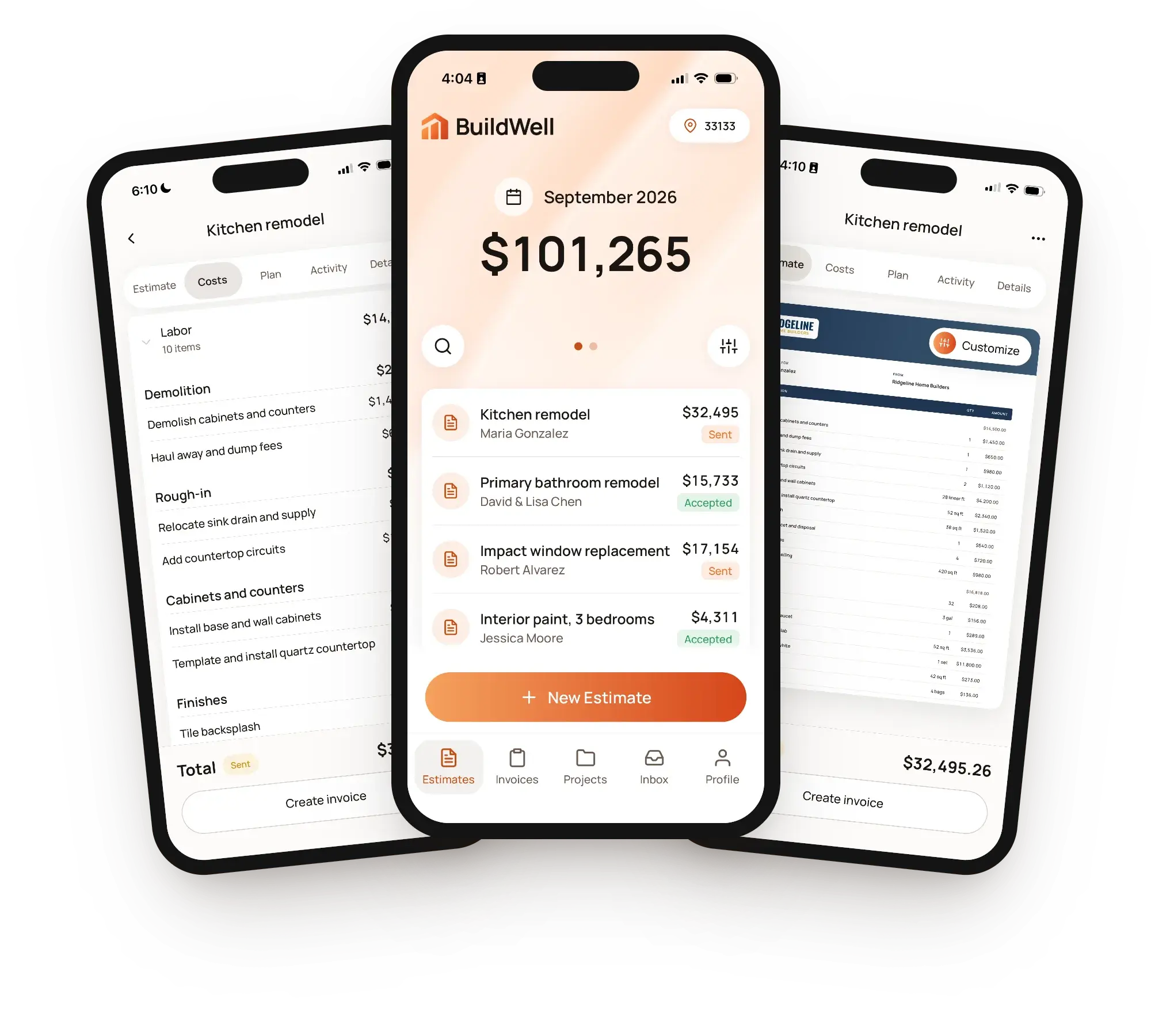
In BuildWell's invoicing software, the signed estimate becomes the invoice, with the same lines and totals, so nothing is retyped.
You can invoice a percentage of the estimate as a deposit, then progress payments and the balance. Every payment is recorded against its invoice. Terms can be due on receipt, 7, 14 or 30 days.
Clients pay from a link on their phone
Clients open the invoice from a link on their phone. They can pay:
- By card or bank transfer, with Stripe connected. Stripe's fee is passed through at cost, with no fee added by BuildWell.
- By Zelle, Venmo, Cash App, PayPal or check, using the details you list.
More on that is on the online payments page. It runs on iPhone, Android and the web.
Construction invoice checklist
- Invoice number, issue date and due date
- Job address and contract reference
- Contract total, signed change orders, payments received, balance due
- Sales tax handled the way your state requires
- Payment terms and every payment method you accept
- Sent the day the payment is earned
Get these right and the invoice becomes the least interesting document on the job, which is exactly what it should be.
Free tools for this guide
Generators, templates, calculators and definitions. No sign-up.
Common questions
01When should a contractor send an invoice?
02What is the difference between an estimate and an invoice?
03Do I charge sales tax on a construction invoice?
04Should I pass card fees on to the client?
05Can I invoice for work before it is done?
Estimates, signatures and invoices in one app
BuildWell prices materials at stores near the job and labor from your metro’s wages plus your overhead and markup, gets the estimate signed on the client’s phone, and turns it into the invoice.
- AI estimates priced for your area
- Estimates, invoices, clients and projects
- Clients sign on any phone
- Card and bank payments, no extra BuildWell fee
- iPhone, Android and the web
- AI estimates priced for your area
- Estimates, invoices, clients and projects
- Clients sign on any phone
- Card and bank payments, no extra BuildWell fee
- iPhone, Android and the web
Both plans include every feature and start with a 3-day free trial. Add a card to start; you’re not charged until the trial ends. Cancel anytime.
Try BuildWell today
Estimates, invoices, e-signatures and payments in one place, on your phone and on the web.