 BuildWell
Time and materials
A time and materials (T&M) contract bills the client for labor hours at agreed rates plus the cost of materials, often with a markup on the materials.
T&M suits repairs, service calls, troubleshooting and small jobs where the work can’t be defined until you open things up. The client pays for what the job actually takes, and the contractor doesn’t carry the risk of a fixed price.
The contract should state the hourly rate for each type of worker, whether travel time and minimum charges apply, how materials are billed (at cost or with a markup), and how equipment is charged. Hourly rates have to cover burdened labor cost, overhead and profit, since there’s no separate fee.
Clients worry about open-ended bills. A not-to-exceed amount, beyond which you need written approval to continue, gives them a ceiling. Daily or weekly time sheets and material receipts keep them informed and make the invoice hard to dispute.
Many fixed-price contracts use T&M rates for extra work. Listing those rates in the original contract makes change orders faster to price and approve.
How a time and materials contract works
A time and materials contract bills the client for the hours worked, at agreed rates for each type of worker, plus the materials used. There’s no fixed price for the job; the bill reflects what the work actually took.
The hourly rate does most of the work. Unlike cost-plus, where overhead and profit come as a separate fee, a time and materials rate has to cover the worker’s wage, labor burden such as payroll taxes and workers’ compensation, a share of overhead, and profit. If the rate only covers wages, every hour loses money.
Materials are billed at cost or with a markup, as the contract says. Equipment you own is billed at a set rate per hour or day; rented equipment at cost or with a markup. The contract should also cover minimum charges, travel time, overtime and after-hours rates.
Time is usually billed in set increments, such as quarter or half hours, often with a minimum charge per visit. Say which, and whether travel to the job and trips to pick up materials count as billable time.
Billing usually happens at the end of a short job, or weekly on a longer one. Each invoice ties back to time sheets and receipts, so the client can match every hour and every part to the work done.
Types of time and materials arrangements
| Version | How it bills | Best for |
|---|---|---|
| Open time and materials | Hours and materials with no ceiling | Service calls and small repairs |
| Not-to-exceed | Hours and materials up to an approved ceiling | Repairs where the client needs a budget |
| Rates for extra work | Rates listed in a fixed-price contract, used for changes | Pricing change orders quickly |
| Labor only | Hours only; the client supplies materials | Client-supplied materials, with warranty limits spelled out |
The not-to-exceed version is the most common answer to a client’s worry about an open-ended bill. You stop and ask for written approval before going past the ceiling.
Whatever the version, the client should know the rates before work starts. Rates written into the contract or work order, rather than quoted over the phone, are the ones that hold up later.
Why time and materials matters to each side
For contractors
Time and materials removes the risk of a fixed price on work you can’t see until you open it up: leaks, troubleshooting, repairs in old buildings. In exchange, you earn the same rate whether the crew is fast or slow, so efficiency benefits the client, and you carry the paperwork of proving every hour.
For homeowners and clients
You pay only for the work done, without a contractor’s cushion for risk. The risk is an open-ended bill, which a not-to-exceed amount, daily time sheets and regular updates keep in check. Ask for the rates and terms in writing before work starts.
For property managers and commercial clients
Maintenance and service agreements are often written on time and materials, with rates set for the year. The client gets predictable rates and a record of every visit; the contractor gets steady work without pricing each call from scratch.
How to run a time and materials job
- Build each hourly rate from the worker’s wage, labor burden, a share of overhead per billable hour, and profit.
- Write the terms: rates by worker type, minimum charge, travel, overtime, material markup and equipment rates.
- Agree on a not-to-exceed amount and who can approve going past it.
- Keep daily time sheets showing who worked, how long and on what, and have the client or their representative sign them.
- Keep every material receipt and match it to the job.
- Stop and get written approval as you approach the ceiling.
- Invoice with the time sheets and receipts attached.
On fixed-price contracts, listing your time and materials rates for extra work makes change orders faster to price and harder to dispute.
On longer jobs, share the running total with the client every day or two. A client who knows where the bill stands is far less likely to question it.
Time and materials example with numbers
Say a contractor is called to find and repair a leak behind a shower wall, on a time and materials basis with a $1,500 not-to-exceed amount. The contract lists a lead technician at $95 an hour, a helper at $60 an hour, and a 15% markup on materials.
| Line | Quantity | Rate | Amount |
|---|---|---|---|
| Lead technician | 6 hours | $95 per hour | $570 |
| Helper | 6 hours | $60 per hour | $360 |
| Materials | $240 at cost | 15% markup | $276 |
| Total | $1,206 |
The total is $570 + $360 + $276 = $1,206, which leaves $294 under the $1,500 ceiling. If the repair had needed another half day, the contractor would have stopped and asked for approval before continuing.
Where does $95 come from? Say the technician earns $36 an hour and the contractor’s labor burden on that wage works out to 30%, or $10.80, for a cost of $46.80. Overhead adds $18 per billable hour, bringing the cost to $64.80. The remaining $30.20 is profit, about 32% of the rate. A rate set at the $36 wage would have lost money on every hour.
Common time and materials mistakes
- Setting rates from wages alone, without burden, overhead and profit.
- Working without a not-to-exceed amount on a job the client expects to be small.
- Skipping daily time sheets, then trying to reconstruct the hours at invoice time.
- Charging travel, minimums or material markup the contract didn’t mention.
- Going past the ceiling and asking for approval afterward.
- Mixing time and materials work with fixed-price work on one invoice without separating them.
- Billing a helper’s hours at the lead technician’s rate, or listing workers who weren’t on site.
Clear rates, a ceiling and signed daily records make time and materials work one of the easiest kinds to get paid for.
Common questions
01Is time and materials a good deal for homeowners?
02What should a time and materials invoice include?
03What does not-to-exceed mean?
04Can contractors mark up materials on a time and materials job?
05What is the difference between time and materials and cost-plus?
06How do contractors set time and materials rates?
Estimates, signatures and invoices in one app
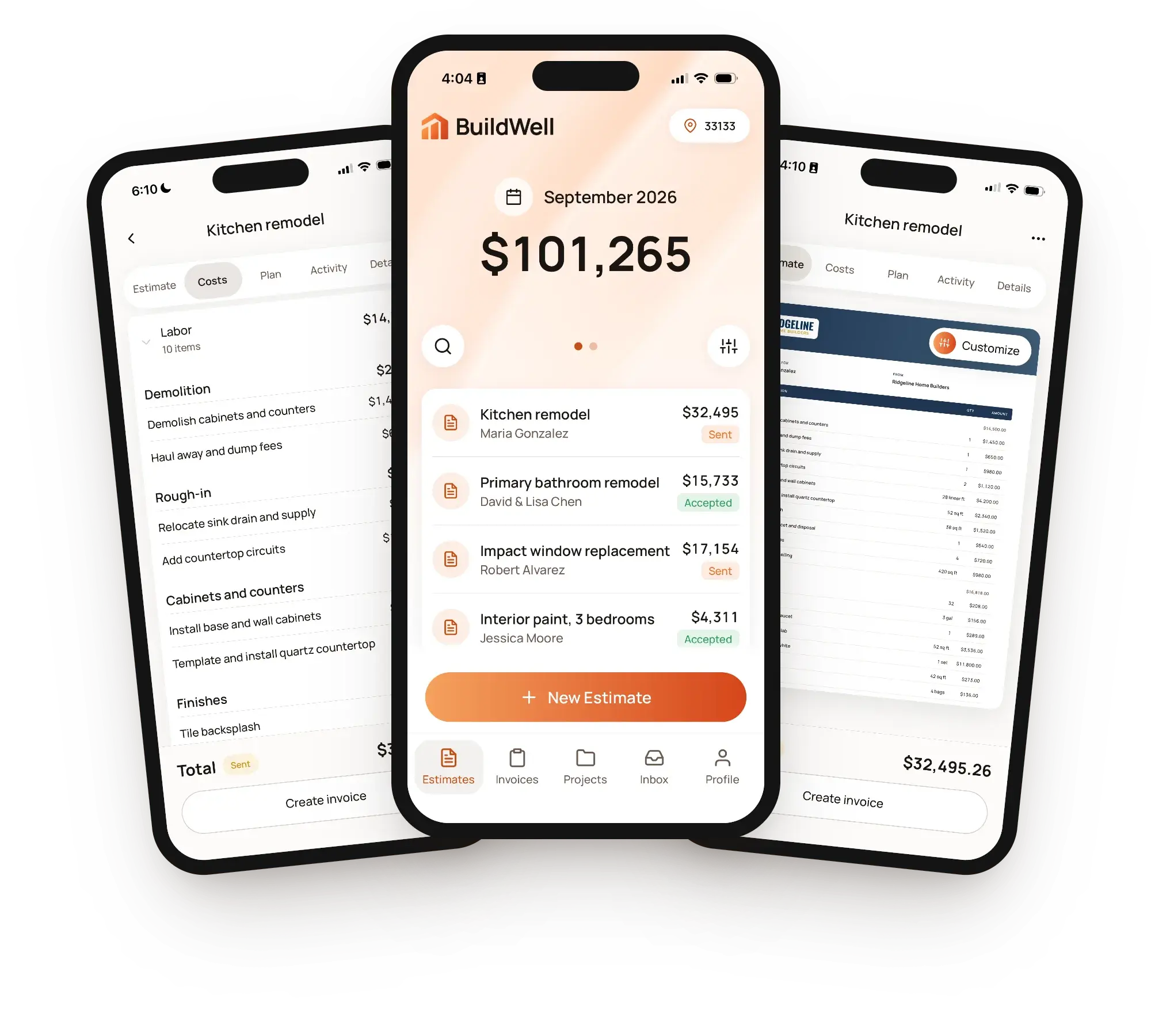
BuildWell writes itemized estimates priced for your area, gets them signed on the client’s phone, and turns them into invoices.
- AI estimates priced for your area
- Estimates, invoices, clients and projects
- Clients sign on any phone
- Card and bank payments, no extra BuildWell fee
- iPhone, Android and the web
- AI estimates priced for your area
- Estimates, invoices, clients and projects
- Clients sign on any phone
- Card and bank payments, no extra BuildWell fee
- iPhone, Android and the web
Both plans include every feature and start with a 3-day free trial. Add a card to start; you’re not charged until the trial ends. Cancel anytime.
Try BuildWell today
Estimates, invoices, e-signatures and payments in one place, on your phone and on the web.