 BuildWell
Change order
A change order is a written agreement, signed by the contractor and client, that changes the scope, price or schedule of a contract after it’s signed.
Changes happen on almost every job: the client upgrades a fixture, adds a closet, or you find rot behind the drywall. A change order puts the new work, its price and its effect on the schedule in writing before you do it.
Include a description of the change and why it’s needed, the added cost or credit, the new contract total, any change to the completion date, and signatures. Number change orders in sequence so the running total is easy to follow.
Get the signature before the work. Verbal approvals on a busy job are easy to forget or dispute, and once the work is done you’ve lost your leverage on price. If something has to happen right away for safety, document it the same day and get the change order signed as soon as you can.
Watch the contract’s rules: many require written change orders and say that unsigned changes won’t be paid. Some state home improvement laws also require changes to be in writing.
In BuildWell, a change order is a revision of the estimate, and the client signs the revised version on their phone.
How a change order works
Every contract fixes a scope, a price and a schedule. A change order changes one or more of them by agreement. It starts when someone identifies a change: the client wants an upgrade, the plans conflict with the site, or opening a wall reveals rot or wiring that isn’t to code.
The contractor then prices the change. Added work is usually priced the same way as the original estimate: materials, labor, any sub costs, and markup for overhead and profit. Deleted work becomes a credit. Some contracts set the method in advance, such as fixed unit prices or a stated markup on change order work.
The change order itself describes the change, gives the added cost or credit, states the new contract total and any change to the completion date, and is signed by both sides before the work starts. Change orders are numbered in sequence, so the contract total at any moment is the original price plus or minus every approved change.
Once signed, the change order becomes part of the contract. It shows up on the next progress invoice as its own line, and on commercial jobs it’s added to the schedule of values. Keep unsigned changes out of billing until they’re approved.
Types of change orders
Change orders differ by who starts them and which way the price moves. The paperwork is much the same, but the conversation isn’t.
| Type | Example | Effect on price |
|---|---|---|
| Client-requested addition | Adding a closet or upgrading a fixture | Increase |
| Deduct or credit | The client drops a built-in or supplies their own fixture | Decrease |
| Hidden or unforeseen condition | Rot, outdated wiring or a buried obstruction | Usually an increase |
| Allowance reconciliation | The tile chosen costs more or less than the allowance | Increase or decrease |
| Required by code or an inspector | An inspector calls for extra blocking or a larger beam | Usually an increase |
Who pays for hidden conditions or code-required changes depends on the contract. A good contract says how unknown conditions are handled before anyone finds one. Some commercial contracts also let the owner direct the work to proceed before the price is agreed, with the price settled afterward.
Why change orders matter
For contractors
A change order is how you get paid for work outside the original scope. Without a signed one, many contracts say the extra work won’t be paid, and even where it might be, you’re arguing about price after the work is done. Change orders also protect your schedule: if a change adds days, the new completion date is in writing.
For homeowners and clients
A change order shows the cost of a decision before it’s made. Clients can say no, choose a cheaper option or adjust other parts of the job. The running total keeps the final bill from being a surprise.
For subcontractors
Subs should get a signed change order from the general contractor before doing extra work, even when the owner asked for it directly. A sub’s contract is with the general contractor, and the general contractor needs its own change order from the owner to pass the cost along.
How to handle a change order step by step
- Write it down as soon as a change comes up, with photos if it’s a hidden condition.
- Describe the change in plain terms: what’s added, removed or replaced, and where.
- Price it from your costs: materials, labor hours and sub quotes, then markup as your contract allows.
- State the schedule effect, even if it’s zero days.
- Show the new contract total: the previous total plus or minus this change.
- Get the client’s signature before starting the work. An e-signature on their phone works for most contracts.
- Add the change to your next invoice as its own line, and to the schedule of values if there is one.
When the work truly can’t wait, such as a safety issue or an active leak, get the client’s approval in writing that day, even by text, and get the formal change order signed as soon as possible.
Change order example with a revised contract sum
Say a remodeler signs a $64,000 kitchen and bath remodel. Over the job, the client approves three change orders:
- Change order 1: the client upgrades the kitchen counters to quartz, +$2,850.
- Change order 2: rotted subfloor under the bathroom has to be replaced, +$1,700, adding 3 days.
- Change order 3: the client drops a built-in pantry, a credit of −$1,200.
Change order 2 is priced from costs. Say materials are $460 and the work takes 12 labor hours at $75 an hour, or $900. That’s $1,360, and the remodeler’s 25% markup adds $340, for $1,700.
| Item | Amount | Contract total | Days added |
|---|---|---|---|
| Original contract | $64,000 | $64,000 | – |
| Change order 1, quartz counters | +$2,850 | $66,850 | 0 |
| Change order 2, subfloor repair | +$1,700 | $68,550 | 3 |
| Change order 3, pantry deleted | −$1,200 | $67,350 | 0 |
The revised contract sum is $64,000 + $2,850 + $1,700 − $1,200 = $67,350, a net change of +$3,350. If the client has already paid $40,000 in progress payments, the balance to finish is $67,350 − $40,000 = $27,350, and every later invoice should show the revised total, not the original $64,000.
Common change order mistakes
- Starting extra work on a verbal yes and writing it up later, or never.
- Describing the change so vaguely that the client remembers a different scope.
- Leaving out the schedule effect, then being blamed for finishing late.
- Forgetting to show the new contract total, so nobody tracks the running sum.
- Not issuing credits for deleted work, which costs trust when the client notices.
- Pricing changes at or below cost to keep the client happy, then losing money on the job.
- Billing change order work before the change order is signed.
Most change order disputes are about memory, not money. A short written change order, priced and signed before the work, replaces memory with a document both sides can point to.
Common questions
01Who pays for a change order?
02Can a contractor refuse a change order?
03Does a change order need to be signed by both parties?
04How much markup should go on a change order?
05What happens if work is done without a change order?
Estimates, signatures and invoices in one app
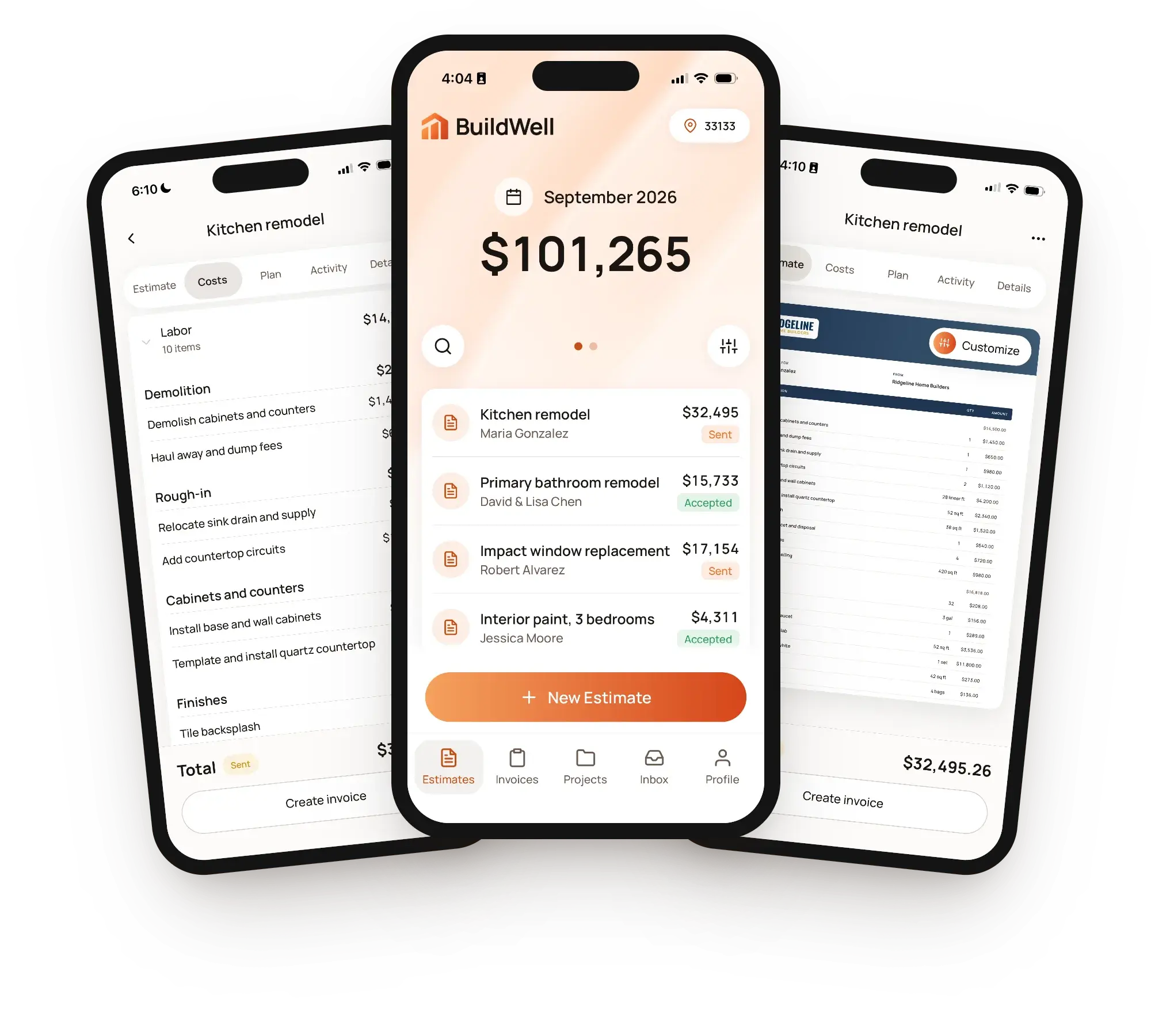
BuildWell writes itemized estimates priced for your area, gets them signed on the client’s phone, and turns them into invoices.
- AI estimates priced for your area
- Estimates, invoices, clients and projects
- Clients sign on any phone
- Card and bank payments, no extra BuildWell fee
- iPhone, Android and the web
- AI estimates priced for your area
- Estimates, invoices, clients and projects
- Clients sign on any phone
- Card and bank payments, no extra BuildWell fee
- iPhone, Android and the web
Both plans include every feature and start with a 3-day free trial. Add a card to start; you’re not charged until the trial ends. Cancel anytime.
Try BuildWell today
Estimates, invoices, e-signatures and payments in one place, on your phone and on the web.