 BuildWell
Progress billing
Progress billing is invoicing a project in stages, as work is completed, instead of billing the full amount at the end.
On any job longer than a few days, progress billing keeps money coming in while costs go out. Each invoice covers the work done since the last one, either by milestone (rough-in complete, cabinets set) or by percentage complete each month.
Milestone billing suits residential work: the client can see the stage is done, and the amounts are fixed in the contract. Percentage-complete billing is common on commercial jobs, where a schedule of values breaks the contract into lines and each monthly pay application shows how far along each line is.
Each progress invoice should show the contract total, approved change orders, what was billed before, this invoice’s amount, any retainage held, and the balance left. That running tally prevents the end-of-job surprise where you and the client remember different numbers.
Tie the schedule to work the client can verify. Front-loading it, so early payments run ahead of the work, causes disputes and, on commercial jobs, gets pay applications rejected.
In BuildWell, an approved estimate becomes the invoice, and deposits and progress invoices are tracked against payments so you can see what’s still owed.
How progress billing works
Progress billing splits the contract price into pieces and bills each piece as it’s earned. The contract sets how progress is measured, how often you can bill, how long the client has to pay, and whether any retainage is held. Everything else follows from those four choices.
Each progress invoice is a running tally of the whole contract, not a stand-alone bill. It restates these figures every time:
- The original contract sum.
- Approved change orders, added or subtracted, giving the revised contract sum.
- Work completed to date, by milestone or by percentage.
- Retainage held, if the contract calls for it.
- Previous billings.
- The amount due on this invoice.
- The balance left to finish, including retainage.
Because each invoice restates the totals, an error or a missed payment shows up on the next one instead of hiding until the end. Billing “to date” rather than “this period” also makes corrections simple: if last month’s percentage was too high, this month’s to-date figure fixes it.
Types of progress billing
Most progress billing uses one of three methods. Some jobs mix them, for example milestones for the main contract and time and materials for extra work.
| Method | How the amount is set | Common fit | Watch for |
|---|---|---|---|
| Milestone | A fixed amount when a stage is done | Residential remodels and additions | Milestones the client can’t verify |
| Percentage complete | Each schedule of values line billed by percent done | Commercial jobs with monthly pay applications | Overstating percentages early |
| Time and materials | Hours and materials used each period | Repair work and jobs with an unclear scope | Missing timesheets and receipts |
Milestone billing is easy to explain and check, but the amounts are fixed when the contract is signed, so a long gap between milestones means a long gap between payments. Percentage-complete billing follows the work more closely but takes more paperwork, and on many commercial jobs the owner’s reviewer checks every line.
Why progress billing matters
For contractors
Progress billing keeps your cash close to your costs. Instead of financing labor and materials for the whole job and waiting for one large payment at the end, you carry a few weeks at a time. It also limits the damage if a client stops paying partway through: the unpaid amount is one invoice, not the whole contract.
For homeowners and clients
Clients pay for work as it happens, which is easier to budget and easier to check. A clear running tally shows what’s been paid, what change orders have added and what’s left, so the final invoice holds no surprises.
For lenders and owners
Construction lenders release money in draws against work completed, so progress billing that lines up with their draw schedule gets paid faster. Owners on commercial jobs use the schedule of values and each pay application to confirm they aren’t paying ahead of the work.
How to set up progress billing step by step
- Choose the method that fits the job and the client: milestones for most residential work, percentage complete for commercial work with a schedule of values.
- Break the contract into milestones or schedule of values lines from your estimate, so each one reflects the real cost of that work plus its share of overhead and profit.
- Write the billing schedule, the payment window and any retainage into the contract.
- Line up your billing dates with the client’s pay cycle, or with the lender’s draw schedule if there is one.
- Bill the day a milestone is reached, or on the agreed date each month.
- Show the full running tally on every invoice, with each change order as its own line.
- Collect lien waivers and other required paperwork with each billing, and track retainage as a receivable until it’s released.
Keep each billing to work actually done. Billing ahead of the work may feel safer for your cash, but on commercial jobs it gets pay applications cut, and on residential jobs it erodes trust. Some states’ home improvement rules also address payments that run ahead of the work, so check yours.
Progress billing example with numbers
Say a contractor has a $90,000 contract for a commercial tenant buildout, billed monthly by percentage complete, with 5% retainage. In the second month, the client approves a $6,000 change order for extra electrical work, bringing the revised contract sum to $96,000.
At the end of month 1, work completed to date is $27,000. Retainage is $1,350, so $25,650 is due. At the end of month 2, completed work is $58,000, including part of the change order. Retainage is $2,900, so earned less retainage is $55,100. Subtracting the $25,650 already billed leaves $29,450 due.
At the end of month 3, the work is complete at $96,000. Retainage is $4,800, so earned less retainage is $91,200, and $91,200 − $55,100 = $36,100 is due. After the punch list and closeout paperwork, the $4,800 of retainage is billed.
| Billing | Completed to date | Retainage held | Previously billed | This invoice |
|---|---|---|---|---|
| Month 1 | $27,000 | $1,350 | $0 | $25,650 |
| Month 2 | $58,000 | $2,900 | $25,650 | $29,450 |
| Month 3 | $96,000 | $4,800 | $55,100 | $36,100 |
| Retainage release | $96,000 | $0 | $91,200 | $4,800 |
The four invoices add up to $25,650 + $29,450 + $36,100 + $4,800 = $96,000, the revised contract sum. On the month 2 invoice, the balance to finish including retainage is $96,000 − $55,100 = $40,900, a number both sides should agree on before month 3 starts.
Common progress billing mistakes
- Front-loading the schedule so early billings run ahead of the work.
- Billing “this period” amounts without a running to-date total, so errors carry forward unnoticed.
- Folding change orders into existing lines instead of showing them separately.
- Forgetting to subtract retainage, or forgetting to bill it once the job is done.
- Setting milestones the client can’t verify, like “50% complete,” on a residential job.
- Missing the client’s or lender’s cutoff date and waiting a full cycle to get paid.
- Billing for change order work before the change order is signed.
Progress billing works when each invoice is accurate, on time and easy to check. The running tally is what makes that possible, so keep it on every invoice from the first to the last.
Common questions
01What is the difference between progress billing and a progress payment?
02How often should you send progress invoices?
03Can you progress bill for materials not yet installed?
04How does retainage work with progress billing?
05Is progress billing the same as a draw?
Estimates, signatures and invoices in one app
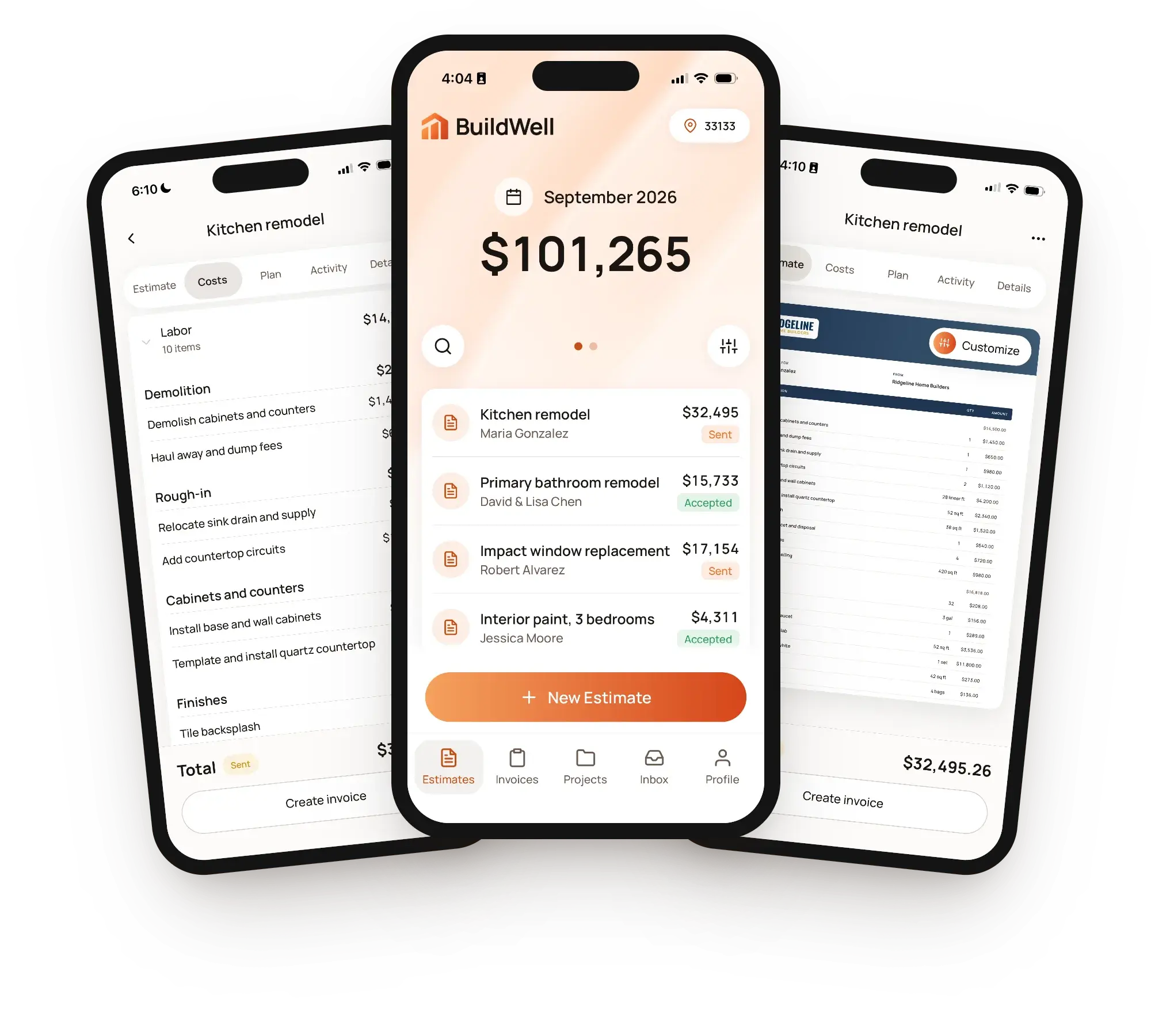
BuildWell writes itemized estimates priced for your area, gets them signed on the client’s phone, and turns them into invoices.
- AI estimates priced for your area
- Estimates, invoices, clients and projects
- Clients sign on any phone
- Card and bank payments, no extra BuildWell fee
- iPhone, Android and the web
- AI estimates priced for your area
- Estimates, invoices, clients and projects
- Clients sign on any phone
- Card and bank payments, no extra BuildWell fee
- iPhone, Android and the web
Both plans include every feature and start with a 3-day free trial. Add a card to start; you’re not charged until the trial ends. Cancel anytime.
Try BuildWell today
Estimates, invoices, e-signatures and payments in one place, on your phone and on the web.