 BuildWell
Contingency
A contingency is an amount set aside in a project budget or contract to cover costs that can’t be predicted when the price is set.
Every job has unknowns: rot behind siding, wiring that isn’t to code, a soil problem under a slab. A contingency puts a number on that risk instead of hoping it doesn’t happen.
There are two kinds. An owner’s contingency sits in the client’s budget for changes they choose or problems they’re responsible for, and it’s spent through change orders. A contractor’s contingency is built into the contractor’s price to cover estimating risk; on a fixed-price job the client usually doesn’t see it as a line item.
Size it to the risk. New construction from complete drawings needs less than a remodel of an old house. Older homes, incomplete plans and work behind finished walls all call for more.
In cost-plus and guaranteed maximum price contracts, the contingency is often visible, and the contract should say who can use it, for what, and what happens to money left over. On remodels, telling clients up front that a contingency exists makes conversations about hidden conditions much easier.
How a construction contingency works
A contingency is money set aside for costs nobody can see when the price is set. On a remodel, that might be rot under a floor, wiring that has to be replaced, or framing that isn’t where the drawings show it. Instead of pretending those risks don’t exist, the budget puts a number on them.
Where the contingency sits decides who controls it. If it’s in the owner’s budget, the owner spends it, usually through change orders. If it’s in the contractor’s price, the contractor uses it to absorb the misses and surprises that come with any estimate. On cost-plus and guaranteed maximum price contracts, the contractor’s contingency is often visible as a line, and the contract sets the rules for using it.
A contingency is drawn down as problems come up. Each draw should be recorded with what it paid for, so everyone can see how much is left. At the end, the contract decides what happens to the remainder: it stays with the owner, stays with the contractor, or is split.
A contingency is different from padding. Padding hides extra money in every line so nobody can see it; a contingency is a stated amount with stated rules. The first erodes trust when it’s discovered. The second builds it, because the client can see the money and what happens to it.
Types of contingency
| Type | Held by | Covers | Money left over |
|---|---|---|---|
| Owner’s contingency | The owner, in the project budget | Owner-requested changes and conditions the owner is responsible for | Stays with the owner |
| Contractor’s contingency, fixed price | The contractor, inside the price | Estimating gaps, small misses, slower work than planned | The contractor’s |
| Contractor’s contingency, cost-plus or GMP | The contractor, as a visible line | In-scope costs that weren’t foreseen | As the contract says |
| Design contingency | The owner or designer, during design | Scope that grows as drawings are finished | Shrinks as the design is completed |
A single project can have more than one. A remodel might carry an owner’s contingency for hidden conditions and a contractor’s contingency for estimating risk, and they should be tracked separately.
Why contingency matters
For contractors
A contingency protects your margin from the problems you can’t price exactly. Without one, every surprise becomes either an awkward change order or a loss. On remodels of older homes, it also gives you a calm way to deal with what you find when walls come open. And it saves you from choosing between absorbing a loss and arguing with a client halfway through the job.
For homeowners and clients
A project budget that includes a contingency is more honest than one that doesn’t. If rot turns up under the bathroom floor, the money to fix it is already planned, and the job doesn’t stop while you look for it. A budget with no contingency on an old house is a budget that will probably be exceeded.
For lenders
Construction lenders often look for a contingency line in the project budget, since a loan that runs out before the work is finished puts both the project and the loan at risk.
How to set and manage a contingency
- List the specific risks on the job: the age of the house, work behind finished surfaces, incomplete drawings, soil, weather.
- Size the contingency to those risks rather than using the same percentage on every job.
- Decide who holds it and write the rules: who can draw on it, for what, and who has to approve each draw.
- Show it as its own line in the budget or contract, separate from allowances.
- Record each draw with the reason, the amount and the balance left.
- Report the balance with each progress invoice or pay application.
- At closeout, settle the remainder the way the contract says.
Explaining the contingency to a client at the start, before anything goes wrong, turns a hidden-condition conversation from a negotiation into a routine update.
When the balance runs low, warn the client before it runs out. A short note that only $1,000 remains, with the work still ahead listed, lets the client plan instead of being surprised.
Contingency example with numbers
Say the construction cost for a remodel of a 1950s house is $80,000, and the owner agrees to carry a 10% contingency, $8,000, for a total budget of $88,000.
| Draw | Amount | Contingency left |
|---|---|---|
| Start of job | — | $8,000 |
| Rotted subfloor under the bathroom | $2,400 | $5,600 |
| Old wiring found in a bedroom wall | $3,100 | $2,500 |
| Owner chooses upgraded windows | $1,500 | $1,000 |
The three draws total $2,400 + $3,100 + $1,500 = $7,000, leaving $1,000. Each was documented with a signed change order. Because this is an owner’s contingency, the $1,000 stays with the owner, and the job comes in at $87,000. Because the balance was reported with each progress invoice, the owner always knew how much was left, which made the window upgrade an easy decision.
On the contractor’s side, say the same contractor priced $3,000 of contractor’s contingency into the fixed price for estimating risk. If the crew runs over on demolition by $1,200, that comes out of the $3,000. Whatever is left becomes profit, because on a fixed-price job the risk and the reward are both the contractor’s.
Common contingency mistakes
- Using the same contingency percentage on every job, whatever the risk.
- Spending contingency on scope changes without a change order.
- Counting a visible contingency as profit before the job is finished.
- Not telling the client how much is left until it’s gone.
- Mixing contingency with allowances, so neither can be tracked.
- Leaving the contract silent on who keeps the money left over.
- Leaving out a contingency on a job with obvious unknowns, just to keep the bid low.
A contingency works when it’s sized honestly, governed by written rules and reported regularly. Treated as a slush fund, it causes more disputes than it prevents.
Common questions
01How much contingency should a remodel have?
02Who keeps unused contingency money?
03Does using contingency require a change order?
04Is a contingency the same as an allowance?
05Should a contingency appear on the estimate?
06What is a contractor’s contingency?
Estimates, signatures and invoices in one app
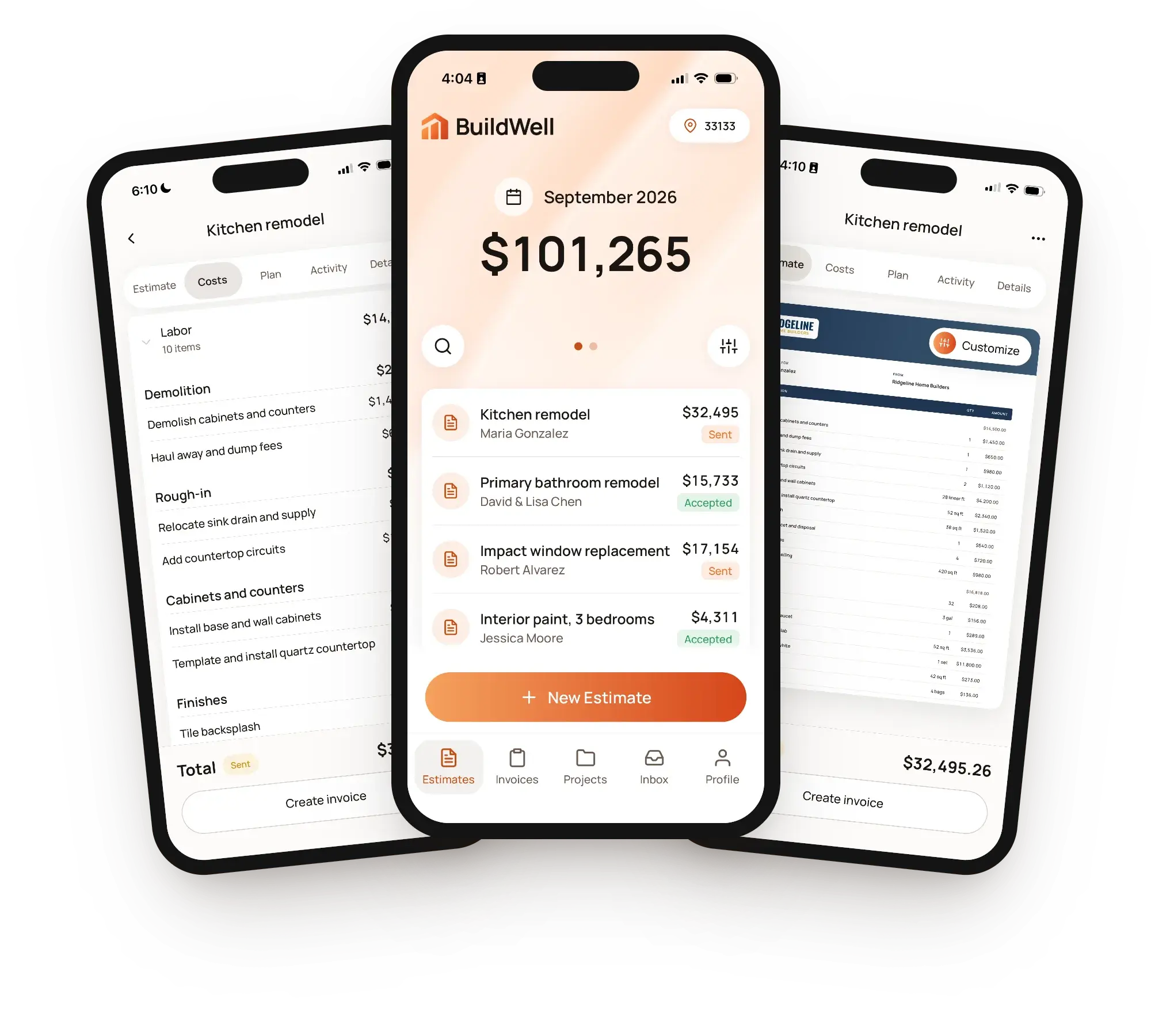
BuildWell writes itemized estimates priced for your area, gets them signed on the client’s phone, and turns them into invoices.
- AI estimates priced for your area
- Estimates, invoices, clients and projects
- Clients sign on any phone
- Card and bank payments, no extra BuildWell fee
- iPhone, Android and the web
- AI estimates priced for your area
- Estimates, invoices, clients and projects
- Clients sign on any phone
- Card and bank payments, no extra BuildWell fee
- iPhone, Android and the web
Both plans include every feature and start with a 3-day free trial. Add a card to start; you’re not charged until the trial ends. Cancel anytime.
Try BuildWell today
Estimates, invoices, e-signatures and payments in one place, on your phone and on the web.