 BuildWell
Net 30
Net 30 is a payment term that makes the full invoice amount due 30 days after the invoice date.
The “net” is the full amount owed after any agreed discounts or credits. The 30 days usually run from the invoice date, not from the day the client opens the email, so date every invoice and send it the same day. If the contract starts the clock somewhere else, such as when a pay application is approved, say that on the invoice too.
Net 30 is common in commercial work and with property managers, general contractors and other businesses that pay bills on a monthly cycle. Homeowners rarely expect it; on residential jobs, due on receipt or a short window is more usual.
Some contractors offer an early-payment discount written as “2/10 net 30”: the client may take 2% off if they pay within 10 days; otherwise the full amount is due in 30. Offer it only if your margin can absorb it.
Write the term the same way everywhere: in the contract, on the estimate and on each invoice, with the due date spelled out (“Due March 15”). A written date leaves less room for argument than a term alone. If you charge a late fee, the contract has to say so before work starts, and state law may limit it.
Net 30 means you carry the cost of labor and materials for a month or more. Price that in, ask for a deposit on larger jobs, or bill in stages so you aren’t financing the whole project.
How net 30 works
Net 30 sets a deadline, not a payment plan. The client owes the whole balance on the invoice, and it’s due on the 30th calendar day after the invoice date. An invoice dated March 1 is due March 31. Weekends and holidays count unless the contract says “business days,” which pushes the date out further.
The clock starts from whatever the contract says. Most often that’s the invoice date. Some commercial contracts start it when the invoice is received, when the work is accepted, or when a pay application is approved, and each of those can add days or weeks. Read that clause before you bid, because the gap between finishing the work and starting the clock is money you carry too.
The “net” refers to the amount after any agreed credits: deposits already paid, approved deducts and, if you offer one, an early-payment discount. If an invoice says $20,000 net 30, the client owes $20,000 by day 30, not a first installment.
Net 30 is a deal between you and the client. It doesn’t change state lien and notice deadlines, any prompt payment law that applies to the project, or your suppliers’ own terms. If a supplier wants payment 30 days after delivery and your client pays 30 days after an invoice you send at the end of the month, you’re paying before you’re paid.
Net 30 variations you’ll see on invoices
The basic term has several common variations. Each one changes the due date or the amount, so write out exactly which one applies.
| Written as | What it means | Due for an invoice dated March 1 |
|---|---|---|
| Net 30 | Full amount due 30 days after the invoice date | March 31 |
| 2/10 net 30 | 2% off if paid within 10 days; otherwise the full amount in 30 | March 11 with the discount, March 31 in full |
| Net 30 EOM | Full amount due 30 days after the end of the month the invoice is dated | April 30 |
| Net 30 from approval | The 30 days start when the client approves the invoice or pay application | Depends on when approval comes |
“EOM” is counted differently by different businesses, so if you see it in a client’s contract, ask how they count it and write the answer down. The same goes for terms a client’s accounts payable team prints on its purchase orders: if they differ from your contract, settle which one governs before the first invoice.
Why net 30 terms matter
For contractors
Every day between paying for labor and materials and getting paid is a day you finance the job. On net 30 that gap is at least a month, longer if you invoice late or the client pays late. It ties up cash you’d otherwise use to start the next job, and if you carry it on a credit card or credit line, it costs interest. That cost belongs in your price.
For commercial clients and property managers
Businesses that pay on a monthly accounts payable cycle need time to match invoices to purchase orders and get approvals. Net 30 fits that cycle. Offering it can make you easier to hire, and insisting on due on receipt may just mean your invoice waits in the same queue anyway.
For subcontractors
A sub on net 30 from a general contractor often waits longer than 30 days in practice, because the general contractor may also have a pay-when-paid clause and its own monthly cycle. Read both clauses together to see when money will really arrive, and plan payroll around that date, not the term on the invoice.
How to set up and collect on net 30 terms
- Decide before you bid whether you can carry the job for 30 days or more. Add up what you’ll have spent by the first payment date.
- Put the term in the contract or signed estimate, along with what starts the clock and any late fee your state allows.
- Invoice the day the work or milestone is done. Every day you wait to invoice is a day added to the wait.
- Print the actual due date on the invoice (“Due March 31”), not just “net 30,” along with the client’s PO number if they use one.
- Send a short reminder about a week before the due date, and confirm the invoice is approved and in the client’s next payment run.
- Check your aging report weekly, and call the day after an invoice goes past due.
- Track lien and notice deadlines separately. They run on state law, not on your payment terms.
On longer jobs, combine net 30 with progress billing so each invoice is smaller and you never carry much more than a month of work at once. Ask suppliers for terms that line up with when you get paid.
Net 30 example: discount and carrying cost
Say a remodeler finishes a $20,000 tenant improvement for a property manager on net 30. By the invoice date, the remodeler has already paid $15,000 in labor and materials. Assume, as a hypothetical, that the remodeler carries that cost on a credit line at 1% a month, which is $150 a month or $5 a day on $15,000.
Paid on day 30, the carrying cost is 30 × $5 = $150. If the client pays 15 days late, on day 45, it’s $225. If the remodeler had offered 2/10 net 30 and the client paid on day 10, the client would pay $20,000 − $400 = $19,600, and the carrying cost would be 10 × $5 = $50.
| When the client pays | Amount received | Carrying cost | Left after carrying cost |
|---|---|---|---|
| Day 10, discount taken | $19,600 | $50 | $19,550 |
| Day 30, on time | $20,000 | $150 | $19,850 |
| Day 45, 15 days late | $20,000 | $225 | $19,775 |
| Day 60, 30 days late | $20,000 | $300 | $19,700 |
At this carrying rate, the discount costs more than waiting. Giving up $400 to get paid 20 days sooner works out to about 37% a year: $400 ÷ $19,600 is about 2.04% for 20 days, and 2.04% × 365 ÷ 20 is about 37%. A credit line at 1% a month is about 12% a year. The discount can still make sense for a client who is a collection risk, or when you need the cash now, but it’s expensive money.
The table also shows why late payment matters more than the term itself. Paid a month late, this invoice costs the remodeler $150 more than paid on time, before counting the hours spent chasing it.
Common net 30 mistakes
- Writing “net 30” without a due date, so the client counts from the day they opened the email.
- Invoicing a week or two after the work is done, which quietly turns net 30 into net 45.
- Offering 2/10 net 30 without working out what the discount costs, then letting clients take it after day 10 anyway.
- Accepting net 30 from a client while paying suppliers on shorter terms, with no cash or credit to cover the gap.
- Assuming net 30 extends your lien or notice deadlines. It doesn’t.
- Adding a late fee to a net 30 invoice when the contract never mentioned one.
- Giving homeowners net 30 by habit when the contract called for payment at completion.
Net 30 works when the term, the due date and the starting point all match in the contract and on every invoice, and when your price covers the month you wait.
Common questions
01What does net 30 mean on an invoice?
02Does net 30 include weekends?
03Is net 30 from the invoice date or the delivery date?
04What does 2/10 net 30 mean?
05Can you charge a late fee on a net 30 invoice?
06Should you offer net 30 to homeowners?
Estimates, signatures and invoices in one app
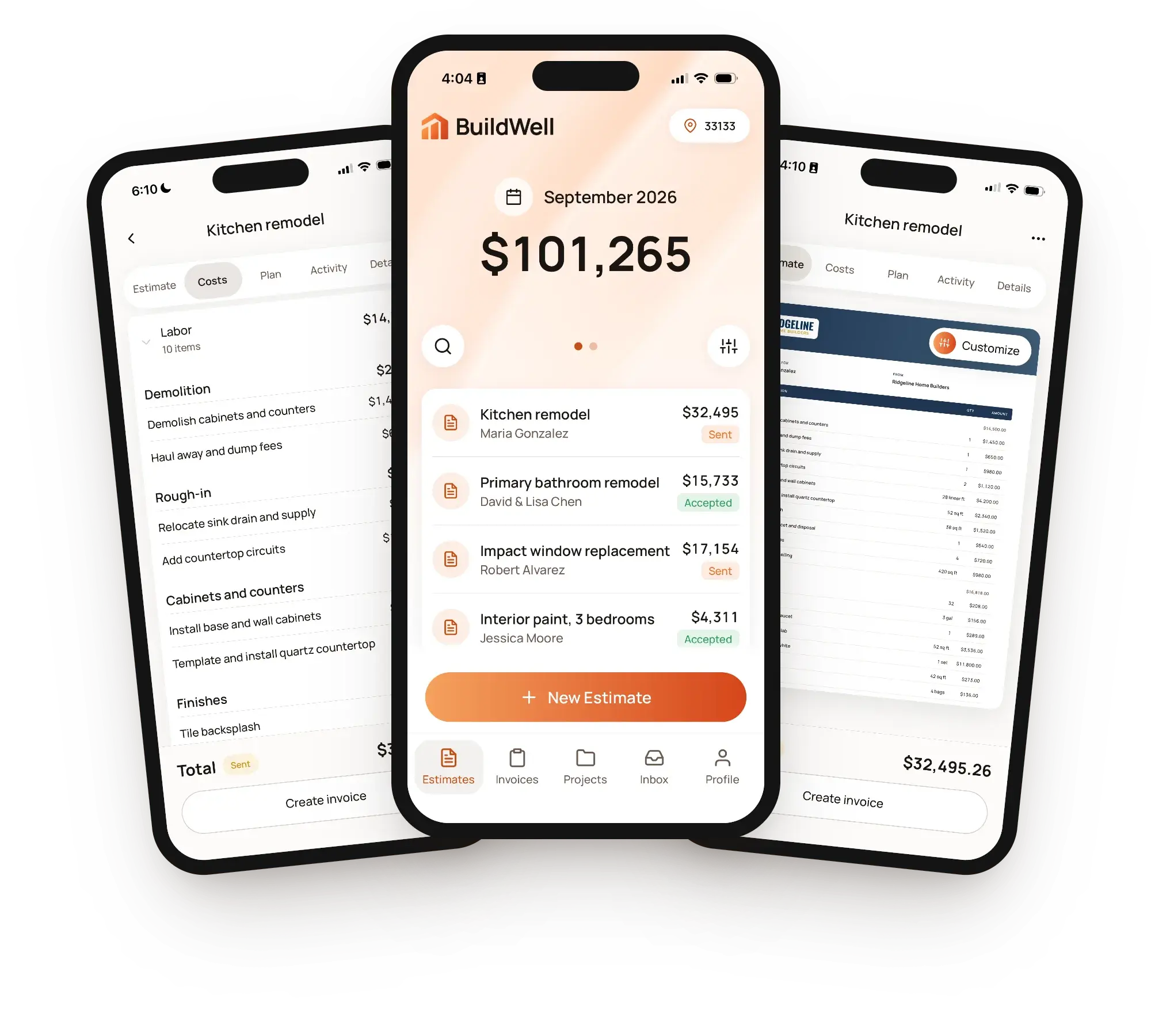
BuildWell writes itemized estimates priced for your area, gets them signed on the client’s phone, and turns them into invoices.
- AI estimates priced for your area
- Estimates, invoices, clients and projects
- Clients sign on any phone
- Card and bank payments, no extra BuildWell fee
- iPhone, Android and the web
- AI estimates priced for your area
- Estimates, invoices, clients and projects
- Clients sign on any phone
- Card and bank payments, no extra BuildWell fee
- iPhone, Android and the web
Both plans include every feature and start with a 3-day free trial. Add a card to start; you’re not charged until the trial ends. Cancel anytime.
Try BuildWell today
Estimates, invoices, e-signatures and payments in one place, on your phone and on the web.