 BuildWell
How to price lawn care jobs
Price mowing and lawn care per visit, per square foot, monthly or by the season, from your own time on site, with a weekly account worked out step by step.
Pricing by trade · 10 min read · Updated
The steps, in order
- 1
Measure the property once
Measure the turf area, the edging length and the beds, and note slopes, gates, obstacles and where the truck parks.
- 2
Time the work on site
Use your own crew's minutes on similar yards to plan labor hours for each visit and each seasonal service.
- 3
Add the visit and the route
Add drive time, loading and setup, and set a minimum so a small yard still pays.
- 4
Build a per-visit price
Price labor at your full hourly cost, add materials, overhead and profit, and check the result against your price per thousand square feet.
- 5
Choose how to bill the season
Bill per visit, spread the season into a flat monthly price, or quote a season of services, and write the rule for skipped visits.
- 6
Quote add-ons as their own lines
List cleanups, aeration, overseeding and mulch separately, so the client can approve or skip each one.
Lawn care pricing looks simple: a number per cut. But that number has to pay for all of this, every week for a whole season:
- The time on the property
- The drive to it
- The equipment and the materials
- The rain days and a profit
Get it a little wrong and the mistake repeats on every visit.
This guide builds a lawn care price from its parts, then shows the ways to bill recurring work: per visit, per square foot, monthly and by the season. It covers the method, not your rates. Wages, fuel and materials vary by metro, so every dollar figure is yours to fill in, and the times in the example are example inputs to replace with your own.
For estimating software built for the trade, see the lawn care industry page.
How lawn care work is measured
- Per visit: mow, trim and blow, the core of a recurring account.
- Square feet: turf area for mowing, aeration, overseeding and fertilizer.
- Linear feet: edging along walks, drives and beds.
- Bed area and cubic yards: mulch refreshes.
- Each or by the hour: shrub trimming, bed weeding, cleanups and leaf removal.
- The load: leaves, clippings and brush you haul away.
Measure each property once, with a measuring wheel or an online map, and keep the numbers. Then note what slows the crew down:
- Slopes that need the trimmer
- Fence lines and trees to mow around
- A gate too narrow for the larger mower
- How far the truck parks from the yard
The formula for a lawn care price
Every per-visit price follows the same pattern:
- Minutes on site × crew size = labor minutes, then ÷ 60 for labor hours.
- Labor hours × your full hourly labor cost = labor cost. That cost is the wage, or what you pay yourself, plus labor burden: payroll taxes, workers' comp and benefits.
- The visit: drive time, loading and setup, either as a share of each visit or as a minimum.
- Materials: fuel, trimmer line and bags, plus seed, fertilizer or mulch when the service uses them.
- Overhead for every billable hour: the truck, the trailer, mowers and their repairs, insurance, phone and software.
- Profit, as a markup on the total cost or a target margin.
The labor rate guide and the labor rate calculator turn pay, burden and billable hours into a full hourly cost.
Be honest about billable hours
In lawn care, billable hours are the honest number. Driving between stops, loading, rain days and the off-season are hours you pay for but cannot bill.
Time on site comes from your own crew
No table can tell you how long a yard takes your crew. Mower size, crew size, the slope, the obstacles and whether you bag clippings all change it. The reliable number comes from your own visits:
- Time a range of properties from arrival to departure, and write down the minutes and the crew size.
- Note the turf area and the conditions for each, so you can compare like with like.
- Separate the services: mowing, trimming, edging and blowing, so you can price a yard that needs only some of them.
After a few weeks you have a feel for labor minutes per thousand square feet on easy and hard yards. Use it to quote new properties, then check the first few visits against the quote and adjust before the season gets busy.
Route density, minimums and trip charges
In lawn care, the drive is part of every price. A crew that mows ten yards on one street spends its day working; a crew that crosses town between stops spends a lot of it driving. Both are paid for the whole day.
Pick one way to cover the drive
There are three common ways to cover the drive:
- A share of each visit. Add the average drive between stops to each visit's labor minutes. It keeps prices honest across the route.
- A minimum charge. The shortest visit you will make, built in minutes from the drive, loading and setup, then priced at your full hourly cost. A small yard pays the minimum.
- A trip charge for properties outside your normal area, as its own line on the quote.
If your labor rate already spreads unbilled drive time over billable hours, do not add it again per visit. Pick one method and use it on every quote.
Grow your route street by street
Route density is also a sales plan. A new account on a street you already mow costs you almost no extra drive, so it is worth more to you than the same yard across town. Ask happy clients to tell their neighbors.
Recurring pricing: four ways to bill the same work
Per visit
The client pays for each visit you make. It is easy to explain and fair in a dry summer when you skip cuts. The downside is uneven income: a slow month in the heat means smaller invoices.
Per square foot
Some lawn care businesses quote from a price per 1,000 square feet of turf. Build yours from your own numbers: take the per-visit prices of yards you know well and divide each by its area in thousands of square feet.
Use the result as a quick check on new quotes, then adjust for slopes, obstacles and the amount of trimming. A price per area alone underprices the yard with a long fence line.
A flat monthly price
The season's visits are spread evenly over the months you bill, so the client pays the same every month:
monthly price = per-visit price × visits in the season ÷ months billed.
Write down what happens when you skip a visit for drought or add one in a wet spring. A flat price works when both of you know the rule.
A season of services
One price for a set list of services, such as weekly mowing plus a spring cleanup and fall aeration, billed in parts. It is the best way to sell add-ons, because the client agrees to the whole season at once. Price each service on its own line, then add them up.
Seasonal services and add-ons
Seasonal work is where a lawn care business grows, and each service needs its own price.
- Spring and fall cleanups: by the hour, or by the size of the beds and the leaf load. Look at the yard before you quote it.
- Leaf removal: by the hour plus disposal, since leaf volume varies wildly.
- Aeration and overseeding: by turf area, plus seed at its rate per thousand square feet.
- Fertilizer and weed control: by turf area plus product, only where your license allows you to apply it for pay.
- Mulch: bed area × depth in feet ÷ 27 = cubic yards, plus the time to spread it.
Quote each as a separate line the client can approve or skip, and bill it when the work is done.
Worked example: a weekly mowing account
Example: A homeowner asks for weekly mowing with trimming, edging and blowing, plus a spring cleanup. You measure the property: about 6,000 square feet of turf, 120 feet of edging along the drive and walk, and two small beds. It is flat, with a wide gate.
Example inputs only. Say your crew takes the times below on this yard. They are round numbers chosen to show the arithmetic, not benchmarks and not BuildWell data. Use your own timed visits.
Labor per visit
| Task | Crew | Example minutes on site | Labor minutes |
|---|---|---|---|
| Mow | 1 | 25 | 25 |
| Trim and edge | 1 | 20 | 20 |
| Blow off hard surfaces | 1 | 8 | 8 |
| Total | 53 |
With two people working at once, one mowing while the other trims, edges and blows, the crew is on site about 28 minutes, and labor is 53 ÷ 60 = 0.88 hours.
Add the drive to each visit
Say this stop also carries 10 minutes of drive time for each of the two people, 20 labor minutes, because it sits in a dense part of your route. That brings the visit to 73 labor minutes, or 1.22 labor hours.
The per-visit price
| Line | How to get it |
|---|---|
| Labor | 1.22 hours × your full hourly labor cost |
| Overhead | 1.22 hours × your overhead per billable hour |
| Materials | Fuel, line and bags per visit |
| Cost per visit | The sum of the three lines |
| Price per visit, P | Cost per visit × (1 + your markup) |
If P comes out below your minimum, charge the minimum. Then divide P by 6, the turf area in thousands of square feet, and compare the result with your price per 1,000 square feet on similar yards.
The season and the monthly price
Say your season here runs 28 weekly visits, billed over 7 months. Use your own count.
- Per visit: bill P after each visit, or monthly for the visits made.
- Flat monthly: P × 28 ÷ 7 = 4 × P each month.
The job cost calculator adds the lines up, and the markup vs margin guide shows why a 25% markup is a 20% margin.
Price the spring cleanup on its own line
Time the beds and the debris on the walkthrough, add disposal, and put the cleanup on its own line.
Common lawn care pricing mistakes
- Pricing from a competitor's flyer. Their costs and pace are not yours.
- Ignoring the drive. A yard across town costs the same windshield time as a big one next door.
- No rule for skipped visits. A flat monthly price needs one in writing.
- Free add-ons. Edging a new bed or hauling a pile of branches is work; quote it.
- Never raising prices. Fuel, equipment and wages rise. Review prices before each season and send a new quote.
How to present a lawn care quote
- Name the service and the frequency: weekly mow, trim, edge and blow, with the season's start and end.
- Put add-ons on their own lines, each with a price the client can approve or skip.
- State the billing rule: per visit or flat monthly, how skipped visits work, and when payment is due. The payment terms glossary entry and the payment terms guide cover the options, including late fees.
- Say what is excluded, such as leaf removal or bagging, unless it is on a line.
A free quote generator or the estimate template for Excel gives you a layout, and the free invoice generator bills a one-off cleanup. The get paid faster guide covers collecting from a route full of small invoices.
Pricing lawn care with BuildWell
BuildWell writes a lawn care quote from a description of the property, by voice, text or photos, and lists each service as its own line.
Set your crew's real time on each line
Lawn care isn't in BuildWell's catalog, so the AI drafts the hours from what you describe; set your crew's real time on each line, or put your per-visit price on it.
Seed, fertilizer and mulch are priced at stores near the property, checked within the last 30 days, and labor starts from a local Bureau of Labor Statistics construction wage plus the overhead and markup you set.
Bill the season from one signature
For a season, put the visits in the quantity and get one signature. BuildWell doesn't send recurring invoices or schedule your route, so each month create an invoice from the signed estimate or duplicate last month's and change the visits.
It reminds you, not the client, when an invoice is due or overdue, and private client notes hold the gate code and the dog's name.
A lawn care pricing checklist
- Turf area, edging and beds measured once and saved
- Minutes on site from your own crew, by service
- Drive, loading and setup covered by a minimum or a share of each visit
- Overhead on every billable hour, then profit
- A per-visit price checked against your price per 1,000 square feet
- A billing method chosen, with a rule for skipped visits
- Seasonal services quoted as separate lines
- Prices reviewed before every season
Free tools for this guide
Generators, templates, calculators and definitions. No sign-up.
Common questions
01Should I charge for mowing per visit or per month?
02How do I price a lawn by the square foot?
03What should a minimum charge cover?
04Should seasonal services be part of the monthly price?
05Can BuildWell bill my mowing accounts automatically?
Estimates, signatures and invoices in one app
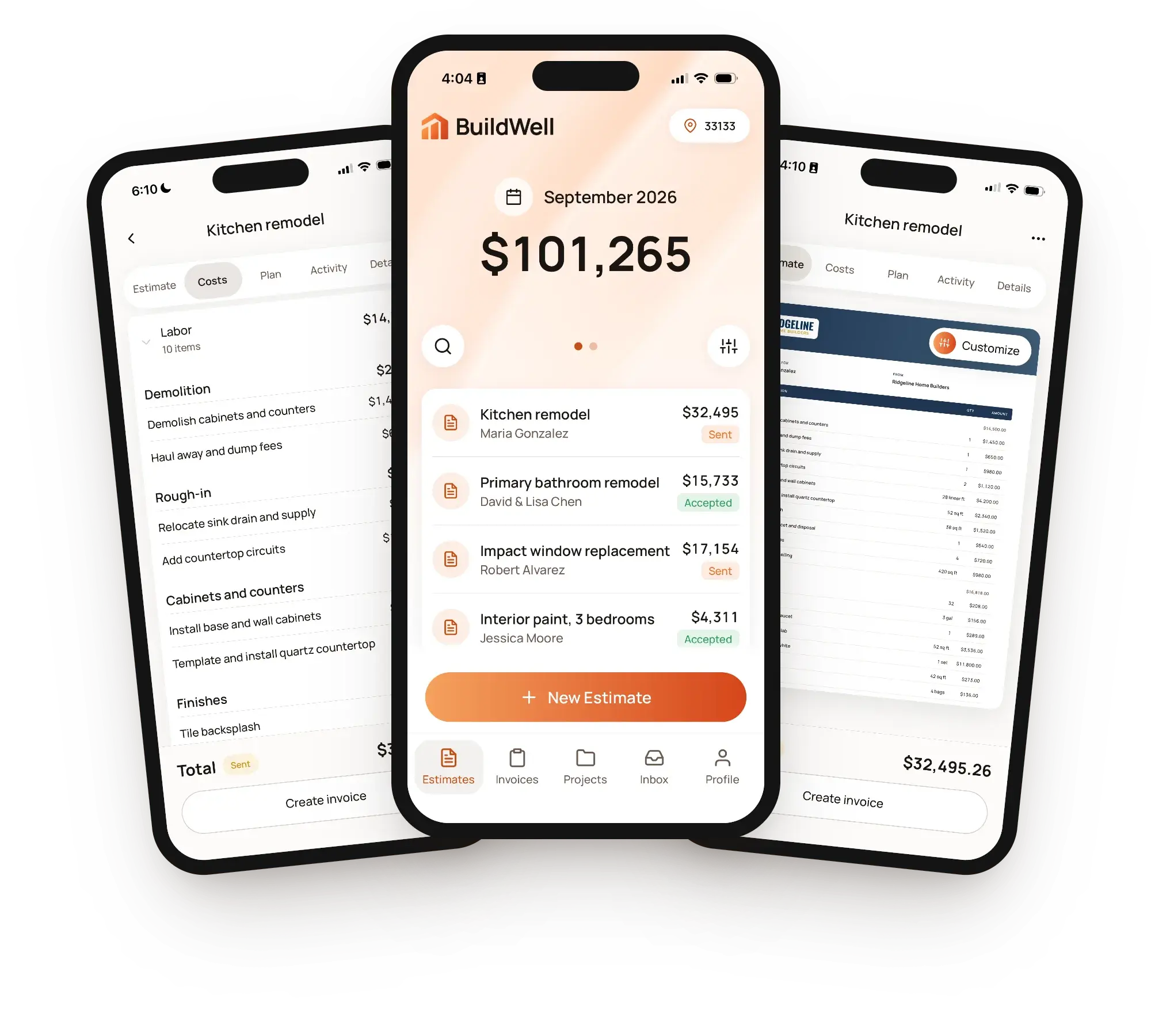
BuildWell prices materials at stores near the job and labor from your metro’s wages plus your overhead and markup, gets the estimate signed on the client’s phone, and turns it into the invoice.
- AI estimates priced for your area
- Estimates, invoices, clients and projects
- Clients sign on any phone
- Card and bank payments, no extra BuildWell fee
- iPhone, Android and the web
- AI estimates priced for your area
- Estimates, invoices, clients and projects
- Clients sign on any phone
- Card and bank payments, no extra BuildWell fee
- iPhone, Android and the web
Both plans include every feature and start with a 3-day free trial. Add a card to start; you’re not charged until the trial ends. Cancel anytime.
Try BuildWell today
Estimates, invoices, e-signatures and payments in one place, on your phone and on the web.