BuildWell
What markup is
Markup is the percentage you add to your cost to get your price. If materials cost you $750 and you mark them up 20%, you charge $900. The $150 difference pays for the work of buying, hauling and standing behind those materials, and leaves a profit.
Markup is how most contractors build a price, because you know your cost first. You price the lumber, the fixtures and the hours, then add a percentage on top. It’s simple to apply line by line, and it scales: a bigger cost earns a bigger dollar markup.
The catch is that markup isn’t margin. A 20% markup leaves you 16.67 cents of every dollar the client pays, not 20 cents. If you plan your business around margin but price with markup, the gap between the two is profit you thought you had.
The markup formula
The calculator uses two formulas.
- Price is cost times one plus the markup: $750 × 1.20 = $900.
- Margin is the markup divided by one plus the markup: 0.20 ÷ 1.20 = 16.67%.
Profit in dollars is the price minus the cost: $900 − $750 = $150. Measured against the cost, that’s the 20% markup. Measured against the price, it’s the 16.67% margin. Same dollars, two percentages.
To go the other way, from a margin you want to the markup that earns it, divide the margin by one minus the margin. A 25% margin needs 0.25 ÷ 0.75 = 33.33% markup. The profit margin calculator does that in one step.
Worked examples
Marking up a materials list
A bathroom’s materials come to $1,200 at your cost: the vanity, toilet, tile, backer board, thinset, grout and the small parts. With a 15% material markup the client pays $1,200 × 1.15 = $1,380 for materials. You keep $180, a 13.04% margin on that part of the job.
Different markups for labor and materials
You price a fence with $2,000 of materials marked up 20% and $1,800 of labor cost marked up 30%.
- Materials: $2,000 × 1.20 = $2,400
- Labor: $1,800 × 1.30 = $2,340
- Price: $4,740 on a cost of $3,800, so $940 of profit
| Part | Your cost | Markup | Price | Profit |
|---|---|---|---|---|
| Materials | $2,000 | 20% | $2,400 | $400 |
| Labor | $1,800 | 30% | $2,340 | $540 |
| Whole job | $3,800 | 24.74% | $4,740 | $940 |
Your overall markup is $940 ÷ $3,800 = 24.74%, and your overall margin is $940 ÷ $4,740 = 19.83%. The blend depends on how much of the job is labor and how much is material.
Working back from a target margin
You want a 25% margin on a $750 job. A 25% markup gives $937.50, which is only a 20% margin. The right markup is 33.33%: $750 × 1.3333… = $1,000, and $250 ÷ $1,000 is 25%.
Markup to margin table
Find your markup on the left to see the margin it really gives, and what it adds to $1,000 of cost.
| Markup | Margin it gives | Price on a $1,000 cost | Profit |
|---|---|---|---|
| 10% | 9.09% | $1,100.00 | $100.00 |
| 15% | 13.04% | $1,150.00 | $150.00 |
| 20% | 16.67% | $1,200.00 | $200.00 |
| 25% | 20% | $1,250.00 | $250.00 |
| 30% | 23.08% | $1,300.00 | $300.00 |
| 33.33% | 25% | $1,333.30 | $333.30 |
| 40% | 28.57% | $1,400.00 | $400.00 |
| 50% | 33.33% | $1,500.00 | $500.00 |
| 60% | 37.5% | $1,600.00 | $600.00 |
| 75% | 42.86% | $1,750.00 | $750.00 |
| 100% | 50% | $2,000.00 | $1,000.00 |
A 100% markup, doubling your cost, is a 50% margin. Past that point, each extra point of markup buys less and less margin.
Choosing your markups
A markup has two jobs. It covers the costs the line itself doesn’t show, and it leaves profit.
On materials, the hidden costs are the trips to the store, the time spent choosing and ordering, the returns, the waste, the storage and your warranty on what you install. A low material markup can look generous until you count the afternoon you spent returning the wrong faucet.
On labor, the hidden costs are mostly overhead: payroll taxes, insurance, the truck, tools and the hours you’re driving, quoting or doing paperwork. Many contractors cover overhead with a separate overhead percentage and keep the labor markup for profit. That’s how BuildWell prices labor: the local wage, then your overhead, then your markup. The labor rate calculator shows the result per hour.
On subcontractors, a markup covers your coordination, your schedule risk and the warranty you give the client for their work.
Set your markups from your own numbers. Look at a year of jobs, see what the business needed to cover its costs and pay you, and work back to the percentages that would have done it.
Common mistakes
Using markup and margin interchangeably. If you want a 30% margin, a 30% markup won’t get you there. It gets you 23.08%.
One markup for everything. A tiny material-heavy job and a long labor-heavy job have different hidden costs. Separate markups for labor and materials, at least, let you price both fairly.
Marking up the tax. Sales tax isn’t part of your cost to mark up. Apply tax after the markup, on what’s taxable.
Marking up once, then discounting twice. A markup that gets cut by a discount, then by a "small" extra done for free, can end up below your costs. Check the margin after every change.
Hiding markup in the hours. Padding labor hours to make up for a thin markup makes your estimates hard to compare and your schedule unreliable. Keep the hours honest and the markup explicit.
Using markup in your estimates
Markup belongs inside each line’s price, not as its own line on the estimate. The client sees the price of the vanity installed, not your cost plus a percentage. That keeps the conversation on the work.
When a client supplies their own materials, take those materials out of the price, and say so on the estimate. Your labor and your markup on labor still apply.
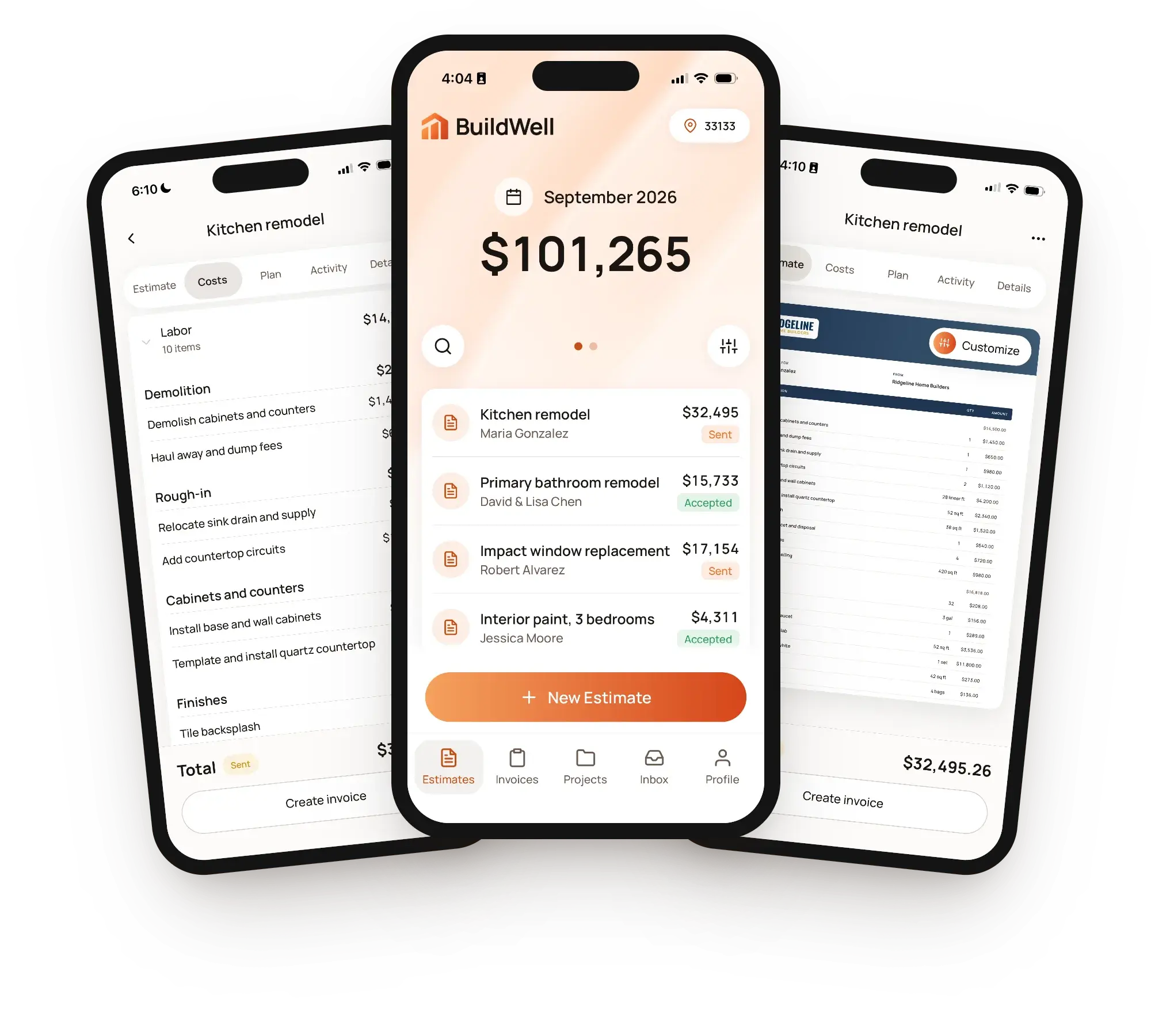
In BuildWell, you set a labor markup and a material markup once in Pricing settings; material markup starts at 20% until you change it. Every estimate prices materials at stores near the job, adds your material markup, prices labor at your area’s wage plus your overhead and labor markup, and lists client-supplied items without charging for them. You can change either markup on any estimate.