 BuildWell
How to price general contracting jobs
Price a general contracting job from your crew's hours, subs' quotes and general conditions, then markup, with a bearing wall removal worked line by line.
Pricing by trade · 11 min read · Updated
The steps, in order
- 1
Split the job into who does what
List the work your own crew does, the work each sub does, and the job-wide costs that belong to no single trade.
- 2
Price your own crew's work
Multiply each quantity by your own hours for that unit of work, then by your full labor cost, and take off the materials.
- 3
Level the subs' quotes
Read each written quote against your scope, fill the gaps between trades, and note what each sub excludes.
- 4
Price the general conditions by time
Set the job's duration, then price supervision, protection, dumpsters, permits and cleanup for that many weeks.
- 5
Add contingency, overhead and profit
Add a stated contingency for what you cannot see, then your overhead and profit as percentages of the total cost.
Pricing a general contracting job comes down to the same equation as any job: price = materials + labor + other job costs + overhead + profit. What makes it different is who does the work. A general contractor prices some of it with their own crew, buys most of the rest as subcontractor quotes, and carries a layer of job-wide costs, the general conditions, that no single trade owns.
The margin is made or lost in that layer and in the gaps between the subs.
This guide covers the three parts of a GC price: your own crew's work, priced from your own hours per unit, the subs' quotes, and the general conditions. Then it prices the removal of a bearing wall from start to finish. Wages, sub prices and material costs vary by metro and by week, so every dollar figure is yours to fill in.
For the general method, see how to price a construction job. For software built around general contracting, see the general contractor industry page.
How general contracting work is measured
A GC estimate mixes four kinds of numbers:
- Your crew's work, in units: linear feet of wall, square feet of protection, beams and openings by the each. These are priced like any trade, as hours per unit.
- Subcontractor work, as quotes: a lump sum from each trade for its scope, or a unit price when the quantity is not known yet.
- General conditions, by time: supervision, dumpsters, protection, temporary facilities and cleanup, which grow with the number of weeks the job runs.
- Markup, as percentages: overhead and profit on the total cost, plus a stated contingency for what you cannot see.
Start every estimate by splitting the scope of work into those columns. Every item should land in exactly one of them. The ones that land in none, like who patches the wall after the electrician, are where a GC's money goes.
The formula for a general contracting price
- Your crew's labor: quantity × labor hours per unit, then × your full hourly labor cost, the wage plus labor burden.
- Your materials: the takeoff for your crew's work at what you will pay near the job now, with waste added.
- Subcontractor quotes: each trade's written price, after you have read it against your scope.
- General conditions: the job's duration × the weekly cost of running it, plus one-time items like the permit.
- Contingency: a stated amount for hidden conditions.
- Overhead and profit, as percentages of the total cost.
Recover overhead as a percentage
Overhead is the one to watch. A trade contractor can recover overhead as a rate on every labor hour. A GC whose subs do most of the work bills few labor hours of their own, so overhead per hour recovers almost nothing on a sub-heavy job.
Recover it as a percentage of the total cost instead. The labor rate guide still sets your crew's hourly cost.
Labor hours for work a GC often self-performs
Take your crew's hours from your own jobs
Many small GCs keep demolition, protection, framing and cleanup in-house and sub out the licensed and finish trades. The hours per unit for that work belong to your crew, so take them from your own job costing records.
On every job, record the hours each line took and the quantity it covered, then divide. Count labor hours, not crew hours: 16 labor hours is one day for a two-person crew.
Keep one number for each line
Keep a separate number for each line:
| Line | Measured in |
|---|---|
| Floor protection and dust walls | Square feet |
| Partition demolition and haul-out | Linear feet |
| Temporary shoring for a bearing wall | Linear feet |
| Built-up header or beam | Each |
| Steel column and beam | Each |
| Joist blocking and bridging | Linear feet |
| Partition framing | Linear feet |
| Door rough opening with header | Each |
| Backing for fixtures and cabinets | Linear feet |
| Dumpster loading | Each |
| Final cleanup and haul-out | Each |
| Lead-safe setup and cleanup | Each |
Even on a job that is mostly subs, these lines matter. Protection, demolition and cleanup touch every room the job passes through, and they are the hours most often left out because no sub quotes them.
General conditions
Price general conditions from the schedule
General conditions are the cost of running the job, separate from the cost of the work. Price them from the schedule, not as a percentage guess.
- Supervision: your hours, or your lead's, for site visits, scheduling subs, meeting the inspector and answering the client. Estimate hours per week × weeks.
- Permits, plan fees and engineering: the building permit, any plan review, and an engineer's letter or drawings for structural work.
- Dumpsters and hauling: each haul is a cost, and a longer job needs more of them.
- Protection: floor and dust protection at the start, and keeping it up as the trades come and go.
- Temporary facilities: a portable toilet, temporary power or heat, and fencing where the job needs them.
- Cleanup: daily sweep-up and the final clean before handover.
Every extra week costs money
Because most of these scale with time, the schedule is part of the price. A job that runs one more week than you planned costs one more week of supervision and rentals, whether or not anything was built that week.
Subcontractor quotes and markup
Get each quote in writing and level it
Read each subcontractor quote against your scope:
- What is included, and what is excluded
- Who supplies fixtures
- Who patches and paints after them
- Who pulls the permit and who hauls their debris
When two quotes for the same trade differ, the difference is usually scope, not price.
Fill the gaps between trades
The work between trades is yours unless a quote says otherwise: patching after the electrician, protecting the new floor from the painter, the second trip when one sub is not ready for the next.
Mark up every sub's price
You schedule the sub, coordinate them, answer for their work under your warranty, and often pay them before the client pays you. The markup on a sub's price pays for that.
Some GCs use a different markup on subs than on their own work. Whichever you choose, use it the same way on every job.
Paper every sub before they start
Get a written agreement for each sub, a certificate of insurance and a W-9 before they start, and lien waivers with each payment where your state uses them. The free subcontractor agreement generator drafts one.
Taking off materials and allowances
For your own crew's work, take off materials the way any trade does: from the layout and the coverage printed on each product, with waste added and rounded up to what you buy. For anything structural, take the size and length from the engineer's design, not from a typical quantity.
For finishes the client has not chosen, use an allowance: a stated amount in the price, with a written rule that selections above it are billed as a change and selections below it are credited.
Worked example: removing a bearing wall
Example: A homeowner wants a 10-foot section of the wall between the kitchen and the living room removed to open the two rooms. The wall carries the ceiling joists. An engineer specifies a dropped LVL beam on posts, with solid blocking below each post down to the foundation.
The house was built in 1988, so no lead-safe setup applies. The job runs three weeks with inspections and drying time.
Who does what on this job
Your crew does the protection, shoring, demolition, beam, blocking and cleanup. Subs do the rest:
- Electrical: relocate a switch and two receptacles that are in the wall, and add a ceiling light.
- Drywall: patch the ceiling and walls, wrap the beam and finish to match.
- Flooring: weave new flooring into the strip where the wall stood.
- Painting: walls and ceilings in both rooms.
Your crew's labor hours
The shoring runs on both sides of the wall, 2 × 10 = 20 feet. Protection covers 400 square feet of floor in both rooms and the path to the door.
Say your crew's own records show the hours per unit below. They are example inputs to show the arithmetic, not a standard: use your own.
| Task | Quantity | Example hours per unit | Labor hours |
|---|---|---|---|
| Floor protection and dust walls | 400 sq ft | 1.5 hours per 100 sq ft | 6.00 |
| Shoring walls on both sides | 20 lf | 0.25 hours per lf | 5.00 |
| Take out the studs and haul them | 10 lf | 0.4 hours per lf | 4.00 |
| Set the beam on its posts | 1 | 4 hours each | 4.00 |
| Blocking below the posts | 8 lf | 0.15 hours per lf | 1.20 |
| Load the dumpster | 1 | 1 hour each | 1.00 |
| Final cleanup and haul-out | 1 | 4 hours each | 4.00 |
| Total | 25.20 |
The check: 6 + 5 + 4 + 4 + 1.2 + 1 + 4 = 25.2 labor hours. Once the shoring carries the load, taking out the studs is much like taking out any partition. A beam longer than a typical header needs more hands to set, so give it more hours than a header would get.
Materials
- Shoring: two 10-foot walls of 2x4 plates and studs, or adjustable shore posts at the spacing the post maker rates for the load.
- Blocking: 8 feet of 2x10 plus cutoffs, so one 10-foot board.
- Protection: floor paper, plastic sheeting and tape for 400 square feet, from the coverage printed on each roll and rounded up.
- Beam: the LVL, posts and connectors come from the engineer's design.
Price it all near the job and call the total M.
General conditions for three weeks
Say you spend 6 hours a week on this job: site visits, scheduling the four subs, the framing inspection and the client walk-throughs. That is 3 × 6 = 18 hours of supervision.
Add the permit, the engineer's fee, the dumpster rental and haul, and the protection materials already in M. The client lets the crew use a bathroom, so there is no portable toilet; write that into the agreement. Call the total G.
Building the price
| Line | How to get it |
|---|---|
| Crew labor | 25.2 hours × your full hourly labor cost |
| Materials | M, from the takeoff above |
| Subcontractors | The four leveled quotes, added up |
| General conditions | G: 18 hours of supervision at your cost, plus the permit, engineer and dumpster |
| Contingency | A stated amount for what is inside the wall: a duct, a drain or a vent to reroute |
| Total cost | The sum of the five lines |
| Price | Total cost × (1 + overhead) × (1 + profit) |
With 10% overhead and 10% profit applied in turn, the price is the total cost × 1.1 × 1.1 = 1.21. That is a 21% markup and about a 17.4% margin, not 20%. The markup vs margin guide explains the gap, and the markup calculator and job cost calculator do the arithmetic.
Most of this job's cost is subs
Notice the shape of this job: 25.2 hours of your crew's labor, and most of the cost in subs and general conditions. Overhead charged only per crew hour would recover almost none of your overhead here.
Common general contracting pricing mistakes
- Sub quotes at cost. You carry the scheduling, the callbacks and the payment risk. Mark them up.
- General conditions as an afterthought. Price them from the schedule, week by week.
- Gaps between trades. Patching, protection and debris belong to someone. If no quote says who, it is you.
- Overhead only on crew hours. On a sub-heavy job, recover it as a percentage of the total cost.
- Hidden conditions buried in other lines. Carry a stated contingency the client can see.
- No written agreement with each sub. Scope, insurance and lien waivers protect you and the client.
How to present a general contracting estimate
- Group the lines by phase or by trade, so the client sees the whole job without seeing every sub's number.
- Show allowances with their amounts and the overage and credit rule.
- Show the contingency and how unused contingency is handled.
- List exclusions: hidden conditions beyond the contingency, and work by others.
- Tie payments to milestones. A schedule of values breaks the price into parts you can bill against as each is done. The progress billing guide covers deposits and draws.
- Explain change orders. Any change is priced and signed before the work. The change order guide and the free change order generator cover how.
The Excel estimate template totals the lines for you. For a one-off, the free estimate generator makes a clean PDF.
Pricing general contracting jobs with BuildWell
BuildWell plans your own crew's work from a description of the job, such as "remove a 10-foot section of bearing wall between kitchen and living room, shore both sides, dropped LVL beam on posts, blocking below."
The AI decides what work the job needs and how much; it does not set prices. BuildWell prices materials at stores near the job and labor at the metro's median wage for each trade, plus your overhead and markup.
You can change any quantity, hour or price, and add each sub's quote and your general conditions as your own lines with your price. Bill a deposit and progress payments as percentages of the signed estimate.
A general contracting pricing checklist
- Scope split into your crew, each sub, and general conditions
- Your crew's work priced line by line from your own hours
- Each sub's quote leveled against the scope, gaps assigned
- General conditions priced from the schedule
- Allowances with overage and credit rules
- A stated contingency for hidden conditions
- Overhead and profit as percentages of total cost
- Sub agreements, insurance certificates and lien waivers in hand
Free tools for this guide
Generators, templates, calculators and definitions. No sign-up.
Common questions
01What are general conditions on a construction estimate?
02Should a general contractor mark up subcontractor quotes?
03Is overhead and profit of 10 and 10 the same as 20 percent?
04How much contingency should I carry?
05Do I need a separate agreement with each sub?
Estimates, signatures and invoices in one app
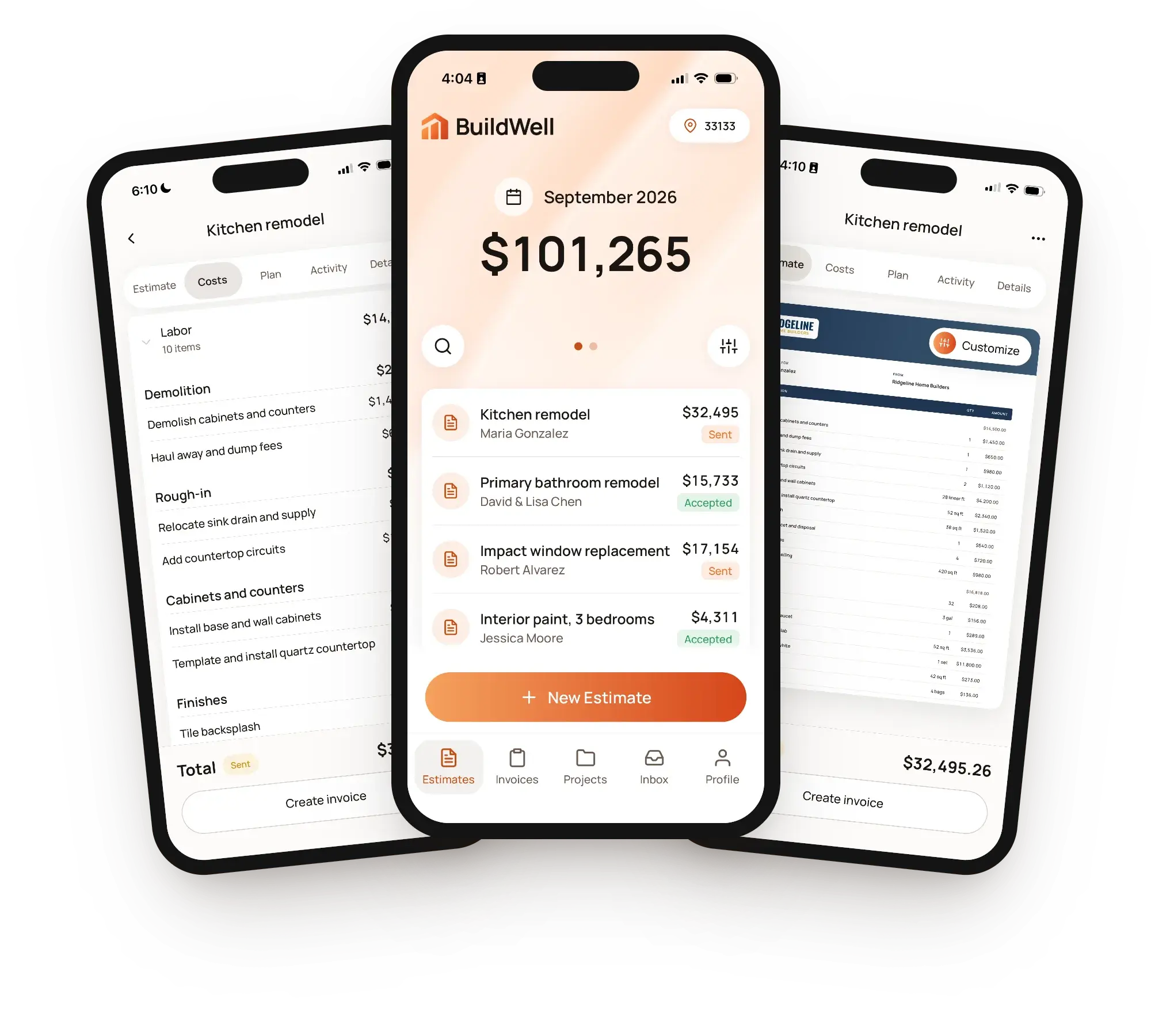
BuildWell prices materials at stores near the job and labor from your metro’s wages plus your overhead and markup, gets the estimate signed on the client’s phone, and turns it into the invoice.
- AI estimates priced for your area
- Estimates, invoices, clients and projects
- Clients sign on any phone
- Card and bank payments, no extra BuildWell fee
- iPhone, Android and the web
- AI estimates priced for your area
- Estimates, invoices, clients and projects
- Clients sign on any phone
- Card and bank payments, no extra BuildWell fee
- iPhone, Android and the web
Both plans include every feature and start with a 3-day free trial. Add a card to start; you’re not charged until the trial ends. Cancel anytime.
Try BuildWell today
Estimates, invoices, e-signatures and payments in one place, on your phone and on the web.