BuildWell
Hourly pay and salary, side by side
Construction pay is mostly hourly. Crews clock in, overtime is paid by the hour, and bids are built from hours. But plenty of decisions need a yearly number: hiring a lead at a salary, comparing a job offer, applying for a loan, or working out what you need to pay yourself.
Turning one into the other sounds like simple multiplication, and it is, as long as you use the right hours. The common shortcut, multiplying by 2,080 hours, assumes 40 hours a week for 52 paid weeks with no overtime. In construction that’s rarely what a year looks like. Weather shuts jobs down, slow weeks run short, busy weeks run long, and unpaid time off comes out of the year.
This calculator goes both ways. From an hourly rate, it gives weekly, every-two-weeks, twice-a-month, monthly and yearly pay, with any regular overtime paid at time and a half. From a salary, it gives the hourly rate that salary really works out to over the hours actually worked.
The hourly and salary formulas
Hourly to yearly:
- Weekly pay = rate × regular hours + rate × 1.5 × overtime hours.
- Yearly pay = weekly pay × paid weeks a year.
- Monthly = yearly ÷ 12; twice a month = yearly ÷ 24; every two weeks = weekly × 2.
At $32 an hour, 40 hours a week and 52 paid weeks: $32 × 40 = $1,280 a week, and $1,280 × 52 = $66,560 a year, or $5,546.67 a month.
Salary to hourly:
- Hours a year = hours worked a week × weeks worked a year.
- Hourly rate = salary ÷ hours a year.
A $60,000 salary for 45-hour weeks over 50 weeks is 2,250 hours, and $60,000 ÷ 2,250 = $26.67 an hour.
Overtime uses time and a half because that’s the federal floor: under the Fair Labor Standards Act, non-exempt employees must get at least 1.5 times their regular rate for hours over 40 in a workweek. Some states add their own rules on top.
Worked examples
A carpenter with two unpaid weeks
A carpenter earns $28 an hour, works 40-hour weeks, and takes two unpaid weeks a year. Paid weeks: 50. Yearly pay: $28 × 40 × 50 = $56,000, not the $58,240 the 2,080-hour shortcut would give. The difference is the two weeks nobody paid for.
Regular overtime in the busy season
A lead earns $30 an hour and works 45 hours a week for 48 paid weeks. The first 40 hours pay $1,200 and the 5 overtime hours pay $30 × 1.5 × 5 = $225, so each week pays $1,425. Over 48 weeks that’s $68,400. If the overtime only happens in summer, run the calculator twice, once for each season, and add them up.
A salary offer that isn’t what it looks like
A project manager is offered $60,000 a year and expects 45-hour weeks with two weeks off. The salary works out to $26.67 an hour over 2,250 hours. At 50-hour weeks it’s 2,500 hours and $24 an hour. Comparing salaries without the hours behind them can make a lower offer look better than it is.
Hourly rates as yearly pay
Gross yearly pay at common construction wages, for a full year of 40-hour weeks and for a year with two unpaid weeks.
| Hourly rate | Weekly (40 h) | Monthly | Yearly, 52 paid weeks | Yearly, 50 paid weeks |
|---|---|---|---|---|
| $18 | $720.00 | $3,120.00 | $37,440 | $36,000 |
| $20 | $800.00 | $3,466.67 | $41,600 | $40,000 |
| $22 | $880.00 | $3,813.33 | $45,760 | $44,000 |
| $25 | $1,000.00 | $4,333.33 | $52,000 | $50,000 |
| $28 | $1,120.00 | $4,853.33 | $58,240 | $56,000 |
| $30 | $1,200.00 | $5,200.00 | $62,400 | $60,000 |
| $32 | $1,280.00 | $5,546.67 | $66,560 | $64,000 |
| $35 | $1,400.00 | $6,066.67 | $72,800 | $70,000 |
| $40 | $1,600.00 | $6,933.33 | $83,200 | $80,000 |
| $45 | $1,800.00 | $7,800.00 | $93,600 | $90,000 |
| $50 | $2,000.00 | $8,666.67 | $104,000 | $100,000 |
| $60 | $2,400.00 | $10,400.00 | $124,800 | $120,000 |
Salaries as hourly rates
The same salary is a very different hourly rate depending on how many hours it buys.
| Yearly salary | 40 h × 52 weeks | 45 h × 50 weeks | 50 h × 50 weeks |
|---|---|---|---|
| $40,000 | $19.23 | $17.78 | $16.00 |
| $50,000 | $24.04 | $22.22 | $20.00 |
| $60,000 | $28.85 | $26.67 | $24.00 |
| $75,000 | $36.06 | $33.33 | $30.00 |
| $90,000 | $43.27 | $40.00 | $36.00 |
| $100,000 | $48.08 | $44.44 | $40.00 |
What the yearly figure leaves out
Every number here is gross pay: before federal and state income tax, the employee’s share of Social Security and Medicare, and anything else taken out of the check. Take-home pay can be a good deal lower, and it depends on withholding choices this calculator doesn’t know.
It also leaves out what the hour costs the employer. On top of the wage, an employer pays its own share of Social Security and Medicare, unemployment taxes, workers’ compensation and any benefits. That’s the labor burden, and it’s why the rate you charge a client has to be well above the wage. The labor rate calculator builds that rate from the wage.
If you’re self-employed, the hourly rate you charge isn’t your wage either. You pay both halves of Social Security and Medicare yourself, as self-employment tax, and your business costs come out before you see a dollar. The self-employment tax calculator shows what that tax takes.
Hourly or salary for your crew
Most construction crews are paid by the hour, and there are good reasons for it. Hours in the trades swing with the weather and the season, and hourly pay follows the work. Overtime is simple to work out. And your estimates are built from hours, so hourly pay keeps your labor cost in the same units as your prices.
A salary makes sense for some roles: an office manager, an estimator, a superintendent who runs several jobs. It gives the employee a steady check and gives you a fixed payroll number to plan around. But a salary doesn’t by itself remove the duty to pay overtime. Whether a salaried employee is exempt depends on the Department of Labor’s tests for pay level and duties, and most people doing hands-on trade work don’t meet them. Check the current rules before you put a field worker on salary.
When you’re weighing the two, convert both ways. An hourly worker’s yearly pay depends on the weeks you actually keep them busy; a salaried worker’s hourly cost depends on how many hours the salary really buys. Put both in the same units before you compare them.
If you’re the owner, the same math works on your own pay. Decide what a year of your work is worth, divide by the hours you really work, and make sure your prices pay that rate before any profit.
Common mistakes
Using 2,080 hours for everyone. It assumes every week of the year is paid at 40 hours. Count the weeks that are really paid.
Paying overtime at straight time. Hours over 40 in a workweek owe at least time and a half to non-exempt employees, whether they’re paid hourly or on a salary that doesn’t meet the exemption rules.
Averaging weeks. A 50-hour week followed by a 30-hour week isn’t two 40-hour weeks. Each workweek stands on its own for overtime.
Comparing salaries without hours. A salary is only as good as the hours it asks for. Convert it to hourly before comparing it with an hourly job.
Confusing pay with price. What you pay a worker per hour and what you charge a client per hour are different numbers, and the gap pays for everything else.
From pay to price
Once you know what an hour of work pays, the next question is what it has to cost the client. The wage is the starting point. Add the labor burden and your overhead, then your markup, and you have the rate to charge. The timesheet calculator totals a week’s hours and overtime, and the labor rate calculator turns a wage into a billable rate.
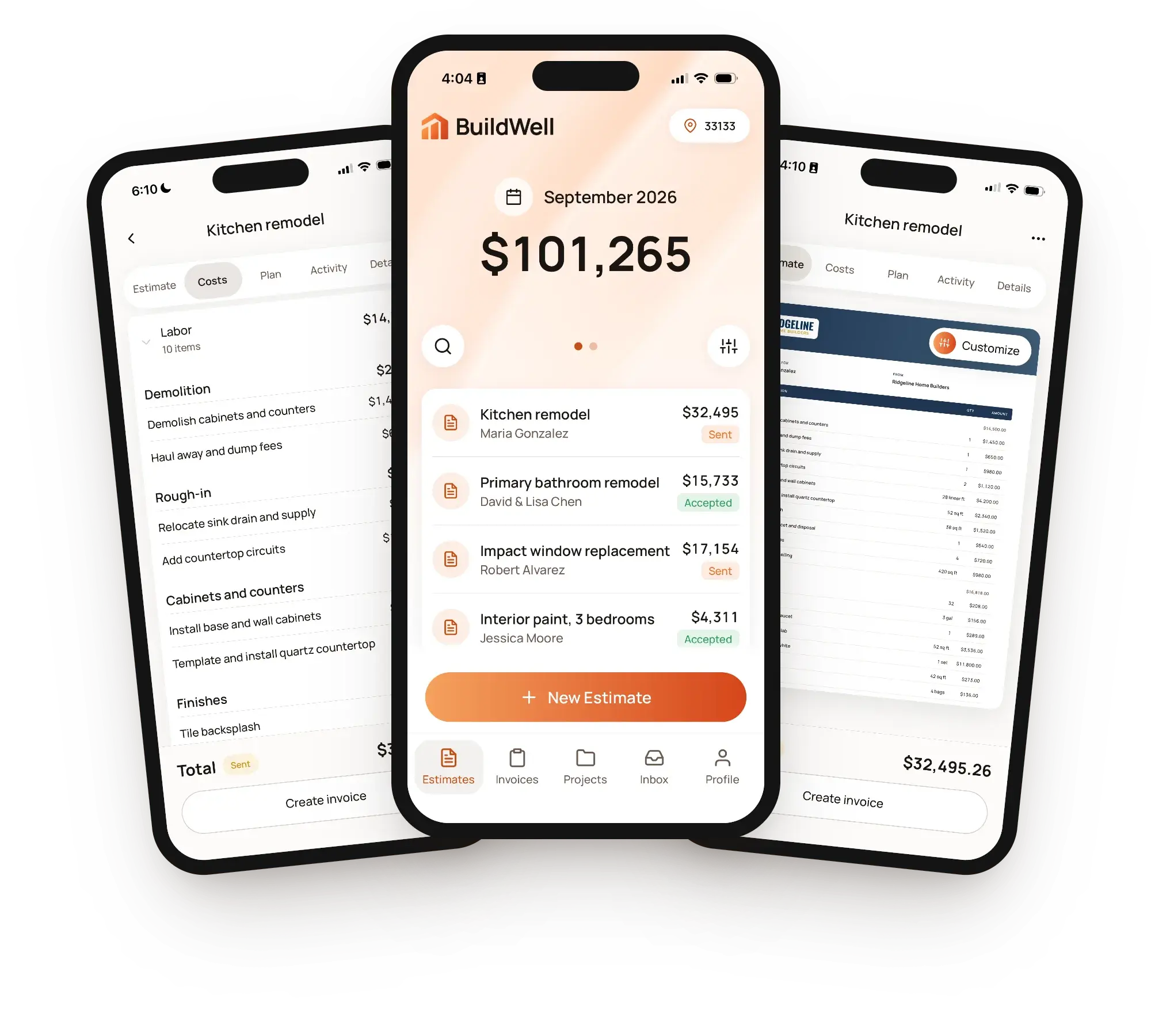
BuildWell starts every estimate from the median wage for each trade in your metro area, published by the Bureau of Labor Statistics, then adds your overhead and labor markup. You set both once in Pricing settings, and you can change any line’s hours and rate on the estimate.
Sources
Each source was checked on the date shown. Rates and rules change, so check the source before you rely on a figure.
- U.S. Department of Labor, Overtime pay (checked 2026-10-02)