BuildWell
How sales tax works for contractors
Sales tax is set by states, and on top of the state rate, many cities, counties and special districts add their own. The rate a job pays is the combination of all of them for that location.
Contractors have an extra layer: whether tax applies to a job, and to which part of it, depends on the state and on the kind of work. Some states treat a contractor installing materials in a home as the final consumer of those materials, so the contractor pays tax when buying them and doesn’t charge it to the client. Others let the contractor buy materials tax-free for resale and charge tax on them to the client. Labor on real property is untaxed in many states and taxed in some. Repair work and new construction can be treated differently from each other.
So there are two questions on every job: what’s the rate, and what’s taxable. This calculator answers the first and does the math. Your state’s revenue department answers the second.
The sales tax formula
- Combined rate is the state’s base rate plus your city, county and district add-ons.
- Sales tax is the taxable amount times the combined rate.
- Total is the taxable amount plus the tax, plus anything on the invoice that isn’t taxed.
On $1,000 of taxable materials in Florida, at the 6% state rate with no local add-on, the tax is $1,000 × 0.06 = $60, and the total is $1,060. If the county adds 1%, the combined rate is 7% and the tax is $70.
Worked examples
Materials taxed, labor not
A deck repair has $2,400 of materials and $1,800 of labor. Where the job is, materials are taxable to the client and labor isn’t, and the combined rate is 8.25%. The tax is $2,400 × 0.0825 = $198, charged on materials only. The invoice total is $2,400 + $198 + $1,800 = $4,398.
Adding a local rate
A state with a 6.5% base rate and a city that adds 1.5% gives a combined 8%. On $500 of taxable parts, the tax is $40. Enter 6.5% through the state picker and 1.5% in the add-on box, and the calculator shows the same $40.
Pulling tax out of a tax-included total
A client paid $1,070 including 7% tax and you need the tax for your records. Divide by one plus the rate: $1,070 ÷ 1.07 = $1,000 before tax, so the tax was $70. Enter $1,000 in the calculator to check it.
Sales tax on common amounts
Tax at a range of combined rates.
| Combined rate | Tax on $500 | Tax on $2,400 | Tax on $10,000 |
|---|---|---|---|
| 4% | $20.00 | $96.00 | $400.00 |
| 5% | $25.00 | $120.00 | $500.00 |
| 6% | $30.00 | $144.00 | $600.00 |
| 6.5% | $32.50 | $156.00 | $650.00 |
| 7% | $35.00 | $168.00 | $700.00 |
| 7.25% | $36.25 | $174.00 | $725.00 |
| 8% | $40.00 | $192.00 | $800.00 |
| 8.25% | $41.25 | $198.00 | $825.00 |
| 9% | $45.00 | $216.00 | $900.00 |
| 10% | $50.00 | $240.00 | $1,000.00 |
State base sales tax rates
These are the state-level base rates BuildWell uses. Local rates add to them.
| State | Base rate | Tax on $1,000 |
|---|---|---|
| AK | 0% | $0.00 |
| AL | 4% | $40.00 |
| AR | 6.5% | $65.00 |
| AZ | 5.6% | $56.00 |
| CA | 7.25% | $72.50 |
| CO | 2.9% | $29.00 |
| CT | 6.35% | $63.50 |
| DC | 6% | $60.00 |
| DE | 0% | $0.00 |
| FL | 6% | $60.00 |
| GA | 4% | $40.00 |
| HI | 4% | $40.00 |
| IA | 6% | $60.00 |
| ID | 6% | $60.00 |
| IL | 6.25% | $62.50 |
| IN | 7% | $70.00 |
| KS | 6.5% | $65.00 |
| KY | 6% | $60.00 |
| LA | 5% | $50.00 |
| MA | 6.25% | $62.50 |
| MD | 6% | $60.00 |
| ME | 5.5% | $55.00 |
| MI | 6% | $60.00 |
| MN | 6.875% | $68.75 |
| MO | 4.225% | $42.25 |
| MS | 7% | $70.00 |
| MT | 0% | $0.00 |
| NC | 4.75% | $47.50 |
| ND | 5% | $50.00 |
| NE | 5.5% | $55.00 |
| NH | 0% | $0.00 |
| NJ | 6.625% | $66.25 |
| NM | 4.875% | $48.75 |
| NV | 6.85% | $68.50 |
| NY | 4% | $40.00 |
| OH | 5.75% | $57.50 |
| OK | 4.5% | $45.00 |
| OR | 0% | $0.00 |
| PA | 6% | $60.00 |
| RI | 7% | $70.00 |
| SC | 6% | $60.00 |
| SD | 4.2% | $42.00 |
| TN | 7% | $70.00 |
| TX | 6.25% | $62.50 |
| UT | 6.1% | $61.00 |
| VA | 5.3% | $53.00 |
| VT | 6% | $60.00 |
| WA | 6.5% | $65.00 |
| WI | 5% | $50.00 |
| WV | 6% | $60.00 |
| WY | 4% | $40.00 |
Alaska, Delaware, Montana, New Hampshire and Oregon have no statewide sales tax, which is why they show 0%. Some local governments in Alaska charge their own sales tax anyway, so a 0% state rate doesn’t always mean no tax.
Finding your combined rate
The state rate is the floor. To find the full rate for a job:
- Look up the address on your state revenue department’s rate lookup. Most states publish one, and it’s the source to rely on.
- Use the job’s address, not your office’s, unless your state says otherwise. Rules for where a sale happens vary.
- Note the date. Local rates change, often at the start of a quarter or a year.
Enter the state from the picker and the rest as the add-on. The calculator adds them up.
Records to keep
Sales tax is reported on a schedule your state sets, monthly, quarterly or yearly depending on how much you collect. Whatever the schedule, the return is easier when every job’s tax is already separated.
- Per invoice: the taxable amount, the rate and the tax, and the job’s address if your rate depends on it.
- Per purchase: receipts showing tax you paid on materials, and any resale or exemption certificate you gave a supplier.
- Per exempt job: the client’s exemption certificate, if a nonprofit, government or other exempt buyer hires you.
Keep the tax you collect apart from your operating money until it’s filed. Spending it as revenue is how a good quarter turns into a bill you can’t pay.
Common mistakes
Using your home rate on every job. If you work across city or county lines, the rate can change from one job to the next.
Taxing what isn’t taxable. Charging tax on labor in a state that doesn’t tax it overcharges the client, and the extra isn’t yours to keep.
Not taxing what is. If the state expects tax on materials and you didn’t charge it, you may owe it out of your own pocket.
Counting tax as revenue. Tax collected belongs to the state. Leave it out of margin and markup math, and set it aside until it’s filed.
Hiding tax in the price. A separate tax line makes it clear what was collected, and many states expect it shown separately when you charge it.
Sales tax on your estimates and invoices
Decide how your state treats your kind of work once, write it down, and apply it the same way every time. If you’re unsure, ask your state revenue department or a tax professional; a short answer up front saves a painful audit later.
On estimates, show tax as its own line so the client sees the full price before signing. On invoices, keep the tax line, so the amount you collected is easy to report.
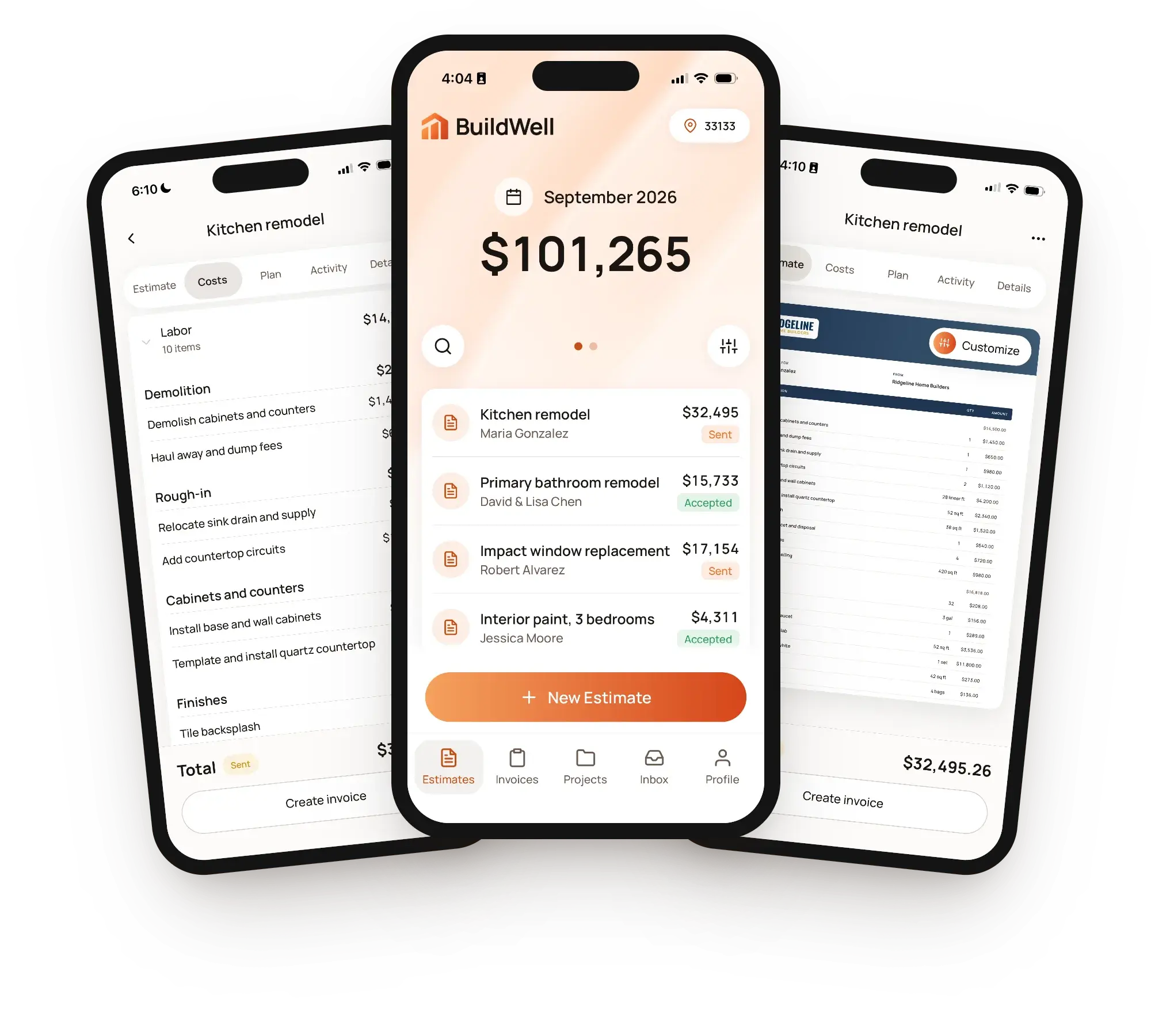
BuildWell applies your sales tax rate to materials only, not to labor. You set the rate once in Pricing settings, and you can change it on any estimate for a job in a different place. When the client signs and you create the invoice from the estimate, it keeps the same lines and totals, tax included.