 BuildWell
How to write a bid proposal that wins
Write a construction bid proposal that wins on more than price: scope, options, schedule, terms, proof and follow-up, with a worked three-option deck proposal.
Estimates and bids · 9 min read · Updated
The steps, in order
- 1
Qualify the job
Decide whether the job fits your trade, schedule and margin before you spend hours bidding it.
- 2
Restate the client's goal
Open with a short summary that shows you understood what the client wants and why.
- 3
Define the scope precisely
List inclusions, exclusions, allowances and assumptions so bids can be compared fairly.
- 4
Offer options
Give two or three priced options so the client chooses between your versions instead of between you and a competitor.
- 5
Show schedule, terms and proof
Add the timeline, payment schedule, warranty, license and insurance, and photos of similar work.
- 6
Make it easy to say yes
Include an expiration date and a way to accept and sign on the spot, then follow up on a schedule.
A bid proposal is a sales document with a price in it. The price matters, but it is rarely the only thing a homeowner weighs. When bids are not built on the same scope, the lowest number is not even a fair comparison.
A proposal that wins does three things:
- It makes the client feel understood.
- It makes the scope impossible to misread.
- It makes saying yes easy.
This guide covers which jobs to bid, what a winning proposal contains, how to present options and how to follow up. It ends with a worked deck proposal with three priced options. For a ready-made form, try the free bid proposal generator.
Bids, quotes, estimates and proposals
The words overlap, and clients use them loosely. In general:
- An estimate is your calculated price for the work, which may change if conditions do.
- A quote is a fixed price for a defined scope, often for smaller jobs.
- A bid is a price submitted to compete for a job, often against a defined scope from the owner or an architect.
- A proposal wraps the price in everything else the client needs to decide: understanding of the project, scope, options, schedule, terms and qualifications.
A proposal wraps your estimate
On a residential job, a good proposal often contains an itemized estimate. The difference is in what surrounds it.
Step 1: Qualify the job before you bid it
A proposal for a $40,000 remodel can take a full day to prepare. Before you spend it, ask:
- Does it fit your trade and crew? Work outside your strengths is riskier to price.
- Does it fit your schedule? A job you cannot start for three months may not be one the client will wait for.
- Is the client ready? A budget, a timeline and a decision-maker are signs the job is real.
- Can you make your margin? If the client's budget cannot cover the job at your price, say so early and kindly.
Saying no frees time for good bids
Saying no to the wrong jobs leaves time to bid the right ones well.
Step 2: Restate the client's goal
Open the proposal with a short paragraph in the client's terms, not yours.
Example: "You want a deck large enough for a table for eight, low maintenance, finished before your daughter's graduation party in June."
Their words show you listened
It shows you listened. It also frames everything after it around what they care about.
Step 3: Define the scope precisely
The scope of work is where proposals are won and lost. A precise scope does two things:
- It makes your price defensible.
- It exposes thinner bids.
Spell it out so clients compare
If your proposal says "includes permit, footings to code, joist hangers, hidden fasteners, and haul-away," the client will ask the other bidders whether theirs does.
Four parts every scope needs
Include:
- Inclusions: every component of the work, specific enough to compare.
- Exclusions: what is not included. "Does not include electrical for lighting or outlets."
- Allowances: amounts for items not yet chosen.
- Assumptions: "Assumes clear access for materials from the driveway."
The estimate guide walks through scope, takeoff and pricing in detail.
Step 4: Offer options
A single price invites one question: yes or no? Two or three options change the question to "which one?" The client is now choosing between your versions of the job instead of between you and another contractor.
Make each option a complete job
Make each option a complete, buildable scope. A good pattern:
- A solid baseline that meets the client's goal without extras.
- A better version with the upgrades the client mentioned.
- A premium version with everything they asked for and what you would recommend.
Price every option with equal care
Price each option with the same care. An option you priced loosely is a loss waiting for a client to choose it.
The pricing guide covers the method. The markup vs margin guide shows how to check that each option still carries your margin.
Step 5: Show schedule, terms and proof
Schedule: give a start window and duration
Give a start window and an expected duration. If weather or material lead times affect it, say so.
Payment terms: follow your state's deposit rules
List the deposit, progress payments and final payment, within your state's rules. Some states cap home-improvement deposits.
In California, a deposit cannot exceed 10% of the contract price or $1,000, whichever is less.
Warranty: yours and the manufacturer's
Say what you guarantee and for how long, and what the manufacturer warranties cover. The warranty entry in the glossary explains the difference.
Proof: only real work and references
Show proof the client can check:
- Your license number, where required
- Proof of insurance
- Photos of similar work you have actually done
If past clients have agreed to be references, offer their contact details. Never invent references, quotes from clients or reviews.
Step 6: Make it easy to say yes
- Expiration date. Thirty days is a common window. It protects you from price changes and gives the client a reason to decide.
- A clear way to accept. A signature line, or better, a link the client can open and sign on their phone the moment they decide.
- Next steps. "Once signed and the deposit is received, the permit application goes in within three business days."
Worked example: a three-option deck proposal
Example: The client wants a 12-by-16-foot deck off the back door, 192 square feet.
The prices below are illustrative figures for this example, not market rates. Price your own options from your own costs.
| Option | Scope | Price |
|---|---|---|
| A: Pressure-treated | Pressure-treated framing and decking, wood railing, one set of stairs, permit and footings | $9,600 |
| B: Composite | Pressure-treated framing, composite decking with hidden fasteners, wood railing, one set of stairs, permit and footings | $13,440 |
| C: Composite plus | Everything in option B, plus aluminum railing and stair lights wired to an existing exterior outlet | $15,900 |
Check each price per square foot
The checks: option A works out to 9,600 ÷ 192 = $50 per square foot, and option B to 13,440 ÷ 192 = $70. Option C is option B plus $2,460 of upgrades: 13,440 + 2,460 = 15,900.
Each option is a complete deck
Each option is a complete deck, not a list of add-ons:
- Option A meets the goal.
- Option B answers the client's "low maintenance" request.
- Option C adds what you would recommend for a deck used at night.
Checking the margin on every option
Before the proposal goes out, check that each option carries your margin. Suppose your full costs (materials, labor, overhead and permit) come to $7,500 for option A, $10,600 for option B and $12,400 for option C.
| Option | Price | Cost | Profit | Margin |
|---|---|---|---|---|
| A | $9,600 | $7,500 | $2,100 | 21.9% |
| B | $13,440 | $10,600 | $2,840 | 21.1% |
| C | $15,900 | $12,400 | $3,500 | 22.0% |
The checks: 9,600 − 7,500 = 2,100, and 2,100 ÷ 9,600 = 0.219. 13,440 − 10,600 = 2,840, and 2,840 ÷ 13,440 = 0.211. 15,900 − 12,400 = 3,500, and 3,500 ÷ 15,900 = 0.220.
Close margins make every choice safe
All three land close together, so it does not matter to your business which one the client picks. If one option had come out at 12%, it would be the best deal on the page for the client. It would also be the one you would least want to build.
What else goes around the table
The proposal around the table would include:
- The client's goal in one paragraph
- Inclusions common to all options: permit, footings, framing to code, hardware, cleanup and haul-away
- Exclusions: "Does not include new electrical circuits; option C uses an existing exterior outlet."
- Schedule: "Starts within two weeks of permit approval; four to six working days on site, weather permitting."
- Payment terms: deposit at signing within your state's limits, a progress payment after framing inspection, balance on completion
- Warranty on workmanship, and the decking manufacturer's warranty for options B and C
- Photos of decks you have built
- Expiration date and a signature line for the chosen option
A deck and fence estimate template gives you the line items behind each option. The deck building page covers how deck builders estimate.
Present it, do not just send it
When you can, walk the client through the proposal instead of emailing it cold. Ten minutes at the kitchen table, or on a video call, lets you:
- Explain why option B uses hidden fasteners.
- Answer the question about the railing before it becomes a doubt.
- Point out what is in your scope that may not be in someone else's.
If the client is ready, they can sign on the spot.
If you must send it, add a note
If you have to send it, add a short note on top: the option you recommend and why, in two or three sentences. Do not make the client work out the differences between options alone.
Bidding to someone else's scope
When an architect, designer or general contractor supplies the scope, your job changes. The scope is fixed, so:
- Price it exactly as written.
- List any assumptions you had to make.
- Flag anything that looks missing or unclear in a short, separate note, rather than quietly pricing around it.
Answer every line, on time
Respond to every item in the bid form, on time, in the format requested. A bid that skips a line or arrives late is often set aside before the price is read.
Step 7: Follow up
A proposal that goes quiet is not necessarily a rejection. The client may be busy, comparing bids or waiting on a spouse.
- Within two or three days: confirm they received it and ask if they have questions.
- A week later: offer to walk through the options, in person or by phone.
- Before it expires: a short note with the expiration date.
Every follow-up should add something
Each follow-up should add something: an answer, a photo of a similar deck, a note about schedule availability. "Just checking in" adds nothing.
When you lose a bid
Ask why, politely. "Thanks for considering me. Would you mind telling me what decided it?"
The answer shows what needs work
The answers tell you which of these needs work:
- Your price
- Your scope
- Your speed
- Your presentation
Compare scopes with the winning bid
If the winning bid was much lower, compare scopes if the client will share them. Often you will find something left out.
Proposal mistakes to avoid
- A price with no scope. The client compares numbers, and yours is not the lowest.
- Vague exclusions. Anything not excluded is arguably included.
- Too many options. Three is plenty.
- Slow delivery. A proposal that arrives a week after the walkthrough competes with one that arrived the next morning.
- No expiration date. Old prices come back to haunt you.
- Invented proof. Fake reviews or borrowed photos destroy trust the moment they are noticed.
Proposals with BuildWell
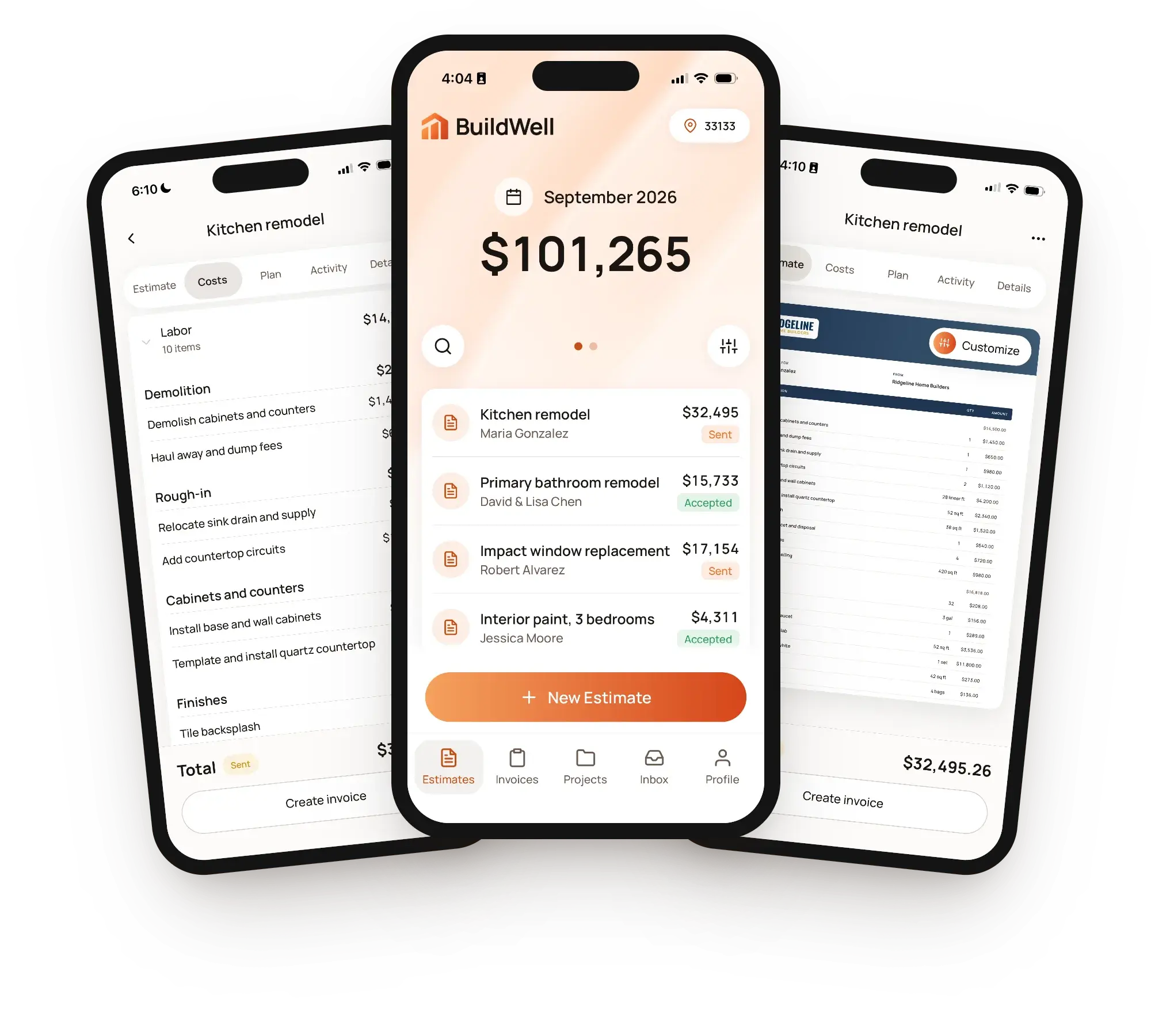
BuildWell builds an itemized estimate from a description of the job. It prices materials at stores near the job, checked within the last 30 days, with labor from your metro's median wage plus your overhead and markup.
Send a link the client signs
With BuildWell you can:
- Attach job photos and before-and-after renders.
- Add your terms.
- Send it as a link the client reads and signs on their phone through the client portal.
You see when they open it, which tells you when to follow up.
Keep a record of every bid
Over time, keep a simple record of every proposal:
- Date sent
- Options
- Price
- Outcome
- When you lose, the reason given
After a dozen bids, patterns appear. They tell you far more about what wins in your market than any guess.
Checklist
- The job is qualified before you bid
- The client's goal is restated in their words
- Scope with inclusions, exclusions, allowances and assumptions
- Two or three complete, priced options
- Schedule, payment terms, warranty and real proof of work
- Expiration date and an easy way to sign
- Follow-up dates on your calendar
Free tools for this guide
Generators, templates, calculators and definitions. No sign-up.
Common questions
01What is the difference between a bid and a proposal?
02How many options should a proposal include?
03Should I lower my price to win a bid?
04How long should a bid proposal be valid?
05How soon should I follow up on a proposal?
Estimates, signatures and invoices in one app
BuildWell prices materials at stores near the job and labor from your metro’s wages plus your overhead and markup, gets the estimate signed on the client’s phone, and turns it into the invoice.
- AI estimates priced for your area
- Estimates, invoices, clients and projects
- Clients sign on any phone
- Card and bank payments, no extra BuildWell fee
- iPhone, Android and the web
- AI estimates priced for your area
- Estimates, invoices, clients and projects
- Clients sign on any phone
- Card and bank payments, no extra BuildWell fee
- iPhone, Android and the web
Both plans include every feature and start with a 3-day free trial. Add a card to start; you’re not charged until the trial ends. Cancel anytime.
Try BuildWell today
Estimates, invoices, e-signatures and payments in one place, on your phone and on the web.