 BuildWell
Free painting estimate template
A painting estimate with 11 common line items already listed, each with its unit, and the terms painting jobs need. Add your quantities and prices, and send it.
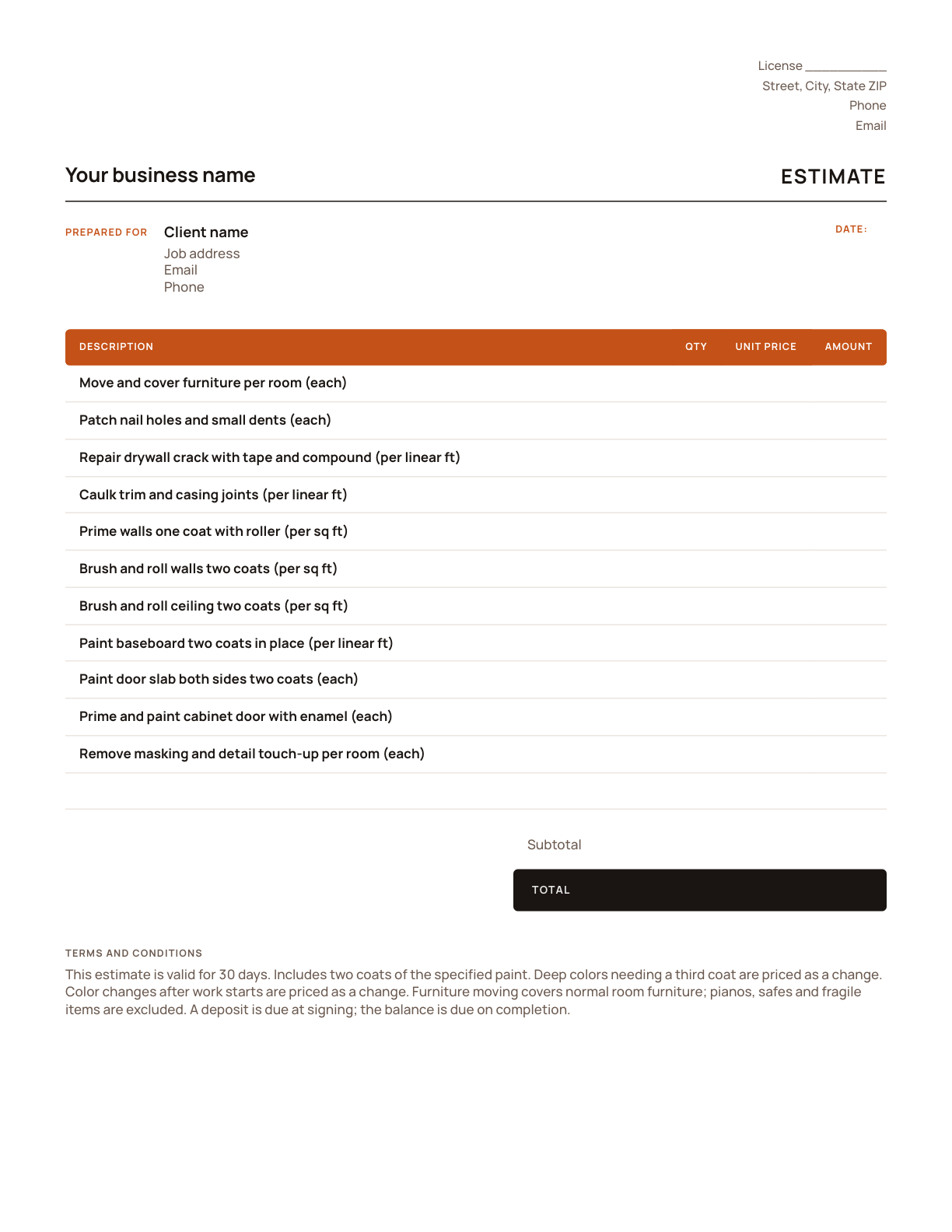
Free, no sign-up. Prices are left blank for your numbers.
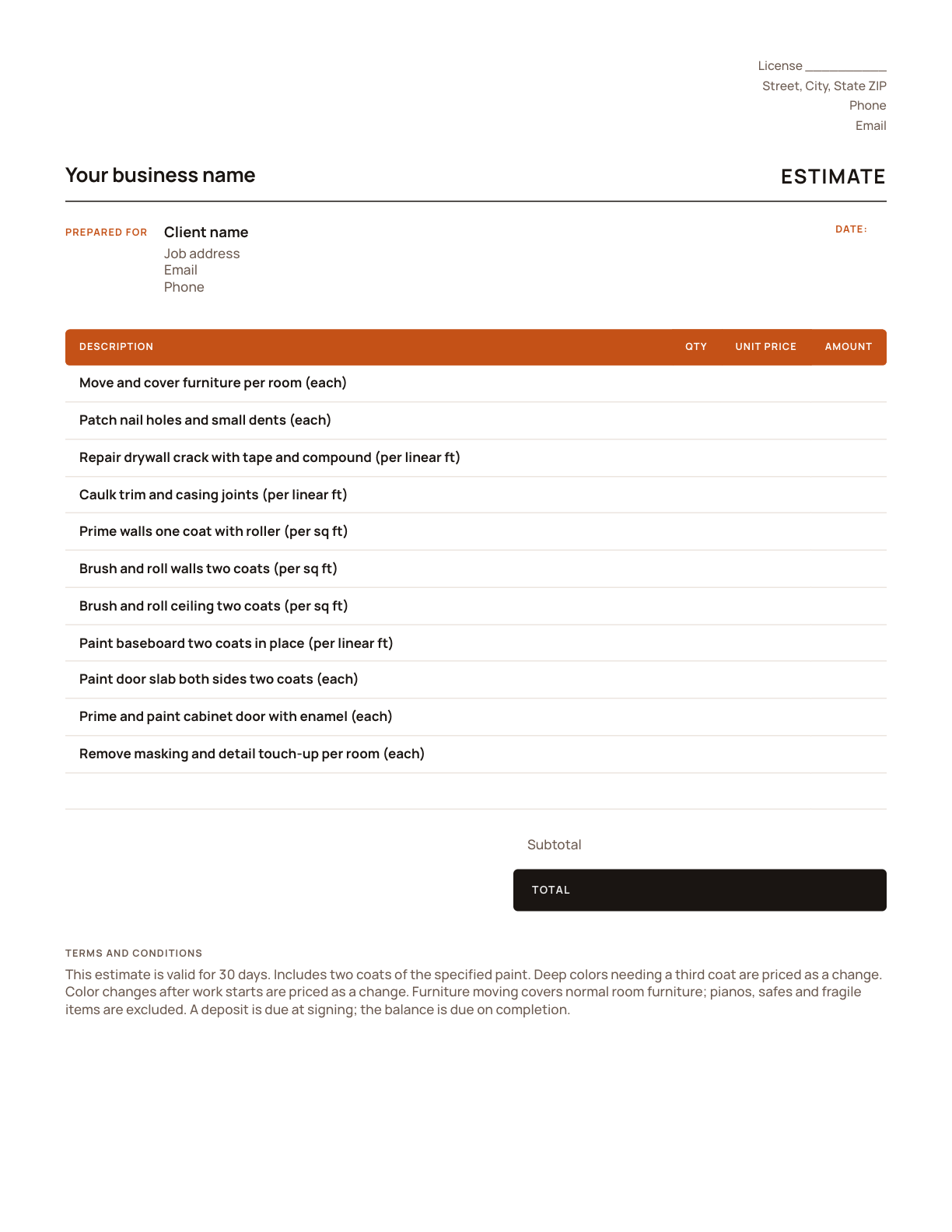
What’s on a painting estimate
Every line is one part of the painting job, priced on its own so the client can see what each part of the job costs.
| Line item | Unit | Why it’s its own line |
|---|---|---|
| Move and cover furniture per room | each | Moving and covering furniture takes time per room, however big the walls are. |
| Patch nail holes and small dents | each | Prep varies more than painting does. Its own lines let you price the walls you actually found. |
| Repair drywall crack with tape and compound | per linear ft | Cracks are measured by the foot and need taping, not just paint. |
| Caulk trim and casing joints | per linear ft | Caulked joints are what make paint look finished, and they take time along every foot of trim. |
| Prime walls one coat with roller | per sq ft | Primer is needed on repairs, new drywall and big color changes, not on every wall, so it’s optional per room. |
| Brush and roll walls two coats | per sq ft | Walls are the core of the job, priced by area for two coats. |
| Brush and roll ceiling two coats | per sq ft | Ceilings are slower than walls, so they carry their own rate. |
| Paint baseboard two coats in place | per linear ft | Trim is linear and slower per foot than walls. A separate line lets clients choose walls only. |
| Paint door slab both sides two coats | each | Doors are counted, not measured. |
| Prime and paint cabinet door with enamel | each | Cabinet doors are detailed enamel work, priced per door and very different from walls. |
| Remove masking and detail touch-up per room | each | The final detail pass is per room and is what the client inspects at the walkthrough. |
Your painting estimate in four steps
- 1
Add your details
Put in your business name, phone, email and license number once, and save the file as your master copy.
- 2
Measure the job
Measure wall and ceiling areas in square feet room by room, trim in linear feet, and count doors, windows and cabinet doors.
- 3
Price each line
Enter a quantity and your unit price on each line the job needs, in each, linear feet and square feet. Delete the lines you don’t need and add any that are missing.
- 4
Send it for a signature
Read the terms, fill in the blanks, save it as a PDF and send it. The client signs the acceptance line before you start.
How painting jobs are priced
Painters price walls and ceilings by the square foot of surface, trim by the linear foot, and doors, windows and cabinet doors each. Some quote by the room, but a room price is built from the same measurements: two coats on the walls, two on the ceiling, the baseboard and the door.
What separates a professional painting estimate from a cheap-looking one is prep. Patching, caulking, sanding and priming are where the time goes, and they vary far more from house to house than the painting itself. Listing prep on its own lines shows the client what they’re paying for and covers you when a wall needs more work than it looked like.
Ceilings and trim go slower than walls, deep colors may need a third coat, and cabinets are a different job entirely, priced per door in enamel. Clients often choose the paint; say in the terms whether paint is included and which product line, and what happens if they change colors once the work has started.
Terms already on the template
Fill in the blanks, or change them to match how you work.
- This estimate is valid for 30 days.
- Includes two coats of the specified paint. Deep colors needing a third coat are priced as a change.
- Color changes after work starts are priced as a change.
- Furniture moving covers normal room furniture; pianos, safes and fragile items are excluded.
- A deposit is due at signing; the balance is due on completion.
Done with templates? Let it price the job.
- AI estimates priced for your area
- Estimates, invoices, clients and projects
- Clients sign on any phone
- Card and bank payments, no extra BuildWell fee
- iPhone, Android and the web
- AI estimates priced for your area
- Estimates, invoices, clients and projects
- Clients sign on any phone
- Card and bank payments, no extra BuildWell fee
- iPhone, Android and the web
Both plans include every feature and start with a 3-day free trial. Add a card to start; you’re not charged until the trial ends. Cancel anytime.
Painting estimate template FAQ
01Is this painting estimate template free?
02Why are the prices blank?
03Can BuildWell price the estimate for me?
04Should I price painting by the room or by the square foot?
05Do I include the paint in the price?
06How do I account for prep work?
Browse by format
- Estimate template for PDF
- Estimate template for Word
- Estimate template for Excel
- Estimate template for Google Docs
- Estimate template for Google Sheets
- Make an estimate online
- Painting invoice template
- Painting quote template
- Painting receipt template
- Painting software
Guides for painting estimates
Browse by trade
- Plumbing estimate template
- Roofing estimate template
- Bathroom remodeling estimate template
- Kitchen remodeling estimate template
- Electrical estimate template
- Drywall estimate template
- Flooring estimate template
- Handyman estimate template
- Carpentry estimate template
- Concrete estimate template
- Deck and fence estimate template
- Siding estimate template
- Window and door estimate template

Price your next painting job today
Estimates, invoices, e-signatures and payments in one place, on your phone and on the web.